
🐬 At a glance
- Scientific name
- Mycteria americana
- Nickname
- Flinthead, ironhead, preacher bird
- Field marks
- Bald gray head, heavy curved bill, white body, black flight feathers
- How it feeds
- Tactile — snaps bill shut on fish it feels in shrinking pools
- Where & when
- Mangrove shallows & dry-season pools; year-round, concentrated in winter
How to identify a wood stork
The wood stork is big and unmistakable up close. The body is white, the legs are dark, and the standout feature is the bald, scaly, gray-black head and neck that looks carved out of stone — hence “flinthead.” The bill is thick, dark and gently down-curved, heavier than any heron's or egret's. Standing on a flat it can look a little hunched and grumpy, like it has somewhere better to be. The real reveal comes in flight: those broad white wings open to show black trailing edges and wingtips, and the bird soars on thermals with its neck stretched straight out, unlike the S-curved necks of herons.
Don't confuse it with a white ibis, which is much smaller with a red curved bill, or with the white herons and egrets, which have feathered heads and straight bills. The bald stony head settles it every time.
Fishing by feel
Here's what makes the wood stork special. It doesn't hunt by sight the way most wading birds do — it hunts by touch. The stork wades through shallow, murky water with its long bill held open underwater, slowly sweeping side to side. The instant a fish brushes that sensitive bill, it snaps shut in a fraction of a second, one of the fastest reflexes of any vertebrate. That's why you'll often see storks crowded into the shrinking pools of the dry season: as the water drops and concentrates the fish, the touch-feeding suddenly becomes wildly efficient. Their whole breeding calendar is tied to those falling water levels.
A genuine conservation comeback
For decades the wood stork was in serious trouble — drained wetlands and altered water flows wrecked the carefully-timed dry-down pools it needs to feed its chicks, and the population crashed. Through long-running wetland restoration across South Florida, it has clawed its way back from endangered to a less-imperiled status: a rare and honest good-news story in conservation. Healthy estuaries like Rookery Bay and the Ten Thousand Islands are exactly the kind of habitat that brought it back, which is part of why seeing one out here feels like a small victory.
| Bird | Head & bill | In flight |
|---|---|---|
| Wood stork | Bald gray head, heavy curved bill | Neck straight out, black wing edges |
| Great egret | Feathered head, straight yellow bill | Neck folded into an S |
| White ibis | Feathered head, red curved bill | Smaller, black wingtips, neck out |
Where to see wood storks near Naples & Marco
Look for wood storks in shallow mangrove backwaters, tidal pools and ditches where fish get concentrated — the quiet edges of the Ten Thousand Islands and Rookery Bay are reliable. They're around year-round, but the best concentrations come in the dry winter months, when falling water levels pack the pools and the storks gather to feed. You may also catch a flock riding a midday thermal in a slow soaring spiral overhead. Add them to your day-list on a dolphin & wildlife tour, and the wildlife-by-season guide will tell you what else is moving the week you're out.
From the Helm: Timing the falling tide to find a wood stork working the back-bay flats
We check the tide chart before the sky when hunting wood storks, since their schedule runs on falling water, not sunrise. As a backwater flat drains on the ebb, the puddles left behind trap mullet, minnows and shrimp in a shrinking pool — that pool is the dinner bell. Our captains time the run for the two hours either side of dead low, when flats are skinniest and bait has nowhere to hide. Show up on a high tide and you’ll motor past a flat that fills with birds later.
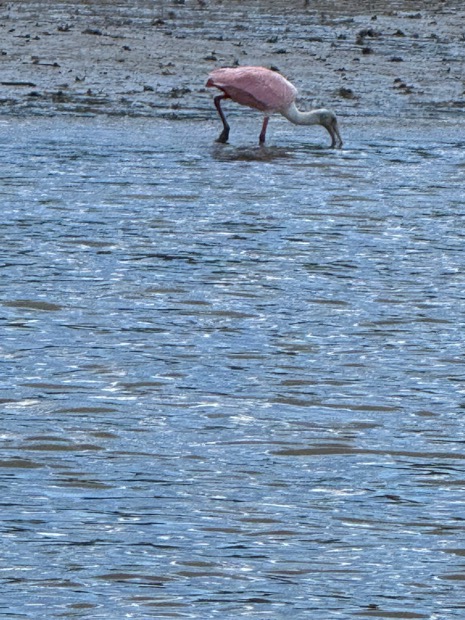
A lone wood stork rarely tips us off from a distance — a stack of birds does. We glass the shoreline for mixed flocks first: snowy egrets stepping high, white ibis probing the mud, maybe a roseate spoonbill sweeping its bill sideways, storks hunched in the middle. That crowd means the water’s rich enough to draw every wader around, and storks are followers as much as hunters — they’ll drop into a pool egrets already stirred up rather than work a flat alone. Find the stack, and you’ve usually found the stork.
Once we spot that stack, the outboard goes quiet before the birds are anywhere near photo range. We cut the motor fifty yards out and finish on the trolling motor, or pole in if the flat’s thin enough, working downwind so our wake reaches the birds last. We hold up-current of the flock so the boat drifts away from them, not into their water. Push too close and the stack lifts at once; hold back, read the angle right, and storks often keep feeding twenty feet off the bow.
At the rail, what catches guests off guard is the silence. Adult wood storks carry almost no voice — nothing like a heron’s croak or an ibis grunt — so the tell isn’t a call, it’s a single sharp clack of the bill across flat water. We tell guests to listen for that sound first, since a stork holding dead still gives almost nothing else away until that clack lands. Between strikes they stand hunched and motionless, which is why a boat drifting in quietly can often sit closer to one than to almost any other wader on the flat.
Wind against tide changes the plan fast. A stiff south breeze can pile water back onto a flat as it should be draining, and a flat that fished well yesterday can stay too deep for storks today. When that happens we shift off the open flats into the mangrove creek mouths, where current still funnels bait through a narrower cut no matter what the wind is doing outside. It’s a smaller window, but the fish concentrate all the same, and the birds follow that logic.
None of this is guaranteed — storks work a flat when conditions line up, not on a schedule we control, and we won’t promise a sighting before we’ve read that morning’s water ourselves. It’s the kind of call our captains like making on a private backwater charter, where we chase the tide instead of a fixed route. Browse the rest of our wildlife guide for what else shares these flats, or book a private charter built around backcountry sightings like this one.