
🗺️ At a glance
- What it is
- Inlet between north Marco & south Keewaydin
- Connects
- Isles of Capri back bays to the open Gulf
- Known for
- Deep water where dolphins are often seen
- Role
- The main route from Isles of Capri out to sea
- Nearby
- Keewaydin to the north, Marco to the south
Where Capri Pass sits
Picture the coastline: Marco Island ends at its north tip, then there’s a gap, then Keewaydin Island begins. That gap is Capri Pass. Behind it lie the canals and bays of the Isles of Capri, and in front of it is the open Gulf. Because it’s the funnel that drains and fills a big chunk of back bay every tide, the current rips through here and scours the channel deep. Deep, moving water is the signature of a good pass — and Capri Pass has it in spades.
It’s one of three big inlets stitching this coast together, alongside Big Marco Pass to the south and Gordon Pass up toward Naples. Each has its own personality; Capri Pass is the dolphin one.
Why the dolphins love it
Bottlenose dolphins are smart hunters, and a deep pass with fast current is a buffet. As the tide pushes through, baitfish get funneled and confused in the moving water, and dolphins station themselves to pick them off. That’s why Capri Pass is one of the most reliable spots on our routes to find them rolling, chasing and sometimes surfing the wake off the bow. We can never promise a sighting — they’re wild animals on their own schedule — but the odds in this kind of water are about as good as they get along the coast. Watch for the calves; spring and summer bring the little ones, half the size of mom and twice as curious. Our Marco Island dolphin tours work this pass on purpose.
| Pass | Between | Known for |
|---|---|---|
| Capri Pass | North Marco & south Keewaydin | Deep water, dolphins, Isles of Capri route |
| Big Marco Pass | North Marco & Sand Dollar Island | The shifting wading bar & bird habitat |
| Caxambas Pass | South Marco toward Kice | Historic launch & fishing inlet |
The Isles of Capri route out
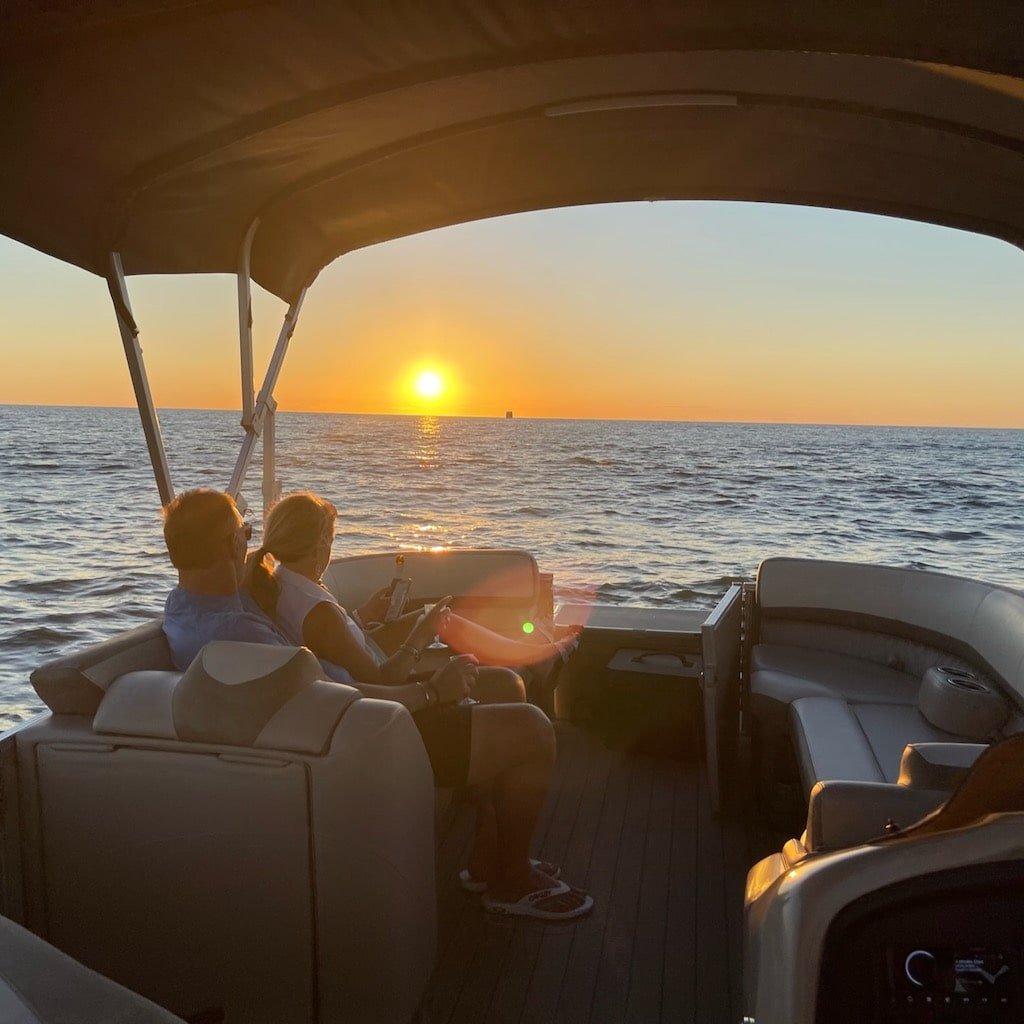
If you’re launching from the Isles of Capri — that low-key fishing village tucked behind Marco — Capri Pass is your front door to the Gulf. Boats thread out through the pass and the whole coast opens up: Keewaydin’s long wild beach just to the north, the open water out front, and the run down to Marco’s beaches and the Ten Thousand Islands to the south. It’s a beautiful piece of water to cross at golden hour, which is why we love it for sunset cruises too — deep blue channel, mangrove islands flanking it, and very good odds of a dolphin escort on the way out.
However you want to use it — dolphins, a beach drop on Keewaydin, or a sunset run — Capri Pass is a stretch our captains know cold. Hop aboard a dolphin tour and let us read the current for you.
From the Helm: Threading the no-wake stretch of Capri Pass on an incoming tide
The moment guests grab a camera fastest through Capri Pass is when a dorsal fin cuts the wake behind us and a dolphin slides up to ride the pressure wave off our bow. We throttle back through this stretch regardless of what’s around us, both for the posted no-wake water and because slow speed gives everyone a longer look instead of a blink-and-it’s-gone pass along the hull.
What most guests never clock is why the dolphins show up here at all. It’s the eddy line where the incoming tide meets calmer back-bay water, a visible seam where bait gets pushed up and pinned against the current. We watch for that seam as much as we watch for fins themselves, because if the bait’s stacked up along it, the dolphins are usually not far behind, working the same current we’re idling through.
On a strong incoming tide we favor running the Keewaydin side of the channel, where the deeper water holds a straighter line; on the ebb we’ll shift closer to the Marco side to dodge a shallow hump that builds on the falling half of the cycle. It’s a small adjustment from one tide stage to the next, but it’s the difference between a smooth pass through and a rough bounce over water that looked identical on the surface.
Around a new or full moon, the spring tide pushes noticeably harder through the pass than it does mid-cycle, and that extra push sharpens the eddy line we’re hunting — it shows up closer to the surface and holds together longer instead of breaking apart into scattered current seams. We’ll check the tide chart before a run for exactly that reason, since a spring-tide day through Capri Pass often gives us the clearest read on where the bait, and the dolphins, are likely stacked.
Once we’re through the pass and the water opens up, we’ll idle down again and let the boat drift a beat rather than motor straight on — engine noise is the fastest way to push a pod back under before anyone gets a photo. Guests standing quietly at the rail in that stretch are usually the ones who walk away with the shot worth keeping, not the ones snapping frantically the second a fin breaks the surface.
On a busy afternoon with boat traffic stacked up at the pass mouth, we’ll sometimes hold back and let the channel clear rather than squeeze through with two or three other boats also chasing the same pod. Patience out here tends to pay off better than crowding in, since dolphins working this pass tend to loop back through rather than simply pass through once and disappear for good.
Capri Pass is a regular stop on our dolphin tours, and it also doubles as the route we run guests through on the way toward the quieter barrier islands further south whenever conditions favor it.