
🐬 At a glance
- Scientific name
- Tursiops truncatus
- Size
- Commonly 8–12 ft, 300–1,400 lb
- Tell-tale
- Curved-back (falcate) dorsal fin, gray stocky body, short thick “bottle” snout
- Where & when
- Naples Bay, Capri Pass, Gordon Pass & the Ten Thousand Islands — year-round
- Etiquette
- Give space, never chase — we idle and let them come to us
How to identify a bottlenose dolphin
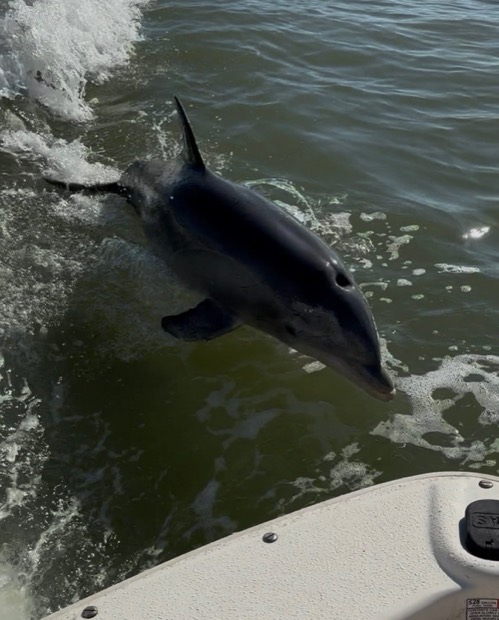
Start with the fin. The first thing you'll see is a smooth gray triangle that curves back toward the tail — biologists call that shape falcate, and it's the classic dolphin silhouette. The body is stocky and battleship-gray, fading to a paler belly, and the snout is short and thick like a stubby bottle, which is where the name comes from. Watch for two or three relaxed surfacings in a row as one cruises, then a longer dive.
Out here they're easy to tell from the other big animal people ask about — the slow, round-backed West Indian manatee — and from the offshore spotted dolphin you almost never see inshore. If you want the full side-by-side, our manatee vs. dolphin page lays it out.
How they behave in our backwaters
These are smart, social animals, and the more time you spend on the water the more you notice the patterns. You'll see them traveling in loose family groups, slow-rolling at the surface (we call that logging), and corralling bait against an oyster bar near Goodland. The showstopper is when one peels off to ride the pressure wave at our bow — a free push they take for the energy savings, which we break down in why dolphins ride the bow wave. To go deeper on the moves, our dolphin behavior glossary decodes breaching, spy-hopping and the rest.
Where and when to see them
The good news for trip planning: bottlenose are resident here every season, unlike the cold-season manatees that come and go. We find them working the passes — Capri Pass, Gordon Pass and the mouth of Naples Bay — where moving tides funnel bait. Calm, glassy mornings make fins easiest to spot, but we see dolphins in all conditions on our dolphin & wildlife tours. They're wild animals, so we never promise a sighting; we just go where the odds are best.
| Animal | At the surface | Quick tell |
|---|---|---|
| Bottlenose dolphin | Fast, arcing fin in sets | Curved gray fin, breathes through a blowhole |
| West Indian manatee | Slow, round gray back, no fin | Snout and nostrils only; nibbles seagrass |
| Atlantic spotted dolphin | Offshore, smaller, speckled | Rare inshore; spots increase with age |
Watching them the right way
Wild dolphins do best when we let them stay wild. We idle down, keep our distance and let curious animals close the gap on their own terms — never chasing, never feeding. That's not just good manners, it's federal law, and it's why mothers feel safe bringing tiny calves through the passes (more on that in our guide to dolphin mothers and calves). Respectful viewing is also better viewing: a relaxed pod will hang around and play, and that's when you get the photo.
From the Helm: Spotting dolphin water-clues off Coon Key Pass before the fin does
Someone at the rail almost always shouts “dolphin!” a beat after our captains have already clocked it, because we're not looking for the fin first, we're looking for what the water's doing around it. A slick patch of smooth water in an otherwise choppy pass, a sudden showering scatter of baitfish, or a small muddy boil kicked up in skinny water off Coon Key Pass all say the same thing before a single dorsal fin ever breaks the surface for anyone to see.
Once we've got that tell, we ease off the throttle rather than power toward it — a slowing engine reads as an invitation to a dolphin that wants to bow-ride, while a boat gunning straight at one usually just pushes it the other way. Idle speed and a straight, predictable line let a curious dolphin decide to come to us instead of us chasing it down across open water, which is really the whole trick to it.
Around the boat, bottlenose dolphins here tend to work rather than perform — you'll often see one working a mud boil in the shallows, herding bait against the bank, or riding the pressure wave off our bow for a stretch before peeling off to fish on its own. A calf traveling tight against an adult's side is common enough that we widen our distance without being asked, since mother-and-calf pairs earn more room than a lone adult would out here.
We'll cut the engine to neutral once a dolphin commits to the bow, since a hull pushing water at speed is what makes bow-riding worth the dolphin's effort in the first place — kill that pressure wave and it usually peels off within a few seconds. Guests leaning out over the pulpit get the closest look, close enough to hear the sharp exhale through the blowhole between surfacings and to catch the faint fishy smell that breath carries with it on a still morning.
If Coon Key Pass is quiet, the open water through the Ten Thousand Islands usually turns something up before long, and part of why we run at a relaxed pace rather than racing between spots is that a dolphin sign spotted at speed is one you've already missed. We treat every sighting as the wild animal deciding to show up, never as something we can promise off the dock.
It's the single thing guests ask about most before ever stepping aboard, and it's why our dolphin tours run at the pace they do rather than rushing point to point. For everything else sharing this water with them, our wildlife guide rounds out what else to watch for along the way.