
🎣 At a glance
- Scientific name
- Lobotes surinamensis
- Looks like
- Deep, blotchy body; floats on its side like a leaf; rounded “three-tail” fins
- Where & when
- Crab-trap buoys, weed lines & markers nearshore; spring through fall
- How we fish them
- Sight-cast a live shrimp or jig to a floating fish
- Table fish?
- Yes — excellent eating; regulated, captain handles rules
How to identify a tripletail
The giveaway is the pose. A tripletail lies flat on its side at the surface, drifting, doing its dead-leaf impression so well that you'll motor right past your first few before your eye learns the shape. Up close they're deep-bodied and mottled — brown, yellow, gray, sometimes nearly black — with rounded dorsal and anal fins set far back that, paired with the tail, create the “three tails” the name promises. It's a one-of-a-kind look, nothing else out here floats and ambushes quite like it.
Where to find them
Tripletail are structure addicts, but the structure they love is floating. We idle the nearshore waters off Naples and Marco scanning crab-trap buoys, channel markers, weed lines, and any chunk of debris drifting on a clean tide. They tuck right up against it, ambushing shrimp and small bait that gather in the shade. Spring through fall is the window, when warm water has them up shallow and visible. It's a slow, eyes-on hunt — the same patient, scan-the-surface style that makes our sight-fishing trips so rewarding — and it pairs perfectly with a nearshore day working markers and bottom.
How we catch them
Stealth wins. We ease up-current of a floating fish, cut the noise, and drift a live shrimp or a small jig right to it — a clean presentation matters because a spooked tripletail just sinks away. When one eats, that lazy-leaf act vanishes instantly: they bulldog hard around the buoy line and try to wrap you up. Land it and you've earned one of the finest fillets in Southwest Florida — firm, white, and sweet. Tripletail are regulated, so your captain keeps you legal, but they're a fish where the catch and the dinner are both highlights. Plenty of folks rank them on the best-eating list for good reason.
| Clue | What you'll see | |
|---|---|---|
| Position | Lying on its side at the surface | |
| Disguise | Looks like a floating leaf or debris | |
| Location | Tight to a buoy, marker, or weed line | |
| Tell | Rounded “three-tail” fin profile |
If a slow, sharp-eyed hunt that ends with a great fight and an even better dinner sounds like your speed, that's a tripletail day — come scan the buoys with us on a Naples fishing charter.
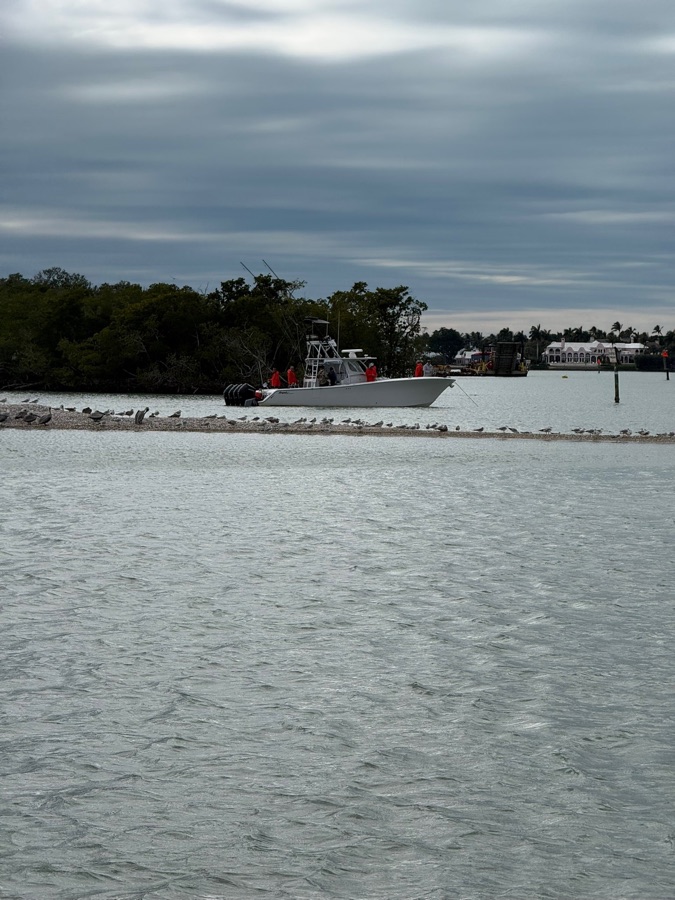
From the Helm: how we sight-cast tripletail off the crab floats outside Coon Key
The first time a guest spots one, they usually don’t believe us. We idle up near a crab-trap float outside Coon Key and point at what looks like a dead leaf or a scrap of plywood tipped sideways in the current, and then it moves. That’s a tripletail, hanging head-down and tail-up against the buoy line, using the shade and the current break to ambush anything that drifts past. Guests reach for a big rod out of instinct; we hand them something much lighter instead, because these fish spook off structure the second they feel a boat coming in too fast or too close.
We rig light for tripletail — a small spinning outfit, twenty-pound fluorocarbon leader tied straight to a light jighead or a bare hook and split shot, with a live shrimp or a small pinfish doing the work. Heavy leader spooks them in clear nearshore water, so we go as light as the structure allows and we never anchor tight against the float itself; a boat pinned right on the buoy line just pushes the fish off it. Instead we idle upcurrent, kill the engine, and coast the last few boat-lengths in on momentum alone, so the bait swings past the fish’s nose without a hull shadow crossing it first.
We look for this bite once you can see the trap lines lift and lean against the current, not on a dead slack — moving water gets a tripletail actively feeding instead of just holding station in the shade. The take itself is sneaky: a soft tick, sometimes nothing more than the line twitching sideways, and then the fish turns hard for the buoy line and the fight gets surprisingly stubborn for something that size. We keep steady pressure and horse it away from the float early, because a tripletail that wraps you around the buoy rope is a tripletail you lose right at the boat.
At the boat we slip a net under it rather than lifting by the leader — tripletail have a tougher mouth than they look like they should and a knack for throwing the hook right at the gunwale. They’re one of the better eating fish we come across out here, and the bite runs through the warmer months, but keep limits and size rules are regulated and change, so we always fish within whatever’s current before anyone keeps one for the cooler. On a slow morning — say the tarpon aren’t showing — a stop at a few crab floats can save the whole trip.
If the floats near Coon Key come up empty, we’ll swing toward any weed line drifting outside Capri Pass instead — tripletail hold under floating grass just as readily as they hold on a buoy, and a scattered line can hide three or four fish strung out over a stretch of water. It’s a slower, more visual hunt than working a single float, easing along the grass edge and watching for that telltale tilted shape before we ever make a cast. Either spot beats fishing blind, which is really the whole idea behind a light-tackle stop on one of our fishing charters.