
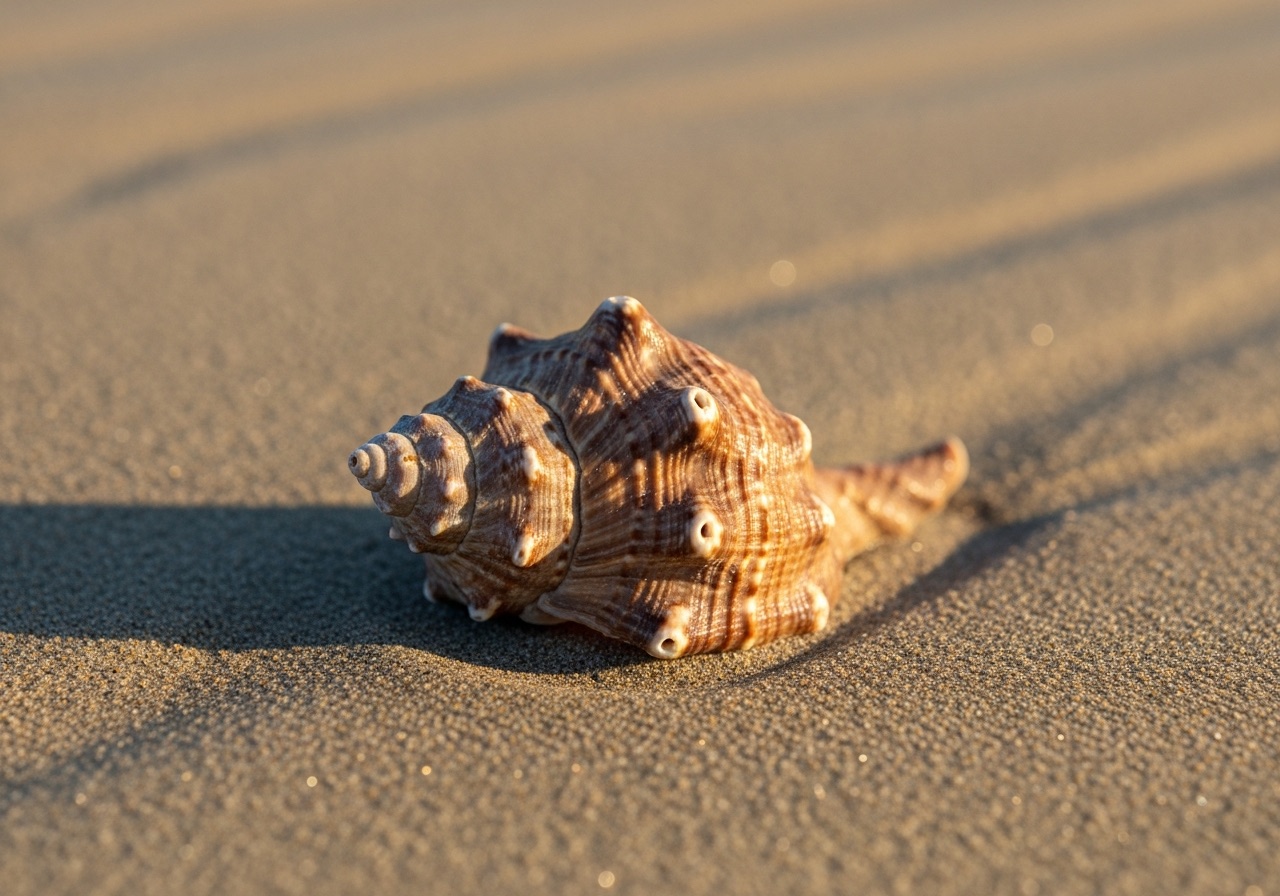
🐚 At a glance
- Scientific name
- Phyllonotus pomum
- Size
- Commonly 2–4 in — roughly the heft of a small apple
- Tell-tale
- Brown blotch at the top of the aperture; three blotches on the outer lip
- Where & when
- Keewaydin, Kice & the Ten Thousand Islands; best at low tide after a front
- Rule
- Empty shells only — live collection is banned in Collier & Lee
How to identify an apple murex
Pick one up and the first thing you'll notice is the weight — an apple murex is a chunky, solid shell with a low spire and a fat, rounded body whorl. Run your thumb over it and you'll feel rows of blunt knobs and short ridges, mottled in brown, gray and cream that often looks like camouflage. Now flip it and look inside the opening: there's a distinctive dark brown blotch right at the top of the aperture, and usually three more brown smudges along the outer lip. That blotch is your whole ID in one glance.
It's a member of the murex family, the same group as its frillier cousin the lace murex — but where the lace murex wears delicate frilly spines, the apple murex is all chunky knobs.
Telling it from the other murex (and friends)
Beginners mostly mix the apple murex up with the lace murex, and the fix is simple: feel the sculpture. Frills and leafy fronds mean lace murex; blunt knobs and that brown aperture blotch mean apple murex. People also confuse it with whelks and conchs, but those are bigger and smoother. Here's the quick sort:
| Shell | Surface | Quick tell |
|---|---|---|
| Apple murex | Blunt knobs, mottled brown | Brown blotch at top of aperture |
| Lace murex | Frilly, leafy spines (fronds) | Delicate frills, no chunky knobs |
| Crown conch | Spiny crown, banded | Larger, dark banding, pointed shoulder spines |
Where we find them
Apple murex love the sandy and rubbly Gulf-facing flats of the barrier islands, and the cleanest, most intact ones turn up on beaches you can only reach by boat. On our shelling tours we run to Keewaydin Island, Kice and the Ten Thousand Islands, where the tide restocks the wrack line all day long. They show up better after a winter cold front pushes fresh material ashore, and we time trips to low tide so there's the most beach to comb. Found a whole, empty one with that brown blotch? Keeper — just confirm nothing's living inside, because Collier County is empty-shells-only.
From the Helm: The outside bar at Kice Island, where first-timers pull their first apple murex
You can watch it happen from the helm almost every trip: someone brand new to shelling bends down on the outside bar at Kice, comes up with a stout, knobby shell, and just stands there weighing it in their palm. That heft is what does it — it doesn’t feel like a gift-shop shell, it feels like something that had to survive out here. We let that moment breathe before we say anything, because it’s usually the one that gets people hooked on the rest of the hunt.
We run the Gulf-facing bar for this species rather than the calmer lagoon side on purpose. Murex like a hard bottom worked over by surf — broken shell hash and rubble the wave action keeps turning — and that outside edge builds a fresh wrack of exactly that material, mixed with whole shells tumbled in alongside it. The lagoon side of the same island stays quieter and sandier, which is lovely for a swim but mostly barren for this particular hunt.
Our favorite window is a falling tide after a few days of steady onshore wind have had time to push material up onto the bar, not the first calm morning after a flat, windless week. Wind does the work here more than tide alone does — it’s what stacks the hash up where a wading foot can find it instead of leaving it scattered across open bottom offshore.
A fresh apple murex still shows some brown blush down in the knobs along its shoulder; shells that have been out in the sun and surf longer lose that color entirely, though the knob structure itself stays the same under a thumb run along the ridge. We show guests to feel for that ridge rather than hunt by color alone, since color is the first thing bleached sun and salt take away, and a shell can be a great find even fully bleached white.
We wade this bar in a loose line rather than a tight cluster, spread a few steps apart so nobody’s shadow is falling across the water someone else is scanning. It’s a small adjustment, but glare off the wash makes shape hard enough to pick out without someone’s shadow flattening the light right where you’re looking. We’ll call the line back together every so often just to compare what’s turned up so far.
When the wash is running too hard to hold footing right on the bar’s edge, we shift the group a stretch down where the same bar tapers into calmer water — same shell hash, easier footing, and nobody fighting current for a shell. It’s a stop we build into our shelling tours specifically for that first-find moment, and it’s worth pairing with a look through our full seashell guide once you’re back aboard comparing notes.