
🐚 At a glance
- Scientific name
- Chicoreus dilectus
- Size
- Commonly 1.5–3 in
- Tell-tale
- Delicate frilly, leafy spines (fronds) running up the shell
- Where & when
- Boat-only islands — Keewaydin, Kice & the Ten Thousand Islands; after fronts
- Rule
- Empty shells only — live collection is banned in Collier & Lee
How to identify a lace murex
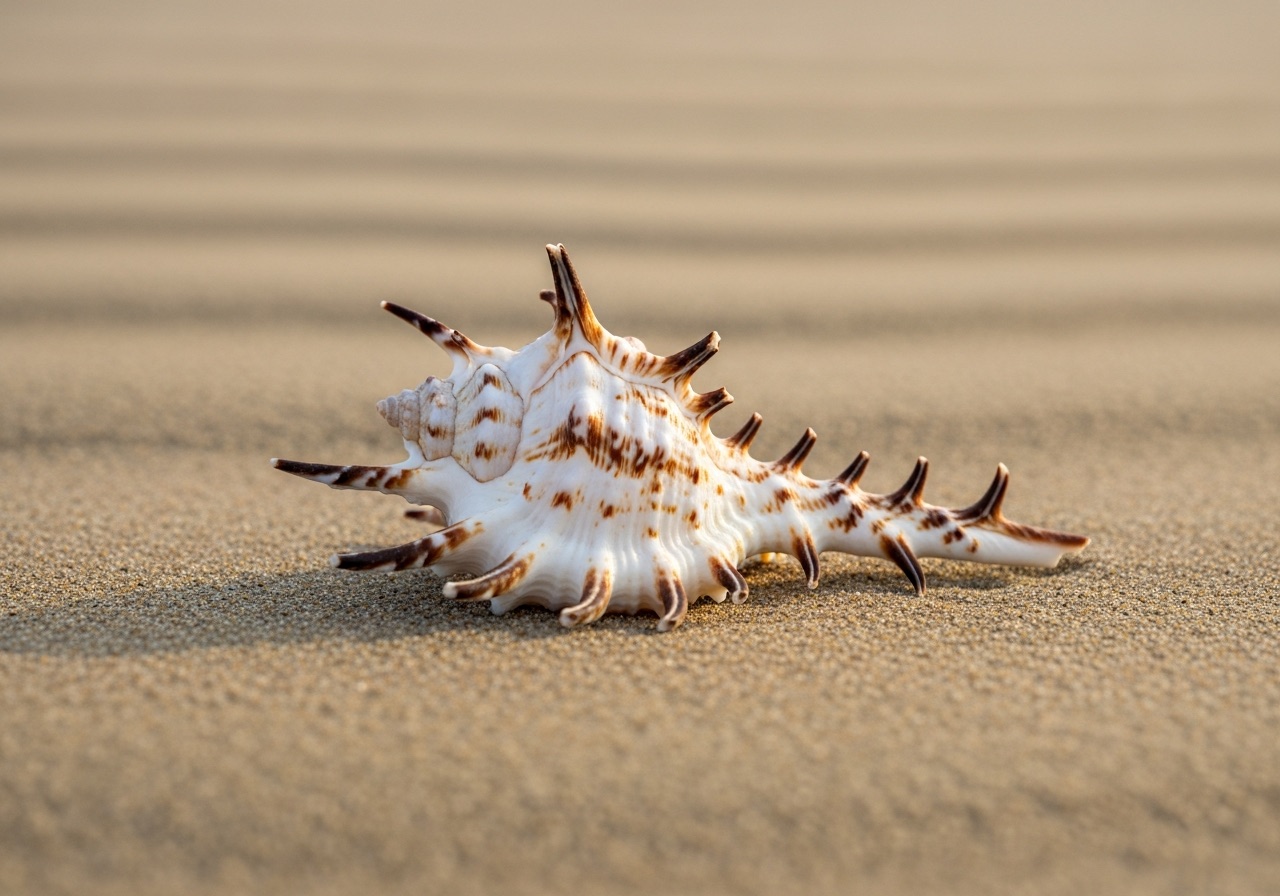
The lace murex is unmistakable the moment you really look at it. Three raised ridges run the length of the shell, and along each one grow rows of thin, curling, leaf-like spines — the fronds — that genuinely resemble lace or coral. The base color is usually tan to brown, sometimes with darker banding, and a fresh, unbroken specimen with all its frills intact is a little showstopper. Those frills are also why it's tricky: they snap easily, so many beach finds are worn down to nubs.
It belongs to the same murex family as the much more common apple murex, but the two are easy to keep straight once you've felt both.
Lace murex vs. apple murex
This is the one comparison every new murex hunter needs, and it comes down to a single sense: touch. Run your thumb along the shell. If you feel delicate, leafy frills, it's a lace murex. If you feel blunt knobs and a chunky body with a brown blotch inside the opening, it's an apple murex. Size helps too — lace murex tend to run a touch smaller and more sculptural.
| Feature | Lace murex | Apple murex |
|---|---|---|
| Surface | Frilly, leafy spines (fronds) | Blunt knobs and ridges |
| Aperture mark | No brown blotch | Brown blotch at the top |
| How often you find it | Uncommon — a prize | Common — beginner-friendly |
Where we find them
Because their frills break so easily, the best lace murex are the freshest ones — the shells that just arrived and haven't been tumbled to pieces. That's exactly why the boat-only beaches win: on our shelling tours we run to Kice Island, Keewaydin and the Ten Thousand Islands, where fresh material lands on sand few feet have walked. We aim for low tide right after a winter cold front, when delicate shells survive the trip in. Find a whole, frilly one? That's a real keeper — just check that nothing's living inside, because Collier County is empty-shells-only.
From the Helm: Working the shell-midden flat off Dismal Key for lace murex
Lace murex don’t turn up on soft, open sand the way a lot of Gulf shells do, so our captains don’t bother searching there for them. We run instead to the shell-and-rubble flat off Dismal Key, built up over centuries by the Calusa into a hard, uneven bottom the open beach never has. On a falling tide that flat comes half-exposed, current still moving fast enough to keep sorting fresh material across it. That’s the zone we work, not the soft stretch a few hundred yards away where everyone else is walking with their heads down.
Hard bottom is the whole point — murex like structure to anchor egg cases and hunt smaller shellfish, so a rubble flat holds them the way plain sand never will. We work the margin slowly, on foot in ankle-deep water, running a bare hand through the loose hash rather than a rake, since a metal tine will snap those fine spines before you ever see what you’ve found. It’s slower than scooping sand, and that’s the trade-off for a shell nobody finds by accident.
A fresh-dead lace murex still carries its full crown of frills — thin, papery, almost leaf-shaped spines you can flex slightly before they’d ever crack. A tumbled one loses that first; what’s left is a row of blunt, chalky stubs where the fronds used to be, and the whole shell reads dull instead of crisp. We have guests run a thumb along one whorl before deciding whether to keep it, since the frills tell you more than the color ever will.
Our window is the last two hours of a dropping tide, ideally a day or two after a north or northwest blow has stacked extra material onto that flat. Slack high water is close to useless here; there’s no current to have moved anything new in, and what’s left has usually already been picked over by the last group through. We’d rather give a shorter stop at the right moment than a long one at the wrong one.
At the rail, we hand the shell over frills-up and let a guest find the pattern before we say a word — it lands better that way. Anyone hoping for a full, unbroken set of spines should treat it as a bonus on a shelling tour, not a guarantee, and our full seashell guide covers what else turns up in the same rubble. Whatever comes home stays an empty shell, as it should — Collier County rules don’t bend for a pretty one.
When the current’s ripping too hard to stand comfortably on that flat, we’ll idle a few hundred yards deeper into the back bay, where the same midden material spreads thinner but calmer, trading volume for a stretch anyone aboard can actually work without fighting the tide underfoot. It’s a smaller patch and a slower search, but a guest who can stand still and look carefully beats one getting knocked around by moving water every time.