
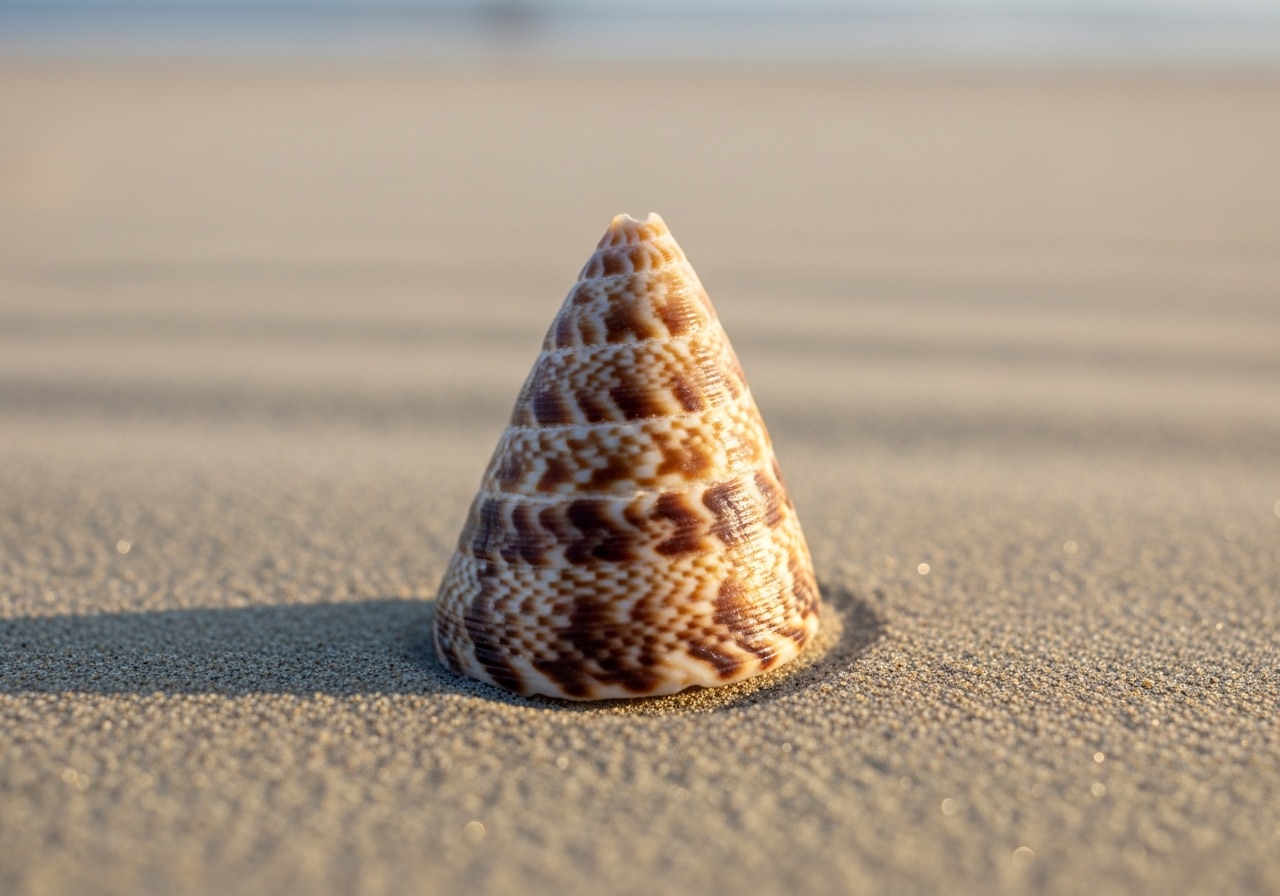
🐚 At a glance
- Scientific name
- Conus anabathrum
- Size
- Commonly 1–2 in — small for a cone
- Tell-tale
- Smooth, softly mottled; no bold letter-like spots
- Where & when
- Sandy bottoms off the boat-only islands; best after storms
- Rule & safety
- Empty shells only — live cones can sting
How to identify a Florida cone
The cone shape gives the family away: broad shoulder, tapering point, a long slit-like opening down one side. The Florida cone separates from its cousins by what it lacks — instead of crisp rows of spots, it wears a soft, watery mottling of cream, tan and pinkish-brown that blends together, sometimes with faint spiral lines. It's small, smooth and easily mistaken for a worn pebble until you turn it and see the cone profile. Fresh ones have a light sheen; beach-worn ones go chalky pale.
If you've already learned the boldly spotted alphabet cone, the Florida cone is essentially its smaller, subtler sibling.
Florida cone vs. alphabet cone
These two are the cones you'll actually sort on a SW Florida beach. Size and spotting do almost all the work.
| Feature | Florida cone | Alphabet cone |
|---|---|---|
| Size | Small (1–2 in) | Larger (1.5–3 in) |
| Markings | Soft, blended mottling | Crisp rows of letter-like spots |
| Overall look | Subtle, plain | Bold, distinctive |
Small and smudgy means Florida cone; bigger with letters means alphabet cone. And the cone-sting rule covers both — never pick up a live one.
Where we find them
Florida cones live on sandy bottoms, and the empties scatter along the Gulf-facing wrack of the boat-only islands. On our shelling tours we comb the fresh sand through the Ten Thousand Islands at low tide, and the small stuff like cones shows best right after a storm or front churns the bottom. Because they're little, they reward a slow, low look at the wrack — and a live cone can sting, so it's empty shells only, always.
From the Helm: Hunting Florida cones across the sand flats off Dismal Key on a falling tide
Before we commit to a cone morning, we check two things off the dock: wind direction and how low the falling tide is scheduled to drop. Florida cones don’t wash up in wrack lines the way whelks do — they sit half-buried in clean sand, and you need the water pulled well back to see them at all. A soft south wind paired with a strong outgoing tide toward Dismal Key is the combination we wait for, since anything stronger just stacks turtle grass over the flat we actually want to walk.
Once we’re anchored off Dismal Key, we don’t walk the whole flat — we work it in a slow grid, eyes down, scanning for a shape smoother and rounder than the shell hash around it. Guests expect a spiky cone shape and are surprised how tucked-in and low these actually sit. We hand each guest a mesh bag and tell them to trust a thumb more than their eyes: a live cone carries a faint sting risk, so we teach the flip-and-check before anything goes in the bag on one of our shelling tours.
A fresh-dead cone still holds its color — soft mottled cream and tan — and a faint shine along the length of the shell, almost like it was just polished. A surf-worn one loses that sheen fast, going chalky and a little pitted within a season or two of tumbling. In your hand, the fresh ones feel almost waxy; the worn ones feel closer to dry bone. We’ll cup one flat in a palm and turn it in the light so guests can see that difference themselves before we ever open a guidebook.
We don’t run this hunt every charter. If the flat off Dismal Key is still holding water when we arrive, or the wind has swung onshore and stacked grass over the sand, we shift the plan toward the barrier islands we already favor for shelling and save the cone flat for a low that actually cooperates. Most mornings that plan-B still turns up plenty of shells even without a cone in the bag, so nobody leaves the boat feeling shorted, and we can circle back to Dismal Key next trip if the tide lines up again.
The Florida cone isn’t a headline find the way a junonia is, but it rewards patience in a way bigger shells don’t — you have to slow down and actually look instead of scanning for something that jumps out at you. We like pointing that out early in a trip, because it resets how guests search for the rest of the day. If close, patient hunting sounds like your speed, browse the full seashell guide before you book, or ask your captain to work a low-tide flat into your next shelling trip.