
🐚 At a glance
- Scientific name
- Oliva sayana
- Size
- Commonly 2–3 in; cylindrical
- Tell-tale
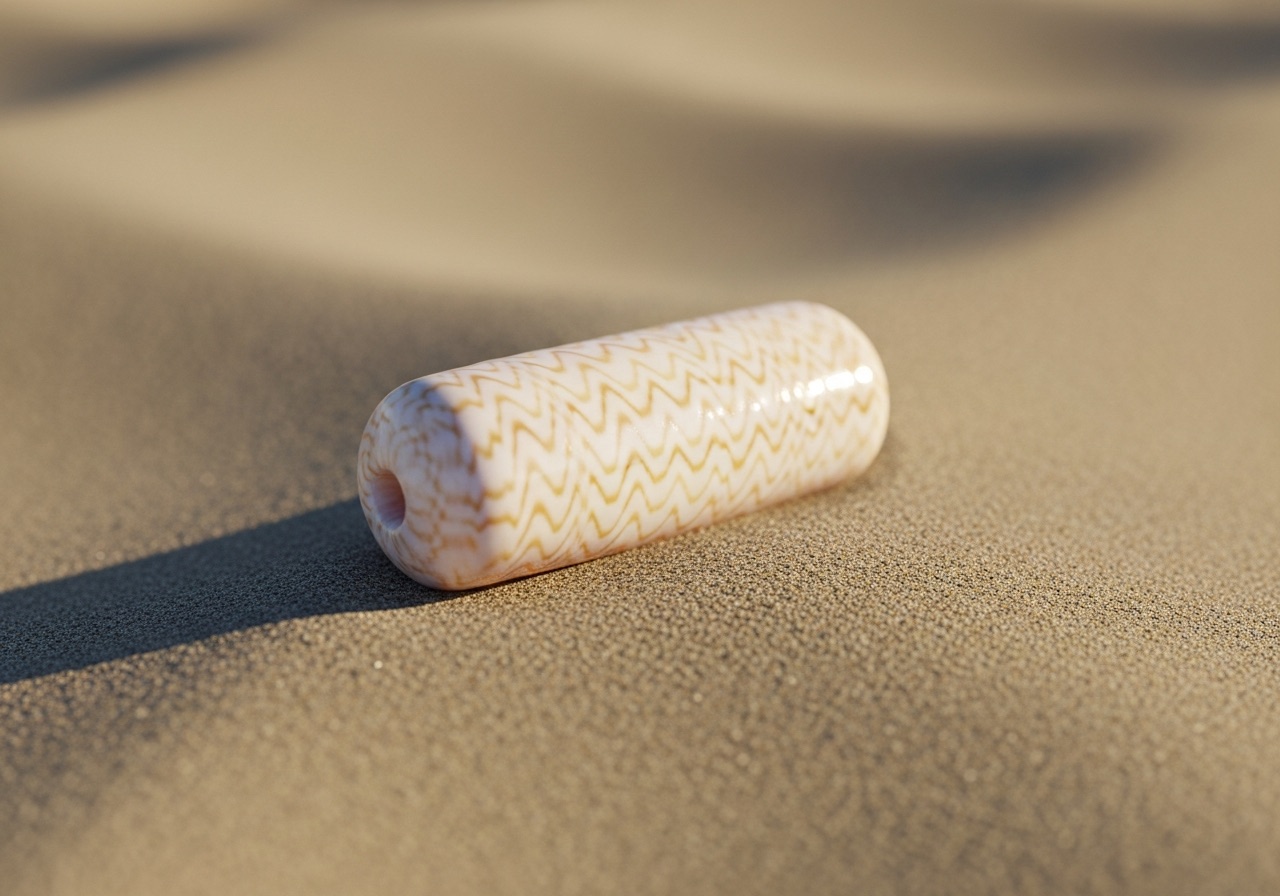
- Natural high gloss; faint zigzag “letter” markings
- Where & when
- Sandy Gulf beaches of the boat-only islands; low tide
- Rule
- Empty shells only in Collier & Lee
How to identify a lettered olive
Shape is your first clue: the lettered olive is a tidy cylinder, smooth-sided and rounded at the ends, with a short spire and a long, narrow opening running nearly its full length — like a polished little torpedo. The color is a soft cream, gray or tan, overlaid with faint, fine zigzag streaks that early collectors read as letters or even tiny script. But the thing your fingers notice first is the shine: it's slick and glassy, the work of the living snail wrapping its glossy foot around the shell.
That same family glossiness shows up in its olive relatives, but this is the olive you'll find on our beaches, and it's a headliner among the Sanibel-six shells collectors chase.
Why it comes pre-polished
Here's a fun bit of biology. In life, the snail's mantle and foot extend up over the outside of the shell, buffing it smooth and depositing a glossy finish — so a fresh lettered olive looks lacquered straight off the beach. That's a treat, because most shells need a rinse and a little work to shine. With this one, a quick rinse usually does it; see our shell-cleaning guide if a find comes up dull or chalky from sitting in the sun. The gloss is exactly why these are such prized keepers.
Where we find them
Lettered olives burrow in sandy bottoms and surf zones, so the empties wash onto the Gulf-facing beaches of the barrier islands. On our shelling tours we work the fresh wrack at low tide on boat-only sand like Keewaydin and around Cape Romano, where they come ashore clean and unbroken before the crowds. A whole, glossy lettered olive is one of the most satisfying shells to slip into a bag — just confirm it's empty, since Collier County is empty-shells-only.
From the Helm: Working the swash at Panther Key for lettered olives
Someone hands us a lettered olive almost every trip and asks the same thing: did you polish this? We like the answer, because the shell does all the work itself. What you’re holding came out of the sand already glossy, no tumbler or wax involved — that shine is just how the animal built it. Our job on the water is mostly getting you to the stretch of beach where the last wave just delivered one, not making it look nicer than it already is.
We work the last few feet of the wash rather than the dry sand above it, since a lettered olive that’s already empty gets rolled by every wave until it lands somewhere new. At Panther Key’s Gulf-facing edge we walk with the receding water instead of against it, letting the foam do the sorting for us. A shell tumbling in that thin skim of water catches the light differently than a broken fragment does — that little roll and glint is usually the first thing that gives one away.
Freshly delivered ones still carry their full gloss and the faint brown zigzag markings that give the species its name, cool and slick in your palm like a piece of polished stone. Ones that have sat in the sun and rolled through dry sand for a season go chalky at the tips first, the shine fading from the point inward, so we can usually tell a same-day tumble from an older one before we even flip it over.
We don’t chase one magic tide for this shell the way we do for some — olives turn up across a wider window, morning or evening, on any falling water with a little wave action behind it. A steady onshore breeze helps more than a dead-calm day, since it’s the wave energy doing the sorting, not the tide stage alone. That makes it a dependable add mid-trip whenever the wind is cooperating with us.
It’s one of the celebrated Sanibel-six collector shells, and on a shelling tour with us it’s often the easiest true keeper for a first-timer to spot on their own, once they know to watch the wash instead of the dry sand above it. Whatever you pocket left the animal behind long before you found it — we only bring home empty shells.
Some guides teach a technique for digging live olives out of the sand as a wave pulls back — we don’t run that with guests, since Collier County only allows empty shells, snail included. Instead we watch for ones the surf has already finished with, tumbling loose in the foam rather than buried and still moving under it. That distinction matters more than people expect, and it’s the first thing we explain before anyone starts walking the wash with us.