
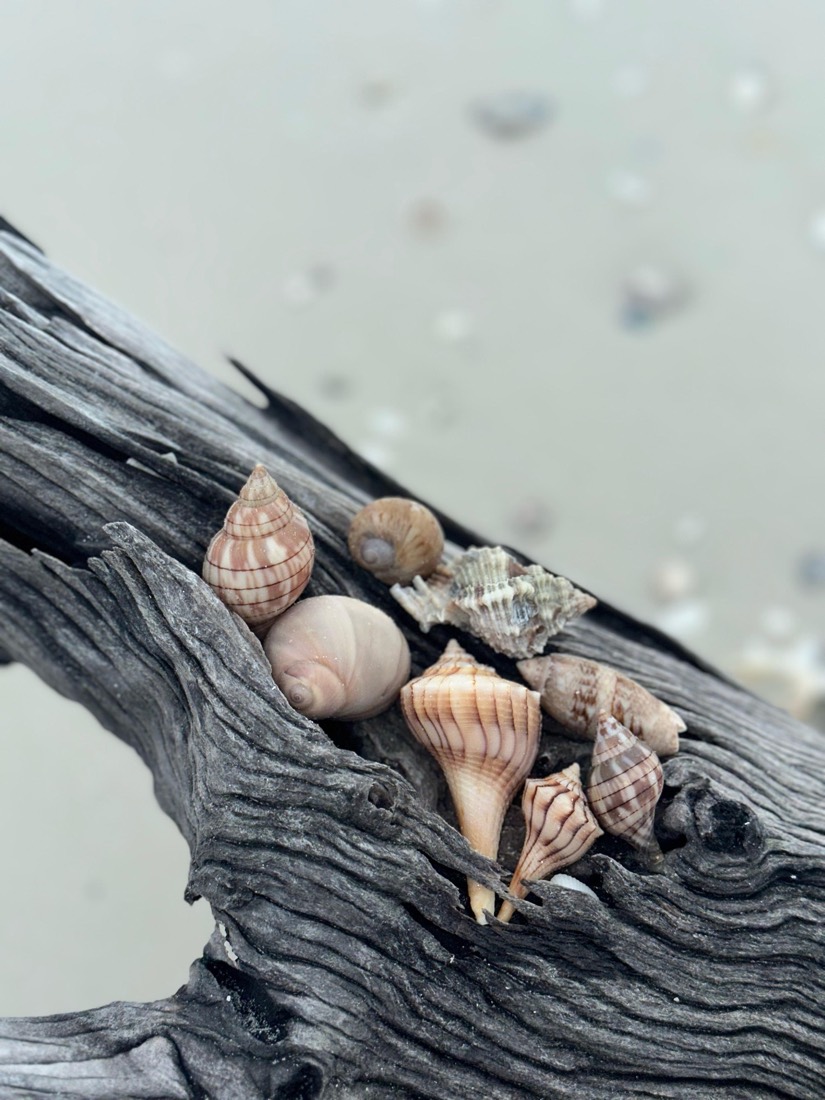
🐚 At a glance
- What it’s called
- Equiangular (logarithmic) spiral — the same curve type as a hurricane band or a hawk’s dive
- Golden ratio?
- Almost never exact — each species holds its own fixed expansion rate
- Why it matters
- Lets the snail keep growing bigger without ever remodeling old shell
- Best local example
- A lightning whelk’s aperture — big, easy to photograph and measure
- Where to find one
- Boat-only islands like Keewaydin, Kice & Cape Romano; empty shells only
- What you need
- A phone camera, a protractor or a free angle app, and about ten minutes
What Kind of Spiral Is a Seashell, Really?
Pick up almost any spiral shell — a lightning whelk, a moon snail, even a tiny auger — and you’re holding a logarithmic spiral, sometimes called an equiangular spiral. That’s different from the spiral on a rolled-up garden hose or a coiled rope, which is an Archimedean spiral: the gap between each loop stays the same width no matter how far out you go. A shell’s spiral does the opposite. The distance between whorls grows wider and wider as you move outward, but the angle at which the curve crosses any line from the center stays fixed the whole way around. That constant angle is the whole trick, and it’s why a shell can add material at the open lip its entire life without ever having to reshape what it already built.
You can see it best on a big lightning whelk fresh off the beach at Keewaydin or Kice — hold it spire-up and trace the ridge from the tip down to the flared opening. Every quarter-turn, the curve has widened by the same proportion. Zoom in on one whorl or zoom out to the whole shell and the shape looks the same, just scaled. That property, self-similarity, is the mathematical signature of every spiral seashell in the Ten Thousand Islands, from the smallest baby’s ear to the biggest horse conch.
Is the Golden Ratio Real in Seashells?
Here’s the part most shell-math posts skip: the popular image of a nautilus shell perfectly overlaid with a golden spiral (an expansion ratio of phi, about 1.618, every quarter turn) is mostly internet folklore. A logarithmic spiral is defined by its own growth rate, and the golden spiral is just one special case where that rate happens to work out to phi. Real, measured mollusk shells almost never land exactly there. Chambered nautilus shells typically measure well below phi, and Gulf species vary even more.
A tight little auger or cerith spirals in slowly, adding only a small percentage of size per turn, which is why it looks like a long, narrow screw. A moon snail or a fig shell spirals in fast and wide, ballooning to a near-globe in just a couple of turns. A lightning whelk sits somewhere in between — enough turns to show a clear spire, wide enough flare to earn that big, glossy body whorl. None of them are “wrong” for missing phi. Each species’ ratio is tuned by millions of years of trade-offs between shell strength, drag in the water and how much energy the animal can spend building calcium carbonate. Honest shell math is species-specific math, not one universal number.
How Shells Grow Bigger Without Ever Remodeling
A snail can’t do what a hermit crab does and just trade up to a bigger house. Once a section of shell is built, it’s built — a mollusk’s mantle tissue secretes calcium carbonate only at the growing edge, the lip of the aperture, laying new material down in thin layers. Old whorls near the spire are essentially finished construction, sealed off and structurally locked in. That’s exactly why the logarithmic spiral is such a good engineering solution: because the growth angle never changes, each new increment of shell fits perfectly onto what came before, the way an addition on a house has to match the roofline of the original. There’s no need to tear anything down and start over.
It also explains why a shell’s spiral tells you its whole life story at a glance. Count the fine growth lines on a whelk or a conch and you’re looking at pauses and pushes in that animal’s feeding and growing seasons — read our guide to how seashells grow for the layer-by-layer version of this same story. The spiral math and the growth-line story are really the same phenomenon seen two different ways: one is geometry, the other is biology, and on a real Gulf shell you can trace both with your thumb.
Measure Your Own Shell’s Spiral
You don’t need a lab to find your shell’s real expansion ratio — a phone camera and a protractor (or a free angle app) will get you a legitimate number in about ten minutes.
- Photograph it flat. Lay the shell aperture-up on a flat surface and shoot straight down in even light so the spiral isn’t skewed by a camera angle.
- Find the center. Locate the spiral’s focal point — usually right at the tip of the columella, where the whorls converge to a point.
- Draw two radius lines. On the photo, draw two straight lines from that center point out to the shell’s edge, a fixed angle apart. Ninety degrees is an easy angle to work with.
- Measure both lengths. Measure each radius in millimeters, or in pixels if you’re working digitally.
- Divide to get your ratio. Divide the longer radius by the shorter one. That’s your shell’s expansion ratio for that angle — compare it to phi (1.618) and see how close, or how far, your real Gulf shell actually lands.
Do this on three or four shells from the same species and you’ll notice the ratio holds remarkably steady — that consistency is the “equiangular” part of equiangular spiral in action. Do it across species and you’ll see just how much that number swings, from tight little augers to wide-flared whelks.
Why Every Gulf Species Spirals Differently
Walk the tideline after a winter front pushes fresh shells onto Keewaydin, Kice or the Caxambas spits and you’ll see the whole range of Gulf spiral math laid out in one bucket. A tulip shell or a lightning whelk flares wide and fast — a shape that trades some structural efficiency for a roomy body whorl the animal can retract deep into. A moon snail goes even further, spiraling into a near-perfect globe that’s brutally hard for a crab to crush. On the tight end, augers and ceriths add only a sliver of size per turn, building a long, narrow tower that’s efficient to construct but easy for a predator to grip — likely why those species tend to burrow rather than sit exposed.
None of this variation is random. Each ratio is a real trade-off between how much material the animal can afford to secrete, how much protected interior space it needs, and how the resulting shape performs against predators and current. It’s the same reason our captains can often name a species from twenty feet away just by its silhouette — the spiral is the identifying feature, long before you can see color or pattern. It’s a nice bit of family-trip science too: hand a kid a protractor on the way out on a shelling tour and the spiral on every shell in the bucket becomes a hands-on geometry lesson, not just a pretty curve. If you want to sort out which of your finds are worth grading up as display pieces once you’re home, our shell grading guide is the natural next stop.
| Shell | Spiral character | Typical whorl count | Field tell |
|---|---|---|---|
| Lightning whelk | Wide, fast-flaring | 6–8 whorls | Big glossy body whorl; opening on the left |
| Moon snail | Very wide, near-globose | 3–4 whorls | Almost spherical; spiral hard to spot |
| Fighting conch | Moderate, flared | 5–7 whorls | Knobby shoulder spines along the spiral |
| Auger & cerith shells | Extremely tight, elongated | 15–20+ whorls | Long, narrow “screw” shape |