
🐚 At a glance
- Color source
- Pigments from the snail’s diet, deposited by cells along the mantle edge
- Pattern mechanism
- Mantle cells switching pigment on and off as the shell grows outward
- Best example
- The lettered olive — every squiggle is a one-of-a-kind growth record
- Freshest color
- Recently vacated shells, before sun and surf bleach them out
- Where it washes up
- Boat-only islands like Keewaydin, Kice & Cape Romano
- Rule
- Empty shells only — Collier & Lee County law
Where shell color actually comes from
A seashell isn’t painted — it’s grown, and its color is a byproduct of biology, not decoration. The mollusk that built it pulls pigment molecules (mostly carotenoids, porphyrins and melanins) out of whatever it’s been eating — algae, plankton, other mollusks — and routes them through its bloodstream to a strip of living tissue called the mantle, which lines the inside of the shell and hugs its outer edge. Specialized pigment cells in that mantle edge secrete the coloring compound into the calcium carbonate as the shell is built, layer by layer, the same way the shell itself is built. That’s why diet shapes color: a whelk eating a pigment-rich diet in one season can lay down a darker band than the same animal did the season before, when food was leaner. It’s also why closely related species that eat different things — and even the same species living in different parts of the Ten Thousand Islands — can come out looking noticeably different, and why a fresh banded tulip or a lightning whelk can run anywhere from pale cream to deep chocolate depending on what that individual snail has been feeding on. Want the mechanics of the growth itself, not just the color? Our guide to how a seashell grows walks through the mantle’s day-to-day work in more detail.
How stripes, spots and zigzags actually form
Color is the ingredient; pattern is the timing. As the mantle edge deposits new shell material, its pigment cells don’t run continuously — they switch on and off, speed up and slow down, in response to the animal’s internal clock, its feeding cycles, even stress and temperature. A steady, unchanging output reads as a solid-colored shell. A pigment cell that pulses on a rhythm lays down stripes or spiral bands. A pigment cell that fires unevenly, in bursts, lays down the mottled spots, flame markings and zigzags you’ll find in a bucket after a good low tide. Because the shell only ever grows at that one active edge and never repaints what’s already built, every pattern is effectively a permanent, chronological recording — a growth log written in calcium carbonate instead of ink. Run your finger from the spire to the lip of almost any patterned shell and you’re tracing that animal’s pigment output through its entire life, oldest markings at the tip, newest at the growing edge. Growth speed changes the reading too: a shell that grew fast during a warm, food-rich stretch stretches its markings wide and loose, while a slow winter growth spurt packs the same on-off signal into tight, narrow bands — which is part of why the same species can look strikingly different shell to shell.
Why no two lettered olives write the same script
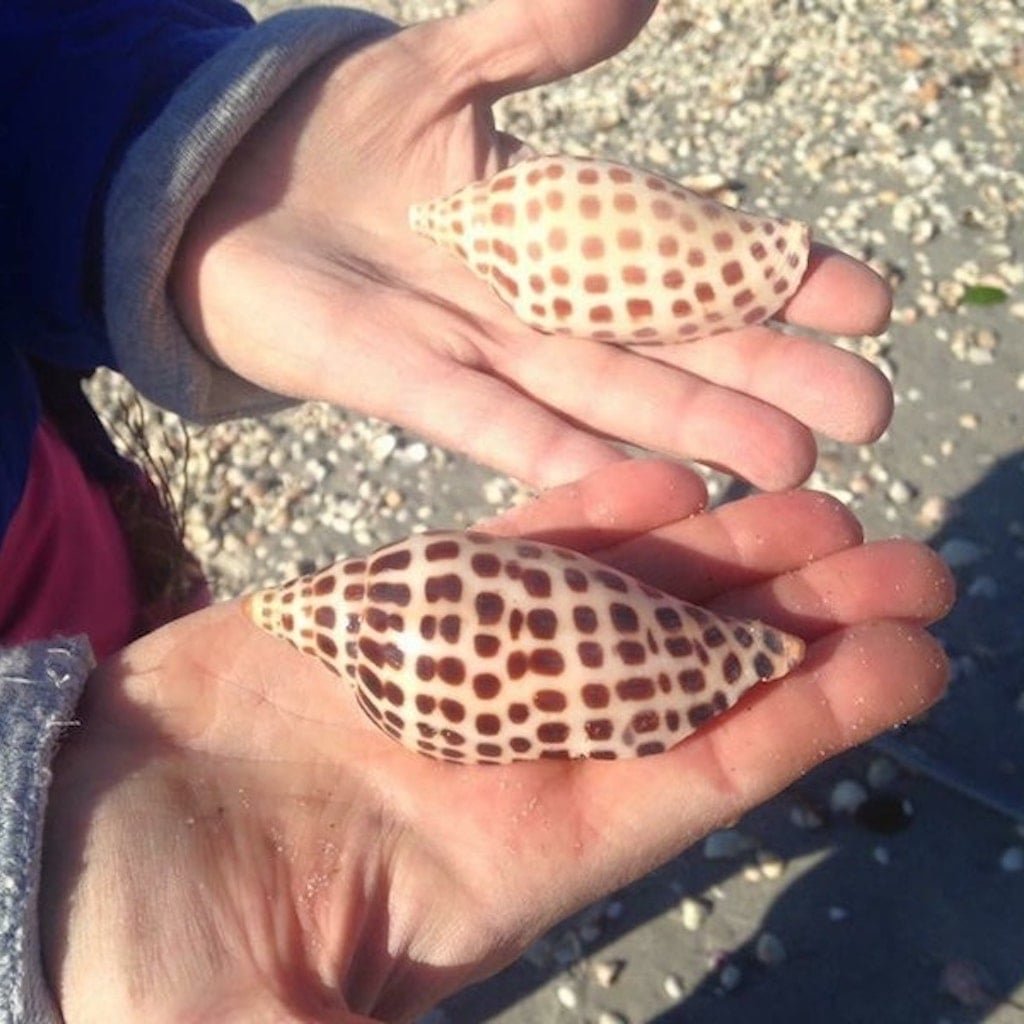
The clearest proof of this on-off recording system is sitting right on the beach: the lettered olive, Florida’s glossy little cursive-covered classic. Its zigzagging tan and brown markings look uncannily like handwriting, which is exactly how it got its name — but it isn’t writing anything. Those squiggles are the pigment cells at the mantle edge firing in short, irregular bursts as the shell grows, and because timing, diet and stress vary from one snail to the next — and from one week to the next, even in the same snail — no two lettered olives ever come out identical. It’s the shelling equivalent of a fingerprint: the pattern is a real biological signature, not a design, and no amount of studying one shell will tell you what the next one out of the sand will look like. That uniqueness is part of why the lettered olive is one of the most collected shells our guests pull out of a bucket, and why serious collectors will sort through a whole handful looking for the one with the boldest, most legible markings and the glossiest, least-faded finish.
Fresh color vs. sun-bleached shells — and where the brightest ones wash up
Once a mollusk dies or is eaten and its shell is vacated, the color stops being renewed and starts being erased. UV light breaks down the pigment molecules, wave action sands away the thin organic skin (the periostracum) that once gave a shell its shine, and repeated tumbling in the surf slowly bleaches even boldly patterned shells toward chalky white. That’s why a shell picked up on a heavily walked public beach often looks washed out compared to one that came straight off a boat-only island — it’s simply had more sun-and-surf time to fade. If you want to see color and pattern the way the living animal actually wore it, you need shells that haven’t been in the wash cycle long, which is exactly what our captains are hunting for when they run to Keewaydin, Kice, the tip of Cape Romano and the Caxambas spits instead of the drive-up beaches — less foot traffic means less time for the sun to do its fading. Storms and winter cold fronts help too: a strong blow can turn over a whole fresh batch of material that hasn’t sat in the sun for months, which is why our captains keep an eye on the tide charts after a front comes through. We only ever collect empty shells; taking anything live, including sand dollars and starfish, is prohibited in Collier and Lee County, so what you find is what the tide has already delivered on its own. Curious how to tell a freshly vacated shell from a well-traveled one at a glance? Our guide to reading beach-worn vs. fresh shells breaks down the tells.
Book a spot on one of our shelling tours and you’ll be working exactly those islands with a captain who can point out fresh color versus faded before you even bag the shell. For the full identification library, browse the Seashell Guide hub.
| Trait | Fresh / recently vacated shell | Sun-bleached beach shell |
|---|---|---|
| Color saturation | True-to-life pigment, often glossy | Faded, chalky, sometimes bone white |
| Periostracum (outer skin) | Often still intact, slight sheen | Worn away by sand and surf |
| Pattern visibility | Sharp, high-contrast markings | Muted, blurred or gone entirely |
| Typical find spot | Wrack line after a tide, boat-only islands | Well-walked public beaches |
| Best kept as | Display-quality collector piece | Craft shell or beach-bag keepsake |