
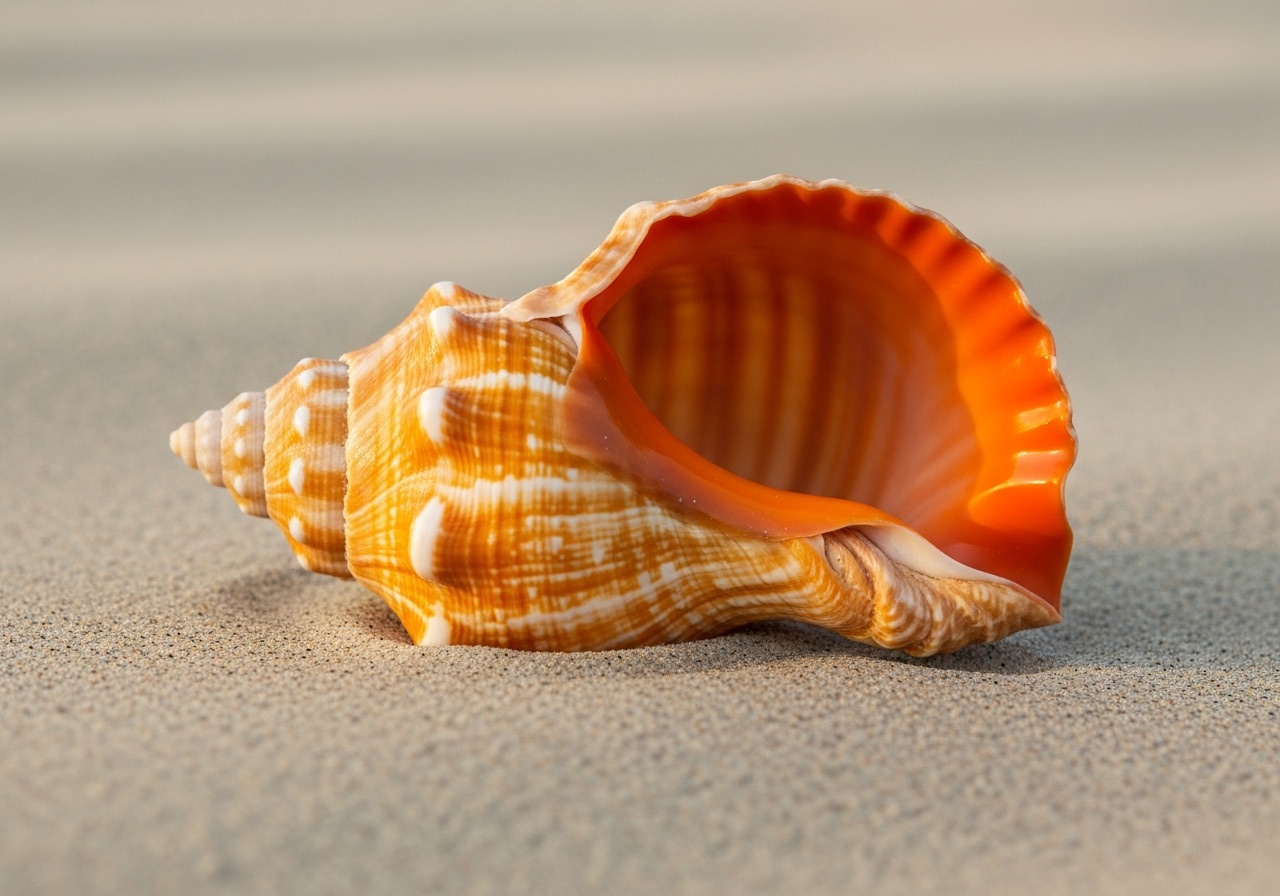
🐚 At a glance
- Scientific name
- Triplofusus giganteus
- Claim to fame
- Florida's state shell & the largest snail in U.S. waters
- Size
- Up to 24 in — most beach finds are smaller
- Tell-tale
- Heavy spindle shape, bright orange aperture; juveniles glow orange
- Where & when
- Ten Thousand Islands & outer sandbars, especially after storms
How to identify a horse conch
Size is the first giveaway — few shells on the beach come close. A horse conch is a long, heavy spindle: a tall pointed spire, a fat body whorl with low rounded knobs at the shoulder, and a long open canal at the base. Older shells often look weathered gray or chalky on the outside, sometimes with a flaky brown coating, but tip one toward the light and the inside flashes a beautiful deep orange.
Despite the name, it isn't a true conch like the fighting conch — it's actually a giant predatory snail that hunts other shells, including tulips and whelks.
Why the young ones glow orange
Juvenile horse conchs are show-stoppers: a brilliant, almost neon orange from tip to tip. Kids on our trips love them, and they're often what makes someone fall for shelling in the first place. The fiery color fades to cream and gray as the snail grows, so a small bright-orange shell and a giant chalky one can be the very same species at different ages.
Where we find them
Horse conchs prefer the sandy bottoms and grass flats around the Ten Thousand Islands, and the empty shells wash up on the outer beaches and sandbars our captains reach by boat — the same wild stretches near Cape Romano where the odds of a real trophy are best after a storm. They're a highlight of our shelling tours. One important note: living horse conchs are protected, and Collier County is empty-shells-only, so we admire and photograph live ones and bring home only the empties.
From the Helm: Tracking horse conchs across the Gullivan Bay grass flats at mid-falling tide
Out on the grass flats of Gullivan Bay, low and green under a couple of feet of moving water, is where we actually expect to find a horse conch — not stranded high on a beach, but working across sand pockets between the turtle grass, hunting the tulip and lightning whelks it preys on. We idle the boat well off the flat and pole or drift the last stretch, because a conch this size throws up a visible track through soft mud when the tide’s shallow enough, and running the outboard through there erases that track before anyone spots it.
We time these runs for a mid-falling tide rather than dead low — enough water still moving that the conch is out hunting and active, but shallow enough that its shell breaks the surface or its trail shows clearly against the grass. Wait too long into dead low and the flat’s often bare of both water and animal; go too early and everything’s still too deep to see. It’s a narrower window than most of our shelling stops, part of why a live horse conch feels like an event when someone actually spots one. We’ll often give that window only twenty or thirty minutes before the flat either floods back in or drains out from under the boat, so once we spot a track, we move on it quickly rather than linger.
When we do lift one aboard to show a group, the size is what gets people every time — even a mid-sized adult is heavier in the hand than guests expect, closer to holding a bowling pin than a beach shell. We turn it so the bright orange aperture catches the light, let everyone feel the weight, then set it right back where the flat gave it up, since a live horse conch goes straight back to the grass it came from. Guests are usually surprised the shell feels warm rather than cold, having sat shallow under the Florida sun instead of down in deeper, cooler water.
If the wind’s wrong for Gullivan Bay — a hard sea breeze chops that shallow water fast — we shift the search toward quieter back-bay flats instead and treat the horse conch as a bonus rather than the plan, since hunting this way depends entirely on being able to see into the water. We’d rather show you three other things well than force a horse-conch hunt in a chop that hides everything.
A live horse conch is a genuinely wild thing to watch working a flat in real time, which is why we like folding this stop into a slower shelling tour rather than rushing past it for a checklist. For the empty shells you can actually keep, the same grass flats nearby also turn up plenty of smaller prey species worth comparing side by side — our knobbed whelk guide covers one of the horse conch’s regular targets, right down to which one usually loses.