
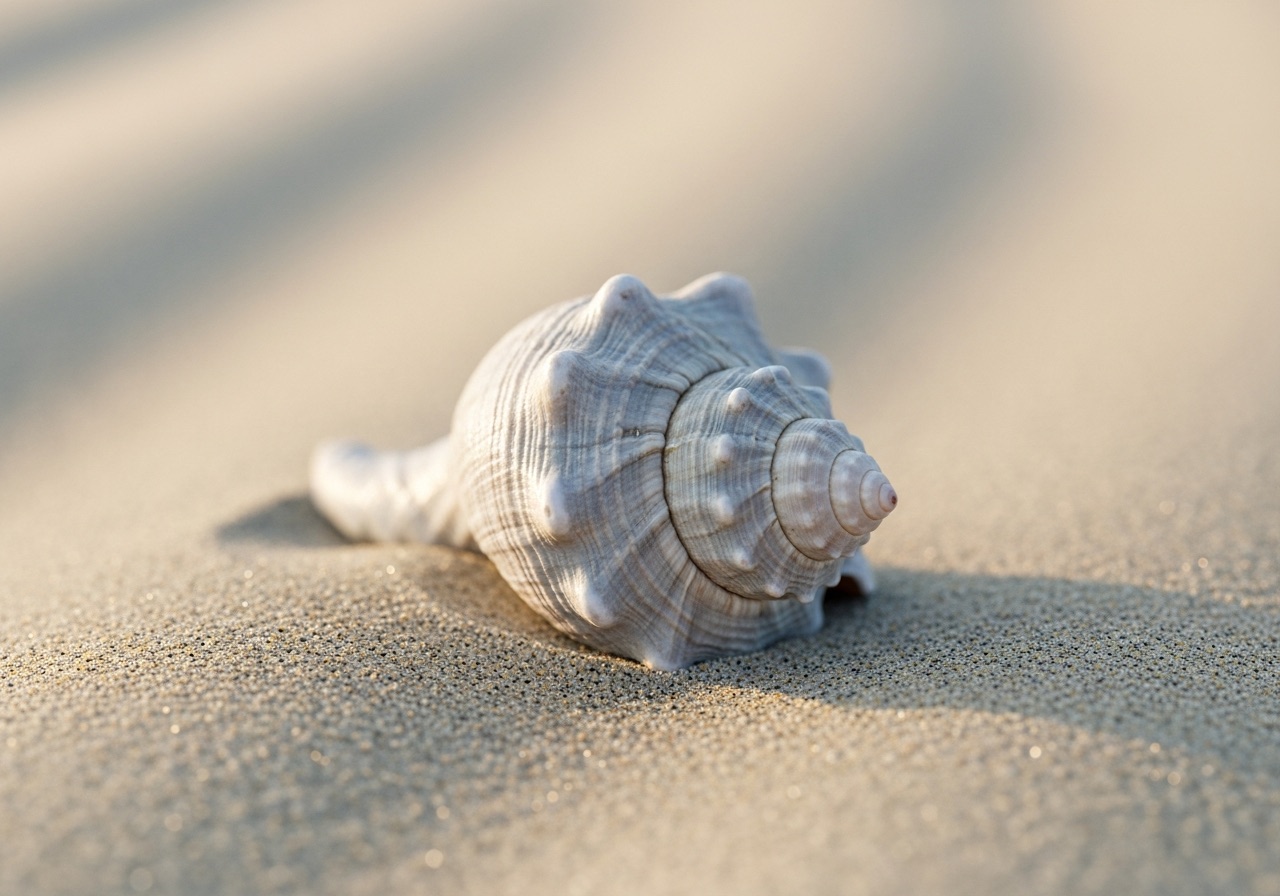
🐚 At a glance
- Scientific name
- Busycon carica
- Size
- Commonly 5–9 in
- Tell-tale
- Dextral — spire up, the opening is on the RIGHT
- Where & when
- Barrier-island flats; less common this far south; low tide after a front
- Rule
- Empty shells only — live collection is banned in Collier & Lee
How to identify a knobbed whelk
Start with the silhouette: a knobbed whelk is a stout, pear-shaped shell with a fairly tall spire and, crucially, a ring of prominent triangular knobs or short spines running along the shoulder of the body whorl. The color is a creamy gray, sometimes with a faint orange wash inside the aperture, and the surface lacks the brown “lightning” streaks you see on young lightning whelks. The knobs are taller and more defined than the lightning whelk’s lower bumps. But the knobs alone won’t settle it — for that, you flip it.
Knobbed vs. lightning whelk: the one test
This is the call every local makes without thinking. Hold the shell with the pointed spire up and the opening facing you. If the aperture opens on the right, it’s a knobbed whelk. If it opens on the left, it’s the sinistral lightning whelk. Almost every snail on Earth is right-handed, so the lightning whelk is the oddball — which makes the knobbed whelk the “normal” one. We break this matchup down further on our lightning vs. knobbed whelk comparison.
| Shell | Opens on the… | Quick tell |
|---|---|---|
| Knobbed whelk | Right (dextral) | Tall, defined knobs; no streaks |
| Lightning whelk | Left (sinistral) | Lower knobs; lightning streaks when young |
| Pear whelk | Right | Smooth, no knobs, low spire |
Where we find them
Knobbed whelks favor the sandy Gulf-facing flats of the barrier islands, though down here near Naples and Marco they turn up less often than their left-handed cousin — the lightning whelk is the dominant big whelk on these beaches. The best ones still land on the boat-only islands. On our shelling tours we run to Keewaydin Island, Kice Island and the Ten Thousand Islands, working the wrack at low tide after a winter front. Found a whole one? Make sure nothing’s living inside — Collier County is empty-shells-only.
From the Helm: Why we run Caxambas Pass, not Tigertail, to settle the whelk mix-up
When a guest wants the lightning-versus-knobbed whelk difference settled in person, we don’t default to Tigertail the way we would for a general shelling stop — we’ll run toward Caxambas Pass instead, since the deeper water and stronger current along that edge tends to turn up the less common, right-handed knobbed whelk more reliably than the barrier-island beaches everybody already knows. It’s a deliberate swap, not a default, and we’ll say so before we make the run. It’s also simply a quieter stretch of water, so a group can spread out and compare shells at their own pace instead of working shoulder to shoulder with other charters anchored off the more popular islands.
We work the shoal edge there on a falling tide rather than the open beach, since a knobbed whelk this far down the Gulf tends to sit in slightly deeper water than its lightning-whelk cousin and shows up more at the edge where sand drops toward the pass channel than up in the dry wrack. It’s a narrower stretch to search, so we usually work it slower and in a tighter group than a wide-open beach walk. The current there also runs harder than guests expect from a chart alone, so we keep everyone closer to the boat and closer together than we would on a calmer barrier-island flat.
The test we teach at the rail is always the same, hands-on: spire up, opening toward you, and we watch a guest’s face when the aperture lands on the right instead of the left they were half-expecting. Feeling the row of blunt knobs along the shoulder with your thumb first, before you even flip it, is usually enough that people stop needing the visual test at all by the end of the trip. That thumb-first habit carries over, too — guests start checking any big whelk shell by feel before they flip it, which speeds up sorting a mixed pile later on.
If Caxambas Pass is running murky — a strong outgoing tide can cloud that water fast — we shift the search to a calmer stretch nearby and treat the knobbed whelk as a bonus rather than force the issue in water nobody can actually see into. Most guests are just as happy working out the lightning-whelk side of the comparison that day and circling back to the knobbed whelk on a future trip when the water’s cooperating.
Settling this mix-up in person, shell in hand, tends to stick with people longer than any photo comparison ever does, mostly because you did the flip yourself instead of being told the answer. If you want to work through it on your own next trip, our shelling tours can build a stop around this exact comparison, and the wider seashell guide covers the rest of the whelks and conchs likely to turn up in that same stretch of water.