
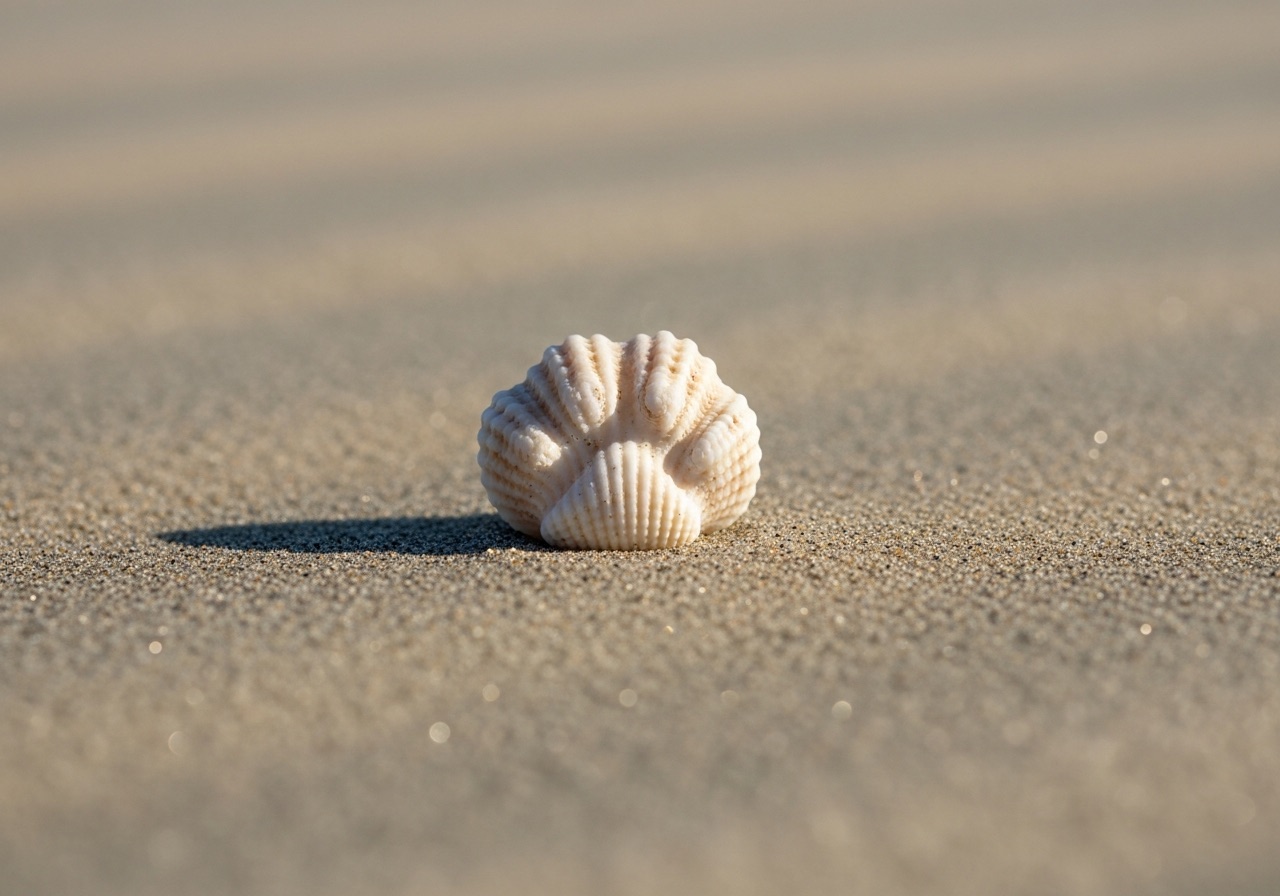
🐚 At a glance
- Scientific name
- Plicatula gibbosa
- Size
- Tiny — usually about ½ to 1 in
- Tell-tale
- Few bold ribs fanning out like a cat's paw print, often with brown streaks
- Trick
- Looks like a scallop but isn't one; often cemented to other shells
- Rule
- Empty shells only in Collier & Lee
How to identify a kitten's paw
The name does the work: a kitten's paw is a small, chunky shell with five to nine raised ribs that splay outward from the hinge, looking for all the world like the pads and toes of a tiny cat's paw pressed into clay. Most are creamy white with reddish or purplish-brown streaks running along the ribs. They're small — you could lose one under a quarter — but the texture is unmistakable once you've run a thumbnail over those ribs.
Flip it and you'll often see a rough or scarred spot where the shell was once cemented to a hard surface. That's a clue to its identity, and the thing that separates it from the free-swimming calico scallop it mimics.
Why it's a scallop look-alike, not a scallop
This is the fun part to know. Despite the ribbed, fan-shaped look, the kitten's paw belongs to a different family entirely. A true scallop, like the calico or the deep-water lion's paw, is a free-living bivalve that can clap its valves to swim. The kitten's paw spends its life cemented in place, glued to rocks, pilings or bigger shells, which is why you'll often find one still fused to a whelk or conch fragment.
| Shell | Family | Quick tell |
|---|---|---|
| Kitten's paw | Plicatulidae (cemented) | Tiny, under 1 in; scar where it was glued down |
| Calico scallop | Pectinidae (true scallop) | Thin, mottled, free valve with flat hinge ears |
| Lion's paw | Pectinidae (true scallop) | Big, heavy, knobby ribs; deep orange-red |
Where to find them
Kitten's paws are common, so they're a great beginner ID and a favorite of kids picking through the wrack line. We turn them up across the Gulf-facing beaches our captains reach by boat — Keewaydin Island, Kice Island and the outer sandbars where the tide stacks small shells into ridges. Because they're little, the trick is to slow down and look closely at the finer shell gravel rather than the big showpieces. Our shelling tours put you on those quieter stretches with time to comb. As everywhere in Collier County, it's empty shells only, so keep the empties and leave anything that's still home to a living animal.
From the Helm: Picking kitten’s paws off the oyster bars near Coon Key Pass
Guests almost always ask the same question when we hand them their first kitten’s paw: why does this feel more like a rock than a shell? That’s the tell we lean on before anything else — this one grows cemented flat against another surface, so instead of a smooth curved shape, you’re feeling the rough, ribbed imprint of whatever it was stuck to. We like handing this one over right after a bigger, obvious find, because the contrast in weight and texture is what actually teaches people that not every bivalve here looks like a scallop. It’s a small shell to build a moment around, but the look on someone’s face when a “shell” turns out to have the grain of a rock beats plenty of showier finds.
We find the best runs of them on the oyster bars tucked in near Coon Key Pass, low in the water column where oysters have built up in clusters over years — kitten’s paws cement onto that same hard structure rather than lying loose in sand, so we’re checking clusters of shell and rock, not open flat. It’s a different kind of looking than a sandy beach walk: less scanning a wide stretch, more turning over individual clumps by hand. We’ll usually turn over several clusters before finding one worth keeping, since most of what’s cemented there is still attached and alive, and those stay exactly where they are.
Because oyster bars can be sharp and the footing’s uneven, we don’t let guests wade in barefoot for this one — water shoes go on, and we usually work it from the boat or from a stable sandbar edge nearby rather than climbing directly onto the bar itself. It’s a small safety call, but it’s one we make every time, since a cut foot ends a shelling stop faster than anything else.
A fresh kitten’s paw still carries reddish-brown streaking clearly against its ribs; an older one bleaches toward plain white and the ribs themselves can wear soft at the edges. We’ll set one in a guest’s palm ribs-up so the fan pattern reads clearly, since held the wrong way it just looks like a broken chip of shell instead of the little paw print it’s named for.
This isn’t a beach where you’ll fill a bag fast, so we usually pair it with a longer stop somewhere sandier so nobody feels like the whole morning went to bending over an oyster cluster. If you’d rather build a trip specifically around smaller, easy-to-miss finds like this one, our shelling tours can slow down for exactly that, and the seashell guide has the rest of what turns up in the same water.