
🐚 At a glance
- Scientific name
- Argopecten gibbus
- Size
- Usually 1–2 in across
- Tell-tale
- Fluted fan with two ears at the hinge; mottled, never-twice-the-same colors
- Where & when
- Keewaydin & Marco wrack lines, abundant after winter fronts
- Rule
- Empty shells only in Collier & Lee
How to identify a calico scallop
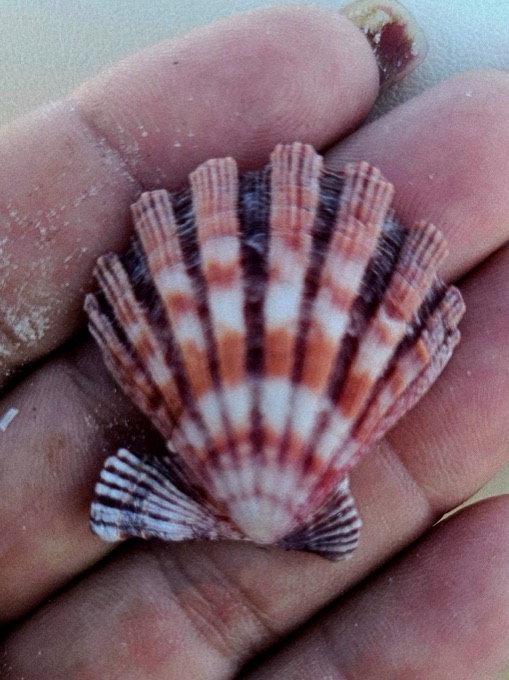
The shape is the classic scallop fan everyone pictures — the shape on the gas-station logo. Look for a rounded shell with bold raised ribs, called flutes, radiating out from a straight hinge at the top, and two small flat flaps (the “ears”) on either side of that hinge. Calico scallops are fairly deeply cupped, with a domed lower valve and a flatter upper one. They run about an inch or two across — small, sturdy and pleasingly symmetrical. Being a bivalve, you'll usually find one valve at a time, since the two halves separate after the animal dies.
Why no two are ever alike
This is the charm of the calico scallop: the coloring. Each shell is a unique splatter of white, rosy red, deep purple, chocolate, orange and yellow, mottled like a calico cat — which is exactly where the name comes from. Run a handful through your fingers and you won't find two that match. That's why they're the go-to for shell jars, mosaics and a kid's first “look what I found.” They're a true scallop (family Pectinidae), cousins to the bigger scallop group and the showy lion's paw, though those big trophies are far rarer here than the everyday calico.
| Feature | Calico scallop |
|---|---|
| Family | Pectinidae — a true scallop |
| Shape | Fluted fan with two ears at the hinge |
| Color | Mottled calico — no two alike |
| Abundance | Very common; piles up after fronts |
Where we find them
Calico scallops are abundant, and they really stack up after a winter cold front pushes fresh shells ashore. On our shelling tours they're often the first thing little hands grab on Keewaydin Island and the Marco-area beaches, and the wrack line out through the Ten Thousand Islands can be carpeted with them. Time it to low tide for the most exposed sand and the freshest fans. They clean up bright — see our how to clean seashells guide before they go in the craft jar. And keep it empty-shells-only, since Collier County prohibits taking anything alive.
From the Helm: Working the Cape Romano Shoal Edge for Calico Scallops
The shoal edge below Cape Romano is where we go looking once a few days of steady east wind have pushed water off that shallow lip, and a dropping tide drains it down even further. That edge holds a different mix than the wrack further up the islands — scallops here tend to still be loosely paired, tumbled together by the same current that's carrying them off the shoal rather than scattered as single valves. We work the boat right up to the edge and let guests step off onto firm sand rather than anchoring off and wading in.
We carry a shallow mesh colander for this stop instead of a bucket, since it lets you scoop a handful of sand right off the shoal and sift the fine grains out on the spot rather than hauling murky water back to the boat. A calico scallop tends to sit fan-side up, half-buried at a slight angle, so we tell guests to look for the ribbed edge breaking the sand line rather than the flat top, which blends in with the shell hash around it almost completely.
Every calico that comes up off this shoal looks a little different — the mottling runs from pale cream through deep purple-brown, and no amount of hunting turns up two that match, which is half the fun of filling a jar here rather than buying a matched set. A fresh one off the shoal still has a faint shine inside the cupped valve even after the animal's long gone, while an older, sun-bleached find from higher up the beach has gone chalky and flat. We keep both, but we tell guests which is which. The ones that still feel faintly damp inside the cup, rather than bone dry, are almost always the freshest of the morning's haul, and that's the detail we point out first when someone holds one up asking if it's a good one.
If the shoal edge is still submerged and the tide hasn't dropped enough, we shift the stop to the lee-side wrack a little further into Gullivan Bay, where a slower current still delivers a thinner scatter of calicos without needing the shoal itself exposed. It's a smaller haul, but it still makes for a fine consolation stop on a day when the wind and tide never quite lined up for us.
We usually pair this stop with time on the wider shelling beaches further up the chain, since the shoal sits along the same run most of our shelling tours already make out to the barrier islands. Bring a jar with a lid — loose calicos rattle around in a pocket and chip against each other faster than you'd think.