
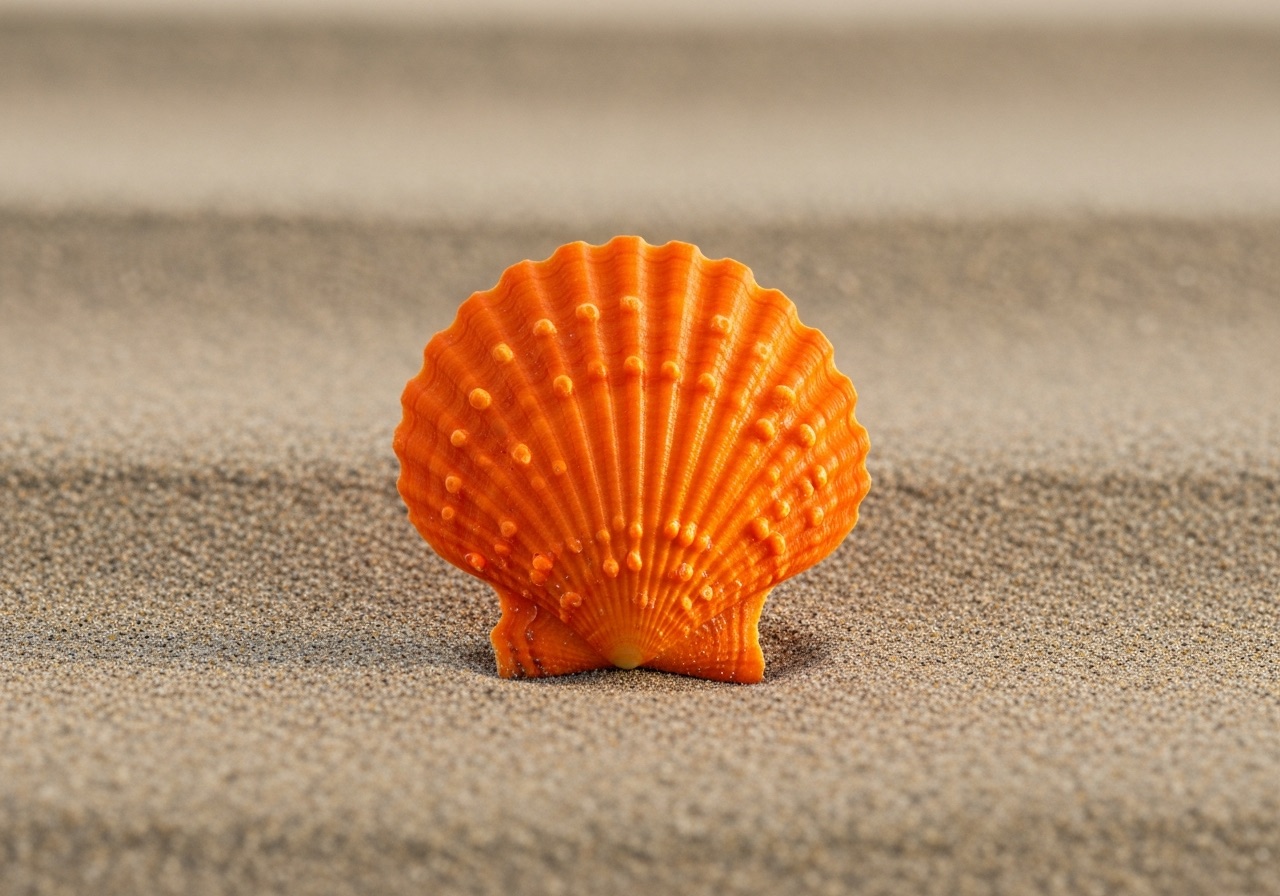
🐚 At a glance
- Scientific name
- Nodipecten nodosus
- Size
- Up to about 6 in across — big and heavy for a scallop
- Tell-tale
- Thick ribs lined with rounded knobs; deep orange-to-maroon color
- Why rare
- Lives ~30–160 ft deep; intact beach specimens are extremely rare
- Rule
- Empty shells only in Collier & Lee
How to identify a lion's paw
Hold a lion's paw and the weight tells you first — it's noticeably heavier and thicker than the thin calico scallops you'll see by the hundreds. The shape is the classic scallop fan with two flat “ears” at the hinge, but the ribs are the giveaway: a handful of bold raised ribs, each one crowned with a row of rounded knobs or nodes, like a paw with its toes spread. The color runs deep — pumpkin orange, brick red, sometimes a dark wine maroon — and the inside often keeps that warm tone.
It's a true scallop, which sets it apart from look-alikes like the kitten's paw, a much smaller ribbed shell that only mimics the family. Once you've felt a lion's paw's heft and seen those knobby ribs, nothing else on the beach reads the same.
Why a whole one is so hard to find
Here's the honest part: the lion's paw isn't a shell you stumble on during a normal walk. The animal lives offshore in fairly deep Gulf water, well below the surf zone, so the only way an empty shell reaches the sand is by being tumbled a long distance through rough water after a storm. By the time it arrives, most are chipped, worn smooth, or broken into single valves. A perfect, intact, double-valved lion's paw off a local beach is the kind of find that earns a photo and a story — right up there with the junonia for difficulty. We won't tell you otherwise, because a captain who overpromises a trophy isn't worth your trust.
Where they turn up
Your realistic odds, slim as they are, climb on the wildest, least-walked beaches right after rough weather pushes deep material in. That means the boat-only outer islands and sandbars of the Ten Thousand Islands and the open Gulf stretches near Cape Romano, not the picked-over mainland sand. Our shelling tours run to exactly those spots and time the trip to low tide after a front, when fresh shells are still arriving. Even if a whole lion's paw never shows, those same beaches hand out scallops, whelks and conchs by the bagful — and it's empty shells only, so check that nothing's living inside before it goes in your bag.
From the Helm: Combing the outer bar at Big Marco Pass after a blow for lion’s paw
Most of what we find of a lion’s paw never came from a beach walk on a calm day — it came off the outer bar at Big Marco Pass a day or two after a strong blow pushed deep-water swell up onto the shallows. That bar takes the brunt of Gulf swell before it ever reaches the pass, and a hard onshore wind is often the only force with enough energy to move a shell that normally lives well outside where anyone wades or swims.
We work that bar on foot at low tide, moving slowly through the coarse shell hash rather than scanning open sand, since a lion’s paw valve tends to sit half-buried among broken shell rather than lying out in plain view. A wide-tooth garden rake works better here than bare hands or a standard sand scoop, since it turns the hash over without shredding the softer, more delicate shells mixed in with it.
A fresh valve is heavy for its size, with ribs you can feel as distinct ridges under a thumb and knobs that haven’t worn round yet. An old one that’s tumbled for years goes smooth and thin at the edges, sometimes bored clean through with tiny holes left by other animals that moved in after the scallop was long gone. We tell guests to weigh it in one hand first — the heft alone says a lot about how long it’s been on the move.
A whole, hinged pair practically never happens for us on this stretch of coast — what we’re really hunting is one good, unbroken valve, and even that’s a stop-the-boat moment when someone spots one. We’d rather set honest expectations at the rail than let anyone walk that bar assuming a matched pair is normal; it isn’t, and treating a single valve as the win keeps the hunt fun instead of a letdown.
We only add this stop to a shelling tour when conditions actually favor it, since a calm week rarely turns up anything worth the walk. Whatever does come home is already an empty valve — the only kind Collier and Lee let us keep anyway. The rest of the Ten Thousand Islands stay the more reliable half of the trip.
When someone does turn up a good valve, we ask them to hold it rib-side toward the sun before tucking it away — the ridges throw a small shadow pattern that reads better in raw light than it ever will pulled out of a bag later. That one extra second in the light is often what tips a shell into a keepsake instead of one that gets a glance and goes straight into the bag.