
🐚 At a glance
- What it is
- The six starter families of Gulf-coast shelling
- The six
- Whelk · conch · murex · cone · olive · tulip
- Why these
- Common, distinctive shapes you’ll learn in one trip
- Where & when
- Keewaydin, Kice & the Ten Thousand Islands; low tide after a front
- Rule
- Empty shells only — live collection is banned in Collier & Lee
The six families every sheller learns first
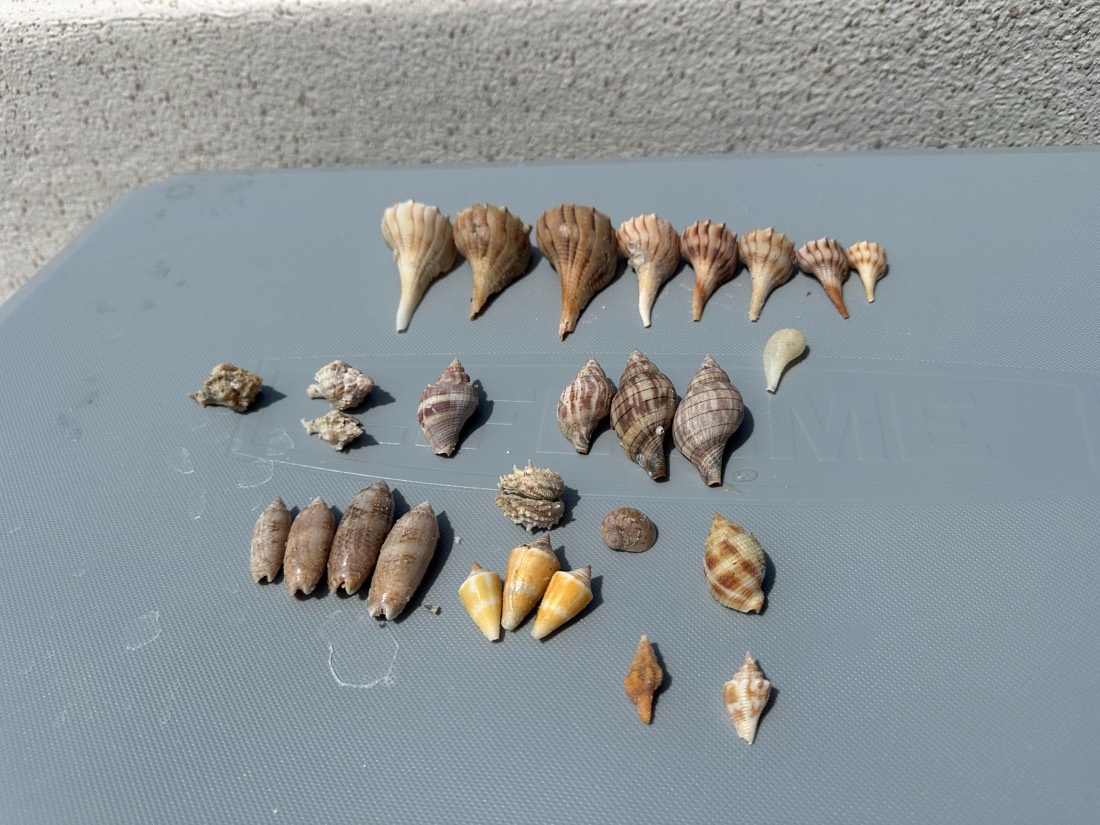
Think of the Sanibel Six as six silhouettes. Once your eye knows them, the whole beach organizes itself. Start with the whelk — big, pear-shaped, knobbed at the shoulder, and famously left-handed in the case of the lightning whelk. Next is the conch, that heavy orange-brown shell with a flared lip you’ll find more than any other down here. The murex is the spiky one, all frills and spines. The cone is a smooth ice-cream cone of a shell — see the alphabet cone with its tiny lettered markings. The olive is glossy, cylindrical and polished like a river stone. And the tulip is the elegant spindle, streaked and graceful.
| Family | Shape | Quick tell |
|---|---|---|
| Whelk | Big, pear-shaped, knobbed | Lightning whelk opens LEFT |
| Conch | Heavy, flared lip | Orange-brown; the everyday find |
| Murex | Spiny, frilly | The “armored” one |
| Cone | Smooth cone | Tiny letter-like marks |
| Olive | Glossy cylinder | Polished, like a bead |
| Tulip | Slim spindle | Streaked, graceful |
How to learn them fast
Don’t memorize species — memorize the six shapes. Once you can sort a handful of shells into “whelk, conch, murex, cone, olive, tulip,” the finer IDs come naturally. The classic move is the Sanibel stoop, that bent-over shuffle every sheller does along the wrack line. It got famous on Sanibel, but it works just as well — with far fewer people — on the quiet, boat-access islands south of there. From the six, you branch out: the whelk family leads you to the knobbed whelk and pear whelk; the tulips split into true and banded.
Where we find them
All six turn up on the Gulf-facing flats of the boat-only barrier islands, where the tide restocks the sand faster than crowds can pick it clean. On our shelling tours we run to Keewaydin Island, Kice Island and the Ten Thousand Islands, timing trips to low tide after a winter cold front when the fresh material is still arriving. Sanibel gets the headlines, but these islands have no bridge, so the shelling stays good all day. Whatever you pick up, keep only empties — Collier County is empty-shells-only.
From the Helm: sorting the six families on the incoming tide at Keewaydin’s lagoon mouth
A guest usually holds up their first find of the day and asks straight off: whelk or conch? We’ve got a fast answer we teach on the boat before anyone’s feet even hit the sand at Keewaydin’s lagoon mouth — look at the silhouette before you look at color or pattern. A tight cone shape reads differently than a long spiral, and a long spiral reads differently than a squat, heavy-lipped shell. Nail the silhouette first and the six families sort themselves out fast, which matters more here than anywhere else on the trip, since this lagoon mouth mixes all six together in one small stretch.
We like working this spot on an incoming half-tide, when the current is still actively sorting material onto the point rather than after a full high has buried everything under fresh sand. Heavier shells like whelks and conchs tend to settle closer to the channel edge where the current runs harder, while lighter olives and tulips drift into the calmer eddy just behind it. Once you know that, you’re not scanning the whole beach at random — you’re checking two specific bands of sand, which is a faster way to build a full six-family set in a single stop.
We hand out a mesh bag rather than a bucket for this one, since you’re moving fast between two zones and a bag rides better on a wrist than a bucket does in a hand. A fresh murex still has sharp, gritty spines that catch on mesh; an older, tumbled one has gone smooth and slides right through your fingers. That difference in texture alone tells you almost as much about how long a shell’s been in the surf as looking at its color does, and it’s a trick worth remembering after you leave the lagoon mouth too.
Some families simply show up more than others on any given morning — olives and tulips tend to be the easiest of the six to fill out, cones and murexes the ones that take longer. We won’t promise you’ll leave with all six in hand every trip, just that the odds are better here than almost anywhere else we run, because the lagoon mouth naturally funnels all six types through one stretch of sand instead of spreading them across miles of open beach. Whatever fills your bag stays empty-shell only, same as everywhere in Collier County.
If you’d rather chase something rarer than the standard six, look at our page on Southwest Florida’s rare shells before you book, so you know honestly what you’re getting into on the odds. Wind direction shifts which of the two bands fills in first, so we’ll point you toward the channel edge or the calmer eddy depending on what that morning’s doing, rather than sending everyone to the same few feet of sand regardless of conditions. For most first-timers, nailing all six families in one morning at the lagoon mouth is plenty satisfying on its own, and it’s a regular stop on our shelling tours whenever conditions allow.