
🐚 At a glance
- Scientific name
- Epitonium spp.
- Size
- Usually ¼–1 in — a delicate micro-find
- Tell-tale
- White shell with raised ladder-like ribs (costae)
- Where & when
- Fine shell & wrack on Keewaydin, Kice & the outer islands
- Rule
- Empty shells only in Collier & Lee
How to identify a wentletrap
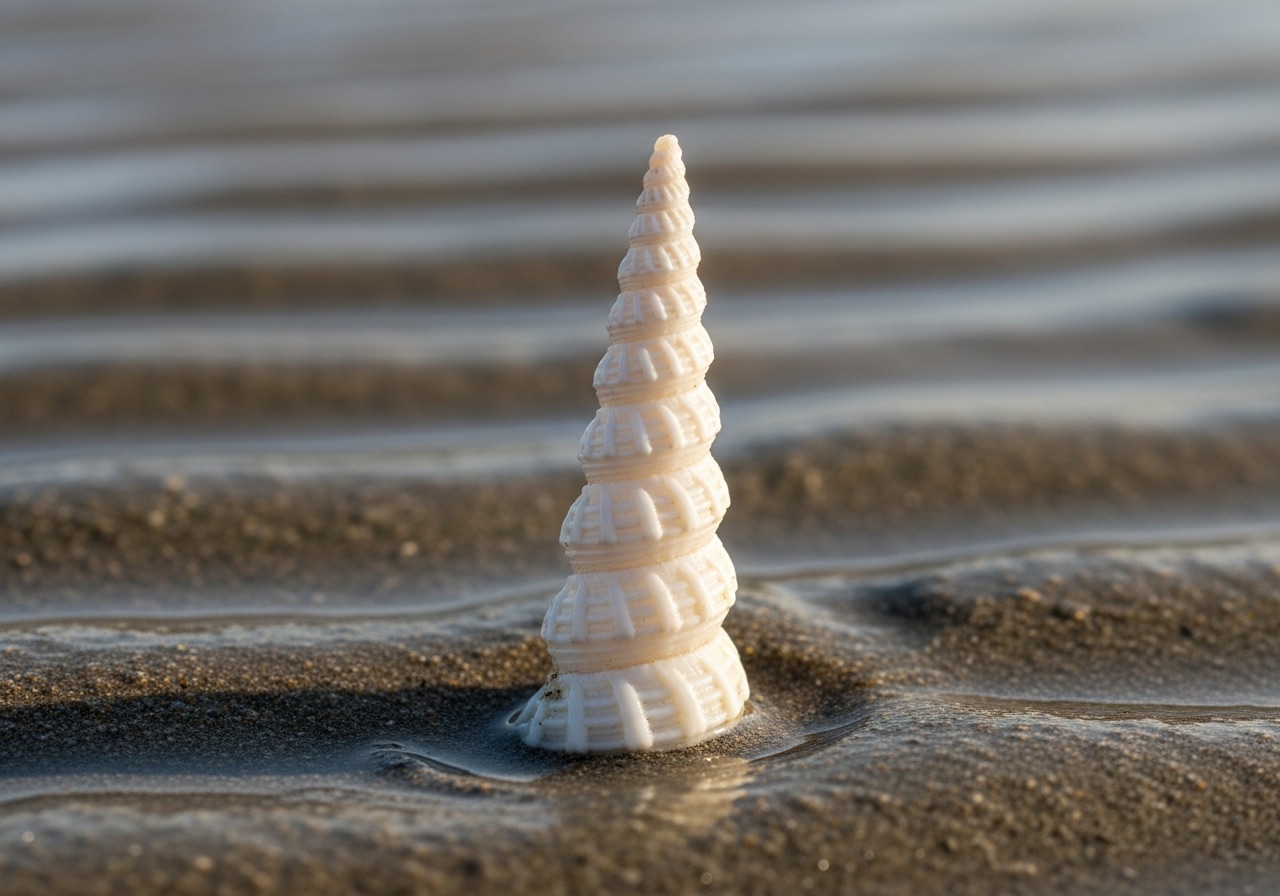
Look for a small, slender, sharply pointed spire in a clean porcelain white — the name comes from an old Dutch word for a spiral staircase, and that's exactly the impression it gives. The shell is built of rounded whorls, and the giveaway is the set of thin, raised, vertical ribs (collectors call them costae) that arch across each whorl like little ribs on a vault. The whorls are often slightly separated, so the shell looks airy and delicate, almost like spun sugar. Hold it to the light and the white can turn translucent. If “costae” and “whorl” are new words, our anatomy glossary has you covered.
The staircase tell that settles it
Here's the one move: find the ribs and follow them up the spiral. On a wentletrap those raised ribs line up whorl to whorl so the shell reads like a winding staircase — rungs climbing around a central post. No other small white Gulf shell does this. A cerith is beaded and bumpy and dull-colored; an auger is smooth; a wentletrap is bright white with those clean ladder ribs. Once you've seen the staircase, it's unmistakable.
| Shell | Color | Surface |
|---|---|---|
| Wentletrap | Porcelain white | Raised ladder ribs (costae) |
| Cerith | Dull gray/tan/brown | Beaded bumps |
| Auger | Tan, often banded | Smooth, slick |
Where we find them
Because they're small and delicate, wentletraps hide in the finer shell at the wrack line — the spots where the tide drops the lighter material. They're a patient sheller's reward, and our shelling tours run to the boat-only barrier islands like Keewaydin and out through the Ten Thousand Islands, where less foot traffic means fragile shells survive intact. Get down low, do the Sanibel stoop, and scan the white flecks — one of them will have rungs. Keep it empty-shells-only, since Collier County prohibits taking anything alive.
From the Helm: Working the wrack line for wentletraps at Panther Key’s low tide
We don’t point you at the open Gulf-front sand to hunt wentletraps — that stretch churns too hard and buries the fine stuff within a single tide cycle. Instead our captains favor the lee wrack line at Panther Key, the low ridge of broken shell the current stacks up behind the point where the water slacks off. That’s where the smallest material settles: sand dollar fragments, chips of bigger shells, and, if you’re patient, a wentletrap or two riding along in the mix. We’ll idle the boat past it first, read how thick the band looks, then decide whether it’s worth the walk that morning.
Once we’re down on it, the technique is less about walking and more about kneeling. We like to work one arm’s-length of wrack at a time, running fingers flat through the top inch rather than scooping a handful and sorting it later — wentletraps are light enough to float free of loose hash if you let the water do some of the work for you. A kitchen strainer beats any fancy sieve we’ve tried, and more than one guest has borrowed ours by the second stop. Rushing the whole stretch in twenty minutes gets you tired knees and an empty pocket.
Timing matters as much as the spot. We watch for the few days after a moderate front, once the surf has laid back down but before the next blow stirs everything up again — that’s the window when a defined wrack line actually forms instead of smearing across the whole beach. A big storm buries fine shell about as often as it exposes it, so we care less about the wildest weather and more about the calm stretch right after it, worked on a dropping tide so the band sits high and mostly dry.
A fresh wentletrap in your hand feels almost too delicate to be real — the ribs stand up sharp enough to catch a fingernail, and the shell carries a faint warmth to its white that hasn’t bleached out yet. One that’s tumbled a season or two in the surf goes chalky and soft-edged, the ribbing worn down to gentle ripples instead of blades. Guests who’ve only ever picked up beach-worn shells are usually surprised by how much texture a good one still carries — it’s the difference between a photo of fine ribbing and a shell you can still feel every ridge on.
At the rail, this is one of the finds we like to hand across rather than let a guest spot cold — turn it so the light catches the ribs, and the reaction is almost always the same double-take. It pairs well with a slower morning on one of our shelling tours, since wentletraps reward the kind of unhurried, close-to-the-ground looking a rushed stop doesn’t allow. We’d rather give you fifteen unhurried minutes on a good wrack line than fifty minutes covering three beaches at a jog.