
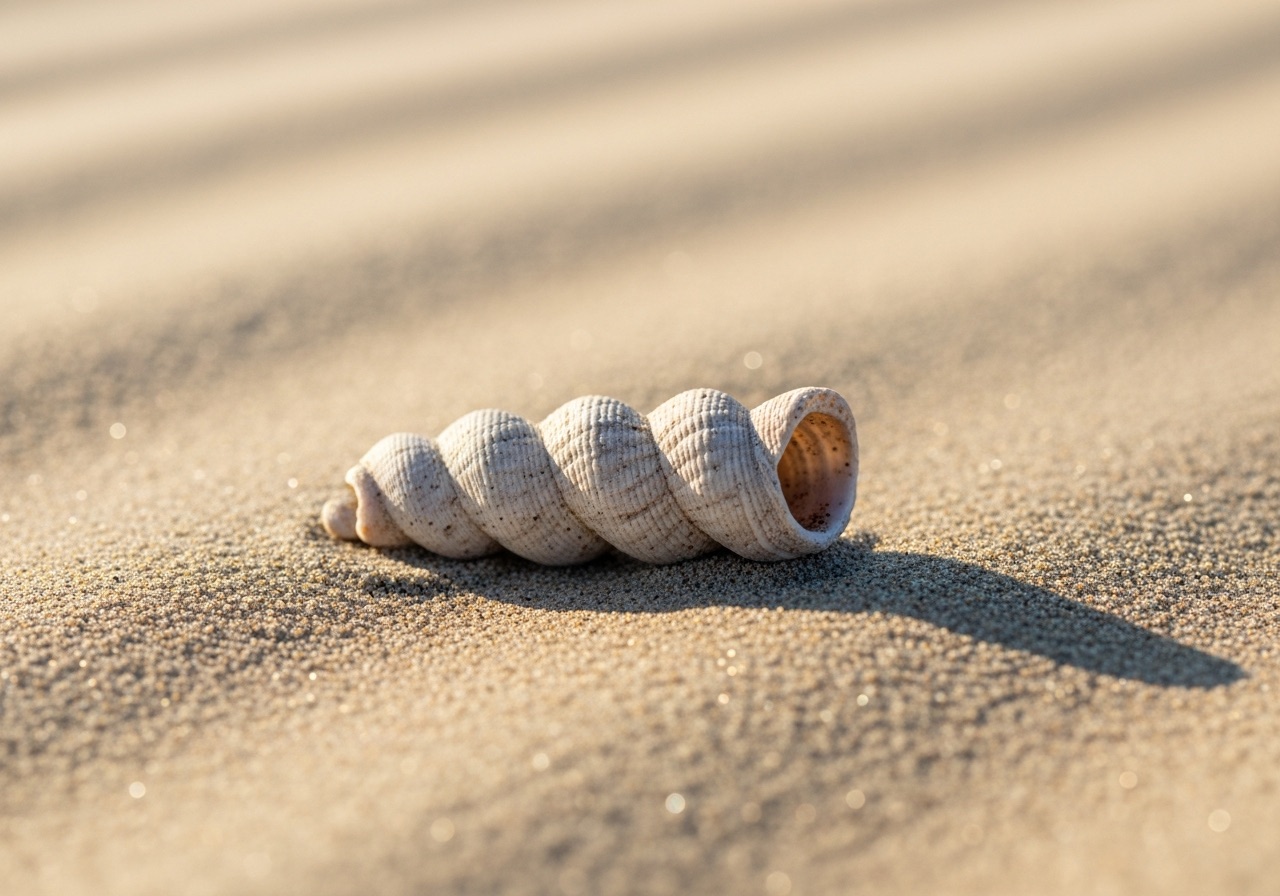
🐚 At a glance
- Scientific name
- Vermicularia spp.
- Look
- Irregular uncoiled tube; tiny tight spiral at one end
- Tell-tale
- Round hollow tube that twists every which way
- Where & when
- Tangled in shell rubble & sponge on the outer islands
- Rule
- Empty shells only in Collier & Lee
How to identify a worm snail
A worm snail breaks every rule you think a shell should follow. Instead of coiling into a tidy cone, it grows as a long, round, hollow tube that loops and bends in no particular direction, often a chalky white, gray or pinkish color. Look at the narrow end and you'll usually find a small, tightly wound spiral — the snail's baby shell — before the tube wanders off. People constantly mistake them for fossils, coral or a tube worm's casing, which is exactly what makes them a fun find. If you want to sound like a local, the round opening at the end is the aperture, the same word we use on every snail (more in our anatomy glossary).
Why it really is a snail, not a worm
Here's the cool part: despite the wormy look and the name, this is a genuine gastropod — a relative of the lightning whelk and every other snail in the Gulf. The animal inside isn't a worm at all; it just gave up on the classic spiral and grew a free-form tube, often cementing itself to rocks, sponges or other shells. That's why you'll sometimes find one fused right onto a bigger shell. Marine tube worms build similar casings, but those are made of different stuff — the worm snail's tube is true shell, calcium carbonate, the same as every other in your bag.
Where we find them
Worm snails like hard surfaces, so they turn up tangled in shell rubble, broken sponge and the gnarly stuff the tide piles at the high-water line. On our shelling tours they're a favorite “what is that” moment, and they're scattered through the wilder, less-walked beaches of Cape Romano and the Ten Thousand Islands, where boats reach and cars don't. They're a great reminder that shelling isn't only about the famous trophies — half the fun is the oddballs. Just keep it empty-shells-only: Collier County prohibits taking anything alive.
From the Helm: Turning over rubble for worm snails on the back-creek oyster bars
We steer away from the open sand for worm snails and duck the boat into the back creeks instead, because that’s not where this one shows up. Worm snails don’t lie loose in the wrack like most of what we find — they’re cemented onto something hard, usually a dead oyster cluster or the backside of an old whelk shell, in the quieter water behind a point rather than out on the open beach. Once we’ve decided the creek is the play for the day, we’re looking less at the sand and more at every clump of shell and oyster we pass.
The hunting method here is turning things over rather than walking a line. We’ll pick up a chunk of oyster rubble or an old empty whelk and rotate it slowly, checking the shaded underside where a worm snail tends to set up. Most people walk right past a good clump without a second look, since nothing about it screams shell from a few feet away. It rewards patience over ground covered — you’ll cover ten feet of oyster bar in the time it’d take to walk past fifty feet of open sand.
We time this one to the bottom half of the tide, when the oyster bars and creek edges are exposed enough to work but still damp, since a bone-dry bar hides the texture we’re after under a crust of dried salt. Wait too long into a rising tide and the whole bar disappears back under a foot of water before you’ve turned over more than a few clumps. It’s a narrower window than open-beach shelling, which is part of why we treat it as a detour rather than the main stop on the morning.
Run a finger over one and it feels gritty and cold, more like coral or a barnacle crust than anything you’d call a shell, which is exactly the reaction we’re going for. We like handing one to a guest without saying what it is first — the guess is almost never right, and the moment it clicks that the tangled little tube is a snail, not a worm or some odd growth, is worth the detour on its own.
If the oyster bars are running slow that day, or the tide’s already turned against us, we’ll shift the group toward open sand and let the whelk and conch hunt carry the rest of the morning instead — there’s always a plan-B stop close by. Either way, whatever comes off that rubble goes back empty, same as anywhere else we stop. It’s one of the smaller, stranger finds we point out on our shelling tours, mostly because it makes people look twice at stuff they’d normally step right over.