
🐚 At a glance
- Whelk
- Carnivore scavenger; narrow shell, long canal; often sinistral
- Conch
- Herbivore grazer; flared lip, stalked eyes, often dextral
- Local whelk
- Lightning whelk (left-handed)
- Local conch
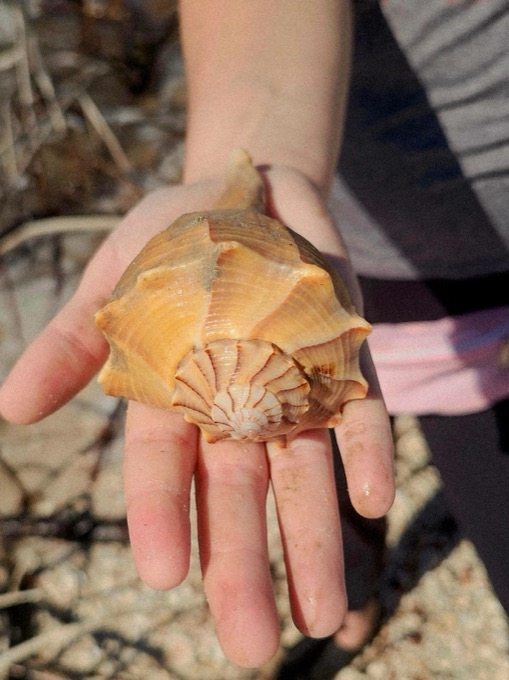
- Florida fighting conch (heavy, flared, orange-brown)
- Rule
- Empty shells only in Collier & Lee
The real difference is in how they live
Forget the shells for a second and look at the animals. A whelk is a hunter. It crawls the sand wedging open clams and scavenging dead things, which is why its shell is built long and lean with a pointed canal at the base that protects its siphon — like a snorkel for smelling out prey. A conch is a grazer. It bulldozes slowly across the flats eating algae and detritus, peering out on two long eye stalks and pole-vaulting forward on a strong, claw-tipped foot. Different jobs, different bodies, different shells. That's the whole secret, and it lines up with our deeper conch vs. whelk guide.
How to tell them apart in your hand
Flip the shell over and run this quick checklist. A whelk tends to be more slender with a tall spire and a long, narrow opening tapering to that pointed canal; if it opens on the left when you hold the spire up, it's a whelk for sure, because no true conch is left-handed (more on that in our left-handed shells guide). A conch is usually heavier and chunkier for its size, with a wide, flared, smoothed-out lip and often a notch near the front where one eye stalk pokes through. The flared lip is the single fastest tell.
| Feature | Whelk | Conch |
|---|---|---|
| Diet | Carnivore / scavenger | Herbivore grazer |
| Shell shape | Slender, long canal | Heavy, flared lip |
| Coiling | Often left-handed (sinistral) | Right-handed |
| Eyes | Short tentacles | Long, stalked eyes |
| Local example | Lightning whelk | Florida fighting conch |
Our local whelks and conchs
Out on our islands the matchup is usually lightning whelk against Florida fighting conch, and they're the perfect teaching pair. The lightning whelk is the big, pale, left-handed one with knobby shoulders; settle any whelk argument with our one-step lightning vs. knobbed test. The Florida fighting conch is smaller, denser, and a warm orange-brown with that classic flared lip — the conch you'll actually find most often. You'll turn up both on the boat-only beaches we run to on our shelling tours, and both follow the same rule: empty shells only in Collier County. Check that nobody's home before it goes in your bag.
From the Helm: Whelk on the outside bar, conch in the grass: where each turns up
Somebody hands us a shell almost every trip and asks the same thing: whelk or conch? Before we even flip it over, we’re already thinking about where it turned up, because that’s half the answer. Lightning whelks favor the open, sandier ground — the outside bar we run along Coon Key Pass, where the surf has room to work and there’s meat to hunt. Florida fighting conchs turn up in calmer water, tucked into the grass flats and oyster-bar edges we ease into on the falling side of the tide. Different neighborhoods, different shells, even before you touch either one.
Once it’s in your hand, we skip the coiling-direction debate and go straight to weight and the opening. A conch sits heavy for its size, with a wide, easy mouth you can slide a couple of fingers into. A whelk feels lighter and narrower, tapering down to a slim canal that barely fits one finger. We’ll hand you one of each side by side when we’ve got them aboard, since the difference in your palm settles it faster than any explanation ever could.
Timing the search matters as much as the spot. We look for whelks once the outside bar at Coon Key Pass has shed enough water to walk without wading knee-deep — usually the back half of the ebb — and for conchs an hour either side of dead low, when the grass flats sit shallow enough to see shell against turtle grass instead of guessing by feel. Chase both on the same ebb and you’ll usually turn up one before the other, since the bar clears before the flats do.
Juveniles complicate things a little, since young whelks haven’t grown their full taper and young conchs haven’t grown their heavy lip yet, so we’ll sometimes just say it plainly: we’re not sure without a closer look, and that’s fine. We’re not out to win every ID on the spot — half the fun of the outside bar and the grass flats is turning up something and comparing notes back at the boat. Most mornings we come home with a small pile of each, plenty for everyone aboard to hold one of both kinds.
Either way, what you pick up should already be empty — a living whelk or conch out here is doing a job in that system, and Collier waters keep it that way by rule. We check before anyone pockets one, mostly out of habit at this point. If puzzling out shells at the rail is your kind of fun, it’s worth spending real time on one of our shelling tours, or browsing the rest of the cast in our seashell guide before you come out.