
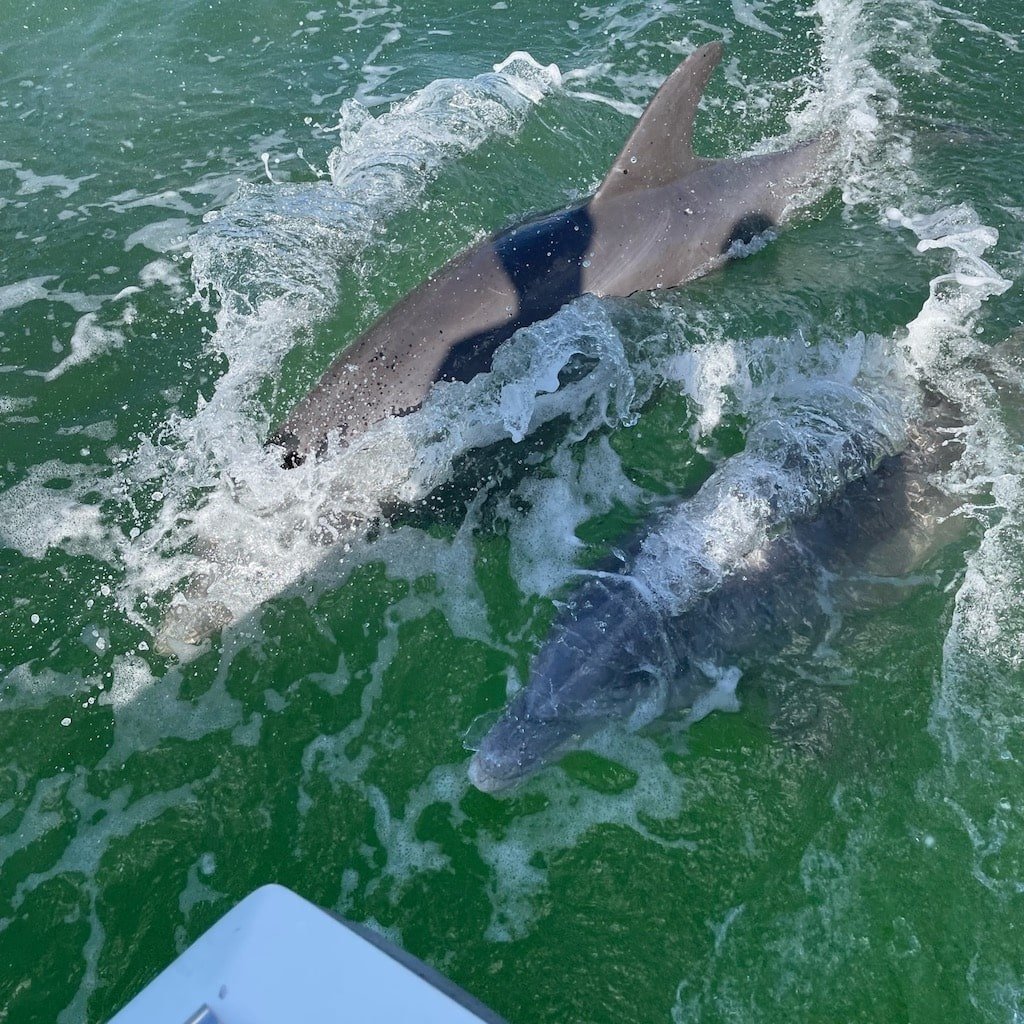
🐬 At a glance
- What to look for
- A small fin surfacing in sync, just behind and beside a larger one
- Echelon position
- Calf rides in mom's slipstream for a drag-reduced, energy-saving tow
- Where & when
- Calm passes and bays near Marco Island & Naples; calves appear year-round but often noticed in warmer months
- Etiquette
- Give extra space, never separate a pair, never chase
How to spot a calf beside mom
The giveaway is rhythm. A mother and calf surface to breathe in near-perfect unison, so you'll see a big fin and a little fin rise and roll together, again and again. The calf is a scaled-down copy — sometimes a third the length — and newborns can look slightly wrinkled, with faint pale bands down the body called fetal folds from being curled up before birth. Keep your eye on a steady pair traveling close, and you'll start to pick out the small shadow riding tight to her flank.
It helps to first know the adult by heart; our bottlenose dolphin profile covers the curved fin and gray body you're scaling down from.
The echelon slipstream: a free tow for the baby
That tight positioning isn't just cuteness — it's physics, and it's the same idea behind why adults ride our bow wave. The calf swims slightly behind and beside the mother's dorsal fin, in a spot called the echelon position. There, the water her body is already pushing creates a slipstream that literally tows the calf forward, cutting its drag so a tiny animal can keep up with a moving pod without exhausting itself. A newborn that drafts in this slipstream burns far less energy than one swimming on its own. It's one of the most elegant bits of behavior you'll see out here.
Where and when we see them
Calm, protected water is where mothers feel safe, so we notice pairs most in the sheltered bays and the slower edges of the passes around Marco Island, Naples Bay and the Ten Thousand Islands. Because bottlenose are resident year-round, calves can show up in any season, though they're often easiest to notice on glassy warm-weather mornings. As always, it's a wild sighting we never guarantee — we just go where families gather and let them come into view on our dolphin & wildlife tours.
Giving families their space
Mother-calf pairs are the one sighting where we slow down even more than usual. A calf can get separated or stressed if a boat crowds the pair or cuts between them, so we idle off, keep our distance and never maneuver to come between a mom and her baby. If they want a closer look, they'll choose it — and a relaxed mother will often bring the calf right past the boat. That patient, hands-off approach is the same give-space ethic we bring to every animal out here.
From the Helm: Giving mother-calf pairs room in the back bay off Coon Key
The moment we spot a calf tucked in beside its mother in the quiet water off Coon Key, the throttle comes back before anyone says a word. We’ve learned to make that call fast rather than wait for a guest to ask, because a mother-calf pair needs more room than a pod of adults traveling together, and closing that distance slowly, on an idle, keeps the pair calm and in view far longer than easing off only after they’ve already started to move away.
The giveaway is a second, smaller fin surfacing in perfect time with the mother’s, tucked just behind and slightly below her dorsal — not trailing loosely the way a young calf sometimes does when it’s tired, but locked into her rhythm stroke for stroke. That syncing is the calf riding her slipstream, and it’s usually the detail that gets the loudest reaction at the rail, quieter and somehow more affecting than a full breach ever is.
We hold our distance and let the pair set the pace rather than run parallel too close, and we never idle in between a mother and her calf even when the gap looks wide enough to slip through. Most mornings that patience is rewarded with a longer look, since a pair that doesn’t feel pressured tends to stay near the surface rather than diving away from the boat and the guests watching it.
We’ll usually swing wide and come up from behind and off to one side rather than straight on, easing off the throttle well before we’re close enough for the pair to notice us at all. Coming at a mother and calf head-on tends to turn a pair away fast, while a slow approach from the flank lets us settle in alongside without ever forcing a reaction, which is really the whole goal of how we handle any sighting like this.
We can’t promise a calf on any given trip — calving happens on its own schedule, and a pod without a calf that morning is just as likely as one with two. But in a season when calves are around, the back bay off Coon Key is one of the calmer stretches of water we run, which makes it easier to hold a slow, respectful distance and actually get a clean look at the echelon position instead of a quick glimpse before the pair moves on.
A calf’s fin can be easy to miss the first time, especially against chop, which is part of why we also walk guests through the wider set of dolphin moves in our dolphin behavior glossary before it comes up on the water. Whether you’re out on one of our dolphin tours or a private charter, the rule stays the same: mother and calf get the room they need, and we let them decide how close is close enough.