
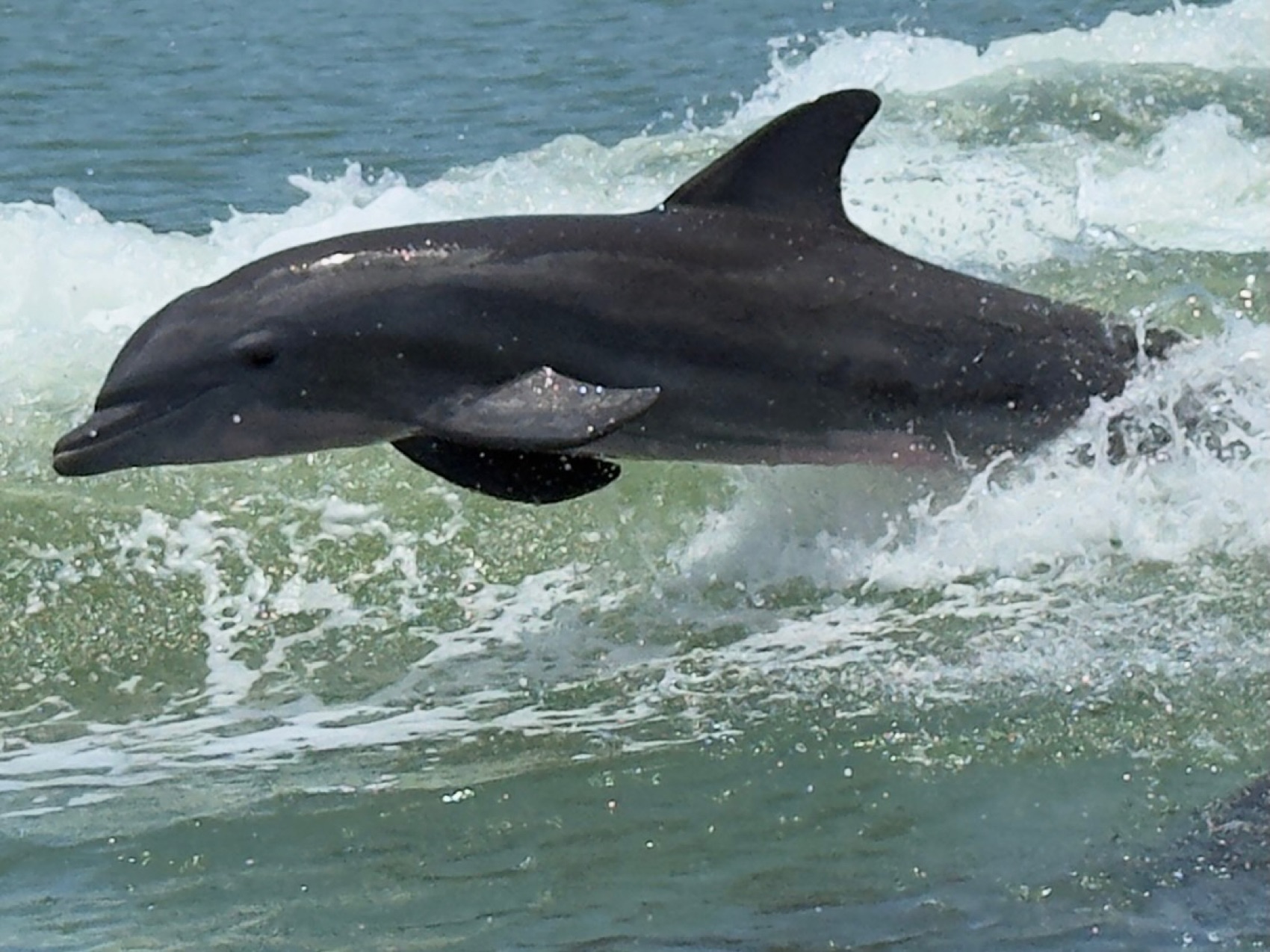
🐬 At a glance
- Local techniques
- Cooperative herding, fish-whacking, wake & oyster-bar foraging
- Secret weapon
- Echolocation — hunting by sound in murky estuary water
- Where
- Goodland, the passes & the Ten Thousand Islands
- Not local
- Strand-feeding (SC/GA) & mud-ring feeding (Florida Bay) — other regions only
- Etiquette
- Never feed wild dolphins; we keep our distance
How they hunt in our backwaters
Our estuaries are tannin-stained and tide-churned, so dolphins lean on teamwork and force. The most common thing you'll see is cooperative herding: two or more dolphins fan out and drive a school of mullet or pinfish into a tight ball, or pin it against a shoreline so it can't scatter. Then comes the chaos — bait showering out of the water and fins slashing through it. Watch closely and you may catch a fish-whack, where a dolphin flips a fish into the air or smacks it sideways with its powerful tail to stun it, then circles back to eat it at leisure.
They also work structure. Around Goodland and the oyster bars and seagrass flats, dolphins cruise the edges where fish stack up on a falling tide, and some follow boat and bait-pod wakes for an easy meal. The Ten Thousand Islands are a maze of these feeding edges.
Hunting blind: echolocation
Here's the part that always gets people: dolphins barely need to see their prey. They fire rapid clicks and read the returning echoes to map fish hiding in cloudy water, under mud, or behind oyster rubble — a built-in sonar that turns murky estuary water into no obstacle at all. It's the same sound system behind their clicks and whistles, and it's why a pod can feed efficiently in water where you'd see nothing but tea-colored swirl.
Famous feeding tricks you won't see here
You may have seen videos of dolphins doing wild specialized hunts — it's worth knowing those aren't ours. We want to be straight with you, so here's the honest breakdown.
| Technique | What it is | Seen near Naples/Marco? |
|---|---|---|
| Cooperative herding | Driving bait into a tight ball | Yes — common here |
| Fish-whacking | Stunning a fish with the tail | Yes — seen here |
| Strand-feeding | Beaching to grab fish on a mud bank | No — the Carolinas & Georgia |
| Mud-ring feeding | Stirring a ring of mud to trap fish | No — Florida Bay & the lower Atlantic coast |
Why we never feed them
One rule we hold hard: we never, ever feed wild dolphins, and we ask you not to either. Hand-fed dolphins learn to beg at boats and lose the hunting skills that keep them and their calves alive — and it's illegal. The whole point of a tour is to watch a wild hunter being wild. We hang back, kill the motor, and let a feeding pod work the tide while you watch the real thing on our dolphin & wildlife tours.
From the Helm: Working a dolphin feeding show at Big Marco Pass on a falling tide
Most mornings we’re easing off the throttle a good quarter-mile before anyone spots a dorsal fin. The tell comes first: a scatter of gulls tightening into a stack over one patch of water, working low and loud, over a dimpled, nervous ripple where the current pushes out through Big Marco Pass. That’s the signal our captains watch for on a falling tide, well before any dolphin shows itself. We’ll idle down early and let the current carry us the last stretch, because a boat that comes in hot scatters the very bait that drew the birds in the first place.
Positioning matters more than most guests expect. We come off plane well outside the activity and drift in from downwind, engine in neutral, so our wake and noise don’t push the school before the pod ever gets to work it. If the tide’s ripping through the pass, we’ll hold just off the seam where the fast water meets the slower eddy along the mangrove edge — that seam is where bait gets pinned and confused, and it’s usually where the first dorsal fin cuts in. Cutting the engine here, rather than idling in gear, keeps the whole scene calm enough to actually watch.
At the rail, this is the moment we tell guests to go quiet and watch the water instead of the horizon. You’ll usually catch the shape before the sound — a low dorsal arcing tight and fast through nervous bait, then another circling in from the opposite side. Kids especially want to lean out and point, and we’ll gently walk them back a step; the show is better witnessed still than chased along the rail. A pod working bait like this rarely stays put more than a few minutes before drifting off with the current.
If the pass goes quiet — and on a slack tide it often does — we don’t sit and wait it out. Our next move is usually toward the backwater creek mouths off Goodland, where bait stacks against the mangrove roots on the last of an outgoing tide even after the main pass has gone still. Some mornings that secondary spot outperforms the pass entirely. We’d rather burn ten extra minutes running than leave a boat full of guests staring at flat water, so the captain is constantly weighing which read is worth chasing and which has already played itself out.
None of this is guaranteed — wild dolphins feed on their own schedule, not ours, and some mornings the birds never stack up at all. But watching for the signs is most of the craft, and it’s a big part of why our dolphin tours run the passes and creek mouths instead of open water. For the fuller picture of how we handle a pod once it does show up, our notes on dolphins and boats cover how we approach once the feeding starts.