
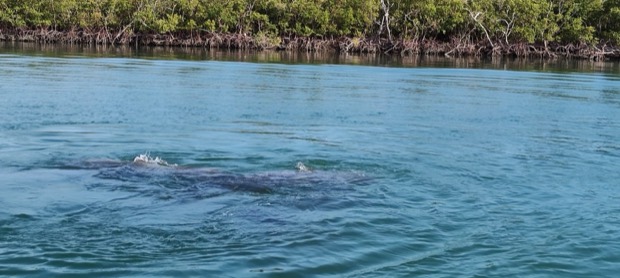
🐬 At a glance
- Species
- West Indian (Florida) manatee — Trichechus manatus
- Top threat
- Boat strikes and propeller injuries
- Golden rule
- Idle in posted zones; no touching, feeding or chasing
- When here
- Concentrate in the cool season (Nov–Mar) below ~68°F
- Where
- Warm, quiet backwaters of the Rookery Bay estuary
Obey the slow zones — always
Manatees spend their time in the same shallow, warm backwaters that boats love, and they surface slowly and unpredictably to breathe. That's why so much of our water is marked with idle-speed, slow-speed and no-wake zones, especially in the cool months. We obey every one of them, no exceptions. Slowing down gives a manatee time to move and gives us time to see it — you simply cannot spot a sea cow if you're flying past at speed. It's the same respect-the-water mindset behind our broader wildlife viewing etiquette.
Don't touch, feed, or chase
It's tempting to reach out, but don't. Touching, feeding, or giving water to manatees is harmful and, in Florida, against the law — it changes their natural behavior and can draw them toward boats and docks where they get hurt. Don't chase one for a better look or corner it against a bank, either. If a manatee chooses to surface near the boat, we cut the engine and let everyone have that quiet, jaw-dropping moment, then let the animal drift off on its own terms. Observing without interfering is the whole game.
Why propellers are the number-one threat
Look closely at almost any Florida manatee and you'll see pale scars across its back — the signature of a boat strike. Because manatees are slow, hang near the surface, and can't dive quickly out of the way, collisions and propeller cuts are the leading human-caused threat to the species. That single fact is why the slow zones exist and why we take them so seriously. Your best chance to actually see one comes in the cool season; learn the timing on our cold-season manatee guide and our wildlife-by-season calendar. When the conditions line up, a dolphin & wildlife tour through the back bays is a wonderful, low-impact way to share the water with them.
From the Helm: Cutting the engine for manatee footprints in the canals off Isles of Capri
On a cold January morning, the decision to drop the engine to idle in the canals off Isles of Capri usually happens before anyone on board has spotted anything at all — we’re watching for a flat, glassy circle on the surface, the kind of footprint a tail fluke leaves a few feet under, and that alone is enough to have us crawling. Waiting for an actual snout to break the surface before slowing down is waiting too long in water this narrow.
Once the water temperature drops into the mid-60s some winter mornings, manatees stack up in the warmer, wind-protected canals around Isles of Capri in numbers you simply won’t find out on the open bay, so that’s exactly where we point the bow on the coldest days of the season. We hold a dead-slow idle the entire way through canal water this time of year, watching both sides of the hull rather than just ahead, because a manatee can surface almost anywhere in water this shallow and this still.
Left alone, a resting manatee will often just hang a foot or two under the surface, barely moving, coming up for a slow breath every few minutes without ever seeming bothered by a quiet hull nearby. We’ve found the calmest sightings happen when we simply hold position and let the boat drift rather than maneuvering for a better angle, since any manatee that wanted distance from us would have already taken it. Watching one hover like that, unhurried, is a completely different experience than the quick surface-and-gone look you get most other places.
On a warmer stretch of days, the canals thin out fast as manatees push back toward open grass flats to feed, so we’ll shift our attention toward the seagrass beds along the edges of the bay instead, watching for the trail of stirred-up sediment a grazing manatee leaves behind. Either way, the habit is the same — find the sign the animal leaves on the surface first, and let that tell you where to put the boat, rather than searching blind.
None of this guarantees a manatee on any given trip — cold snaps help the odds in winter, but a warm stretch can scatter them across water too wide to predict. What we can promise is a quiet, patient approach every time, because a startled manatee is a manatee that won’t be there for the next boat either. If winter manatee-watching is what brought you here, our water shuttle runs pass right through these same canals, and private charters let you build a slower morning around exactly this kind of watching.