
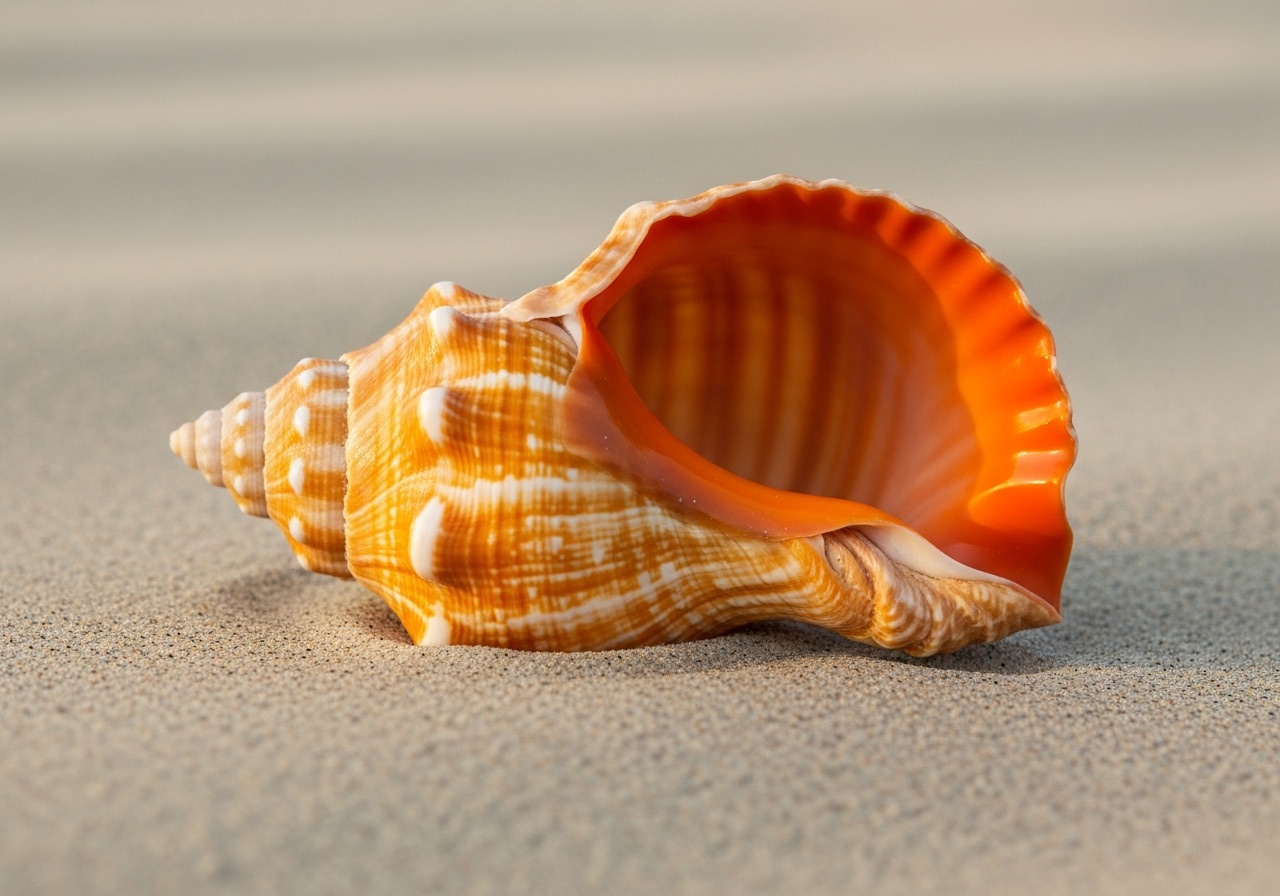
📏 At a glance
- Maximum size
- Up to about 24 in (2 ft) long
- Typical size
- Often 6–12 in on local beaches
- Claim to fame
- Largest gastropod in U.S. waters
- Range
- Southwest Florida is prime habitat
- Rule
- Empty shells only — live collection restricted locally
Just how big is a horse conch?
Record-class horse conchs reach roughly 24 inches — a full two feet of spiraled shell, easily the size of a forearm. That's not a typo. The horse conch is the largest gastropod in U.S. waters and ranks among the largest sea snails anywhere in the world. When you cradle a big one, it's heavy, dense, and absolutely commands the room — this is the shell that gets your photo in the local paper.
That said, the 24-inch giants are the exception. Most horse conchs you'll actually come across on the beach run in the 6-to-12-inch range, which is still a serious, two-hands-needed shell next to the cockles and olives around it. Even a “small” horse conch dwarfs almost everything else on the tide line.
Why they get so big here
Size comes from a long life and a lot of food, and the horse conch has both. It's a slow-growing, long-lived carnivore that hunts other snails, so a big one is essentially an old, well-fed apex predator of the tide flats. Give it warm Gulf water, rich seagrass and oyster habitat, and decades to grow, and you get a giant.
Southwest Florida delivers exactly that. The protected backwaters and shell-rich shoals around the Ten Thousand Islands and boat-only beaches like Keewaydin are prime habitat — which is why some of the most jaw-dropping specimens turn up right in our backyard, especially the empty shells that wash in after a strong winter front.
| Size class | Length | How often you'll see it |
|---|---|---|
| Juvenile | 2–5 in | Common, often bright orange |
| Typical adult | 6–12 in | The usual good find |
| Large adult | 12–18 in | A genuine trophy |
| Record class | Up to ~24 in | Rare, photo-worthy |
Finding a big one
The biggest empty horse conchs tend to show up on the wilder, boat-access islands after weather has stirred the Gulf and pushed material in. They're too heavy and too far out for casual walk-in beachgoers to scoop first, which is part of why our guests find such good ones. If you do find a live giant, leave it — it's a protected, decades-old animal, and our live-vs-empty guide helps you tell the difference at a glance. Want to hunt one yourself? Our shelling tours run straight to the islands where these giants turn up, and we'll help you measure, ID, and (if it's empty) pack your trophy to take home.
From the Helm: How big horse conchs really get on the Gullivan Bay flats
The first time a guest hauls a horse conch out of the grass and it barely fits both hands, we watch the same double-take every time — the shell looks almost too big to be real, and there’s usually a pause before anyone says a word. Our captains have learned to let that moment sit for a second before we start talking numbers, because the size means more once you’ve felt the weight of it yourself than it ever does read off a page.
We find the biggest ones working the grass flats and oyster edges around Gullivan Bay rather than the open sand beaches, because that’s where the tulip snails and smaller whelks they hunt tend to bury. A push pole and a slow drift beat an anchor and a walk out here — horse conchs sit half-covered in grass and sediment, and you spot the faint drag trail in the mud more often than the shell itself. Polarized sunglasses aren’t optional; without them, that trail disappears straight into the glare.
We favor the first push of a young flood for this hunt, once there’s just enough water crossing the Gullivan Bay grass to float the skiff without stirring the bottom into a brown-out, but not so much that the flat disappears under it. Let the tide build on toward dead high and the grass vanishes under too much water; catch the tail end of the ebb instead and you’re grinding a hull through mud better left alone. That narrow stretch of rising water is one reason we’d rather keep our own eyes on the tide chart than leave the timing to chance.
When we do bring one aboard for a closer look, we lift it by the shoulder of the shell rather than palming the aperture, because a horse conch this size can clamp its foot down with real force and guests are always a little surprised at the grip. We keep it in a few inches of bay water in a bucket rather than laid out dry on the deck, both for the animal’s comfort and because a horse conch out of water starts working its way toward the rail faster than people expect.
Guests often assume the biggest specimen must be the oldest, and that’s usually right, but size alone doesn’t guarantee it’s still alive down in there — some of the largest shells we bring alongside the boat turn out to be empty already, occupied instead by a hermit crab that traded up. Either way, our rule stays the same: anything still occupied goes back exactly where it was found, no exceptions, because a horse conch that size took years to grow that shell.
If you want to see one up close without wading a flat yourself, it’s exactly this kind of find that makes a shelling tour worth the ride past the closer beaches. We go deeper on whether you’d actually want to eat one in our notes on the horse conch’s table manners — short version, no.