📖 At a glance
- Edible?
- Not a food species — it's a predatory snail, not the fritter conch
- Dangerous?
- No venom, not aggressive to people; dangerous only to other snails
- Diet
- Carnivore — hunts and eats other sea snails
- Status
- Florida's official state shell (Triplofusus giganteus)
- Rule
- Empty shells only — taking live horse conchs is restricted locally
Is the horse conch edible?
This is the big mix-up. The famous, delicious “conch” you've eaten as fritters or in a salad is the queen conch, a plant-grazing tropical snail. The horse conch is a completely different animal — a large carnivorous whelk-relative that hunts other mollusks. It isn't harvested or sold as food, and there's no local food tradition around eating it. So while it shares the word “conch,” it has nothing to do with what's on the menu at a waterfront restaurant. Short version: it's not dinner.
Beyond that, taking a live horse conch in Collier and Lee County is restricted — this is the heart of empty-shells-only country — so the question is moot on our beaches anyway. You enjoy this one by finding its big empty shell, not by harvesting it.
Is the horse conch dangerous?
To you? No. The horse conch has no venom and no interest in people — it can't sting, bite, or chase you. If you find a live one in the shallows, it's just a slow snail with a startling bright-orange foot doing snail things. The only creatures that need to fear it are other snails. It's an ambush predator that engulfs prey like tulips, whelks, and even other horse conchs. So “dangerous” is accurate — just not to you. Watching one hunt in a tide pool is one of the coolest things you can witness on a shelling beach.
One practical note: a live horse conch is heavy, very much alive, and protected here. Don't pick it up to take it. A quick look and a photo is the move.
| Question | Horse conch | Queen conch (the food one) |
|---|---|---|
| Eaten? | No | Yes (fritters, salad) |
| Diet | Carnivore — eats snails | Herbivore — grazes algae |
| Danger to people | None | None |
| Take it live? | Restricted locally | Protected, do not take |
How to enjoy a horse conch the right way
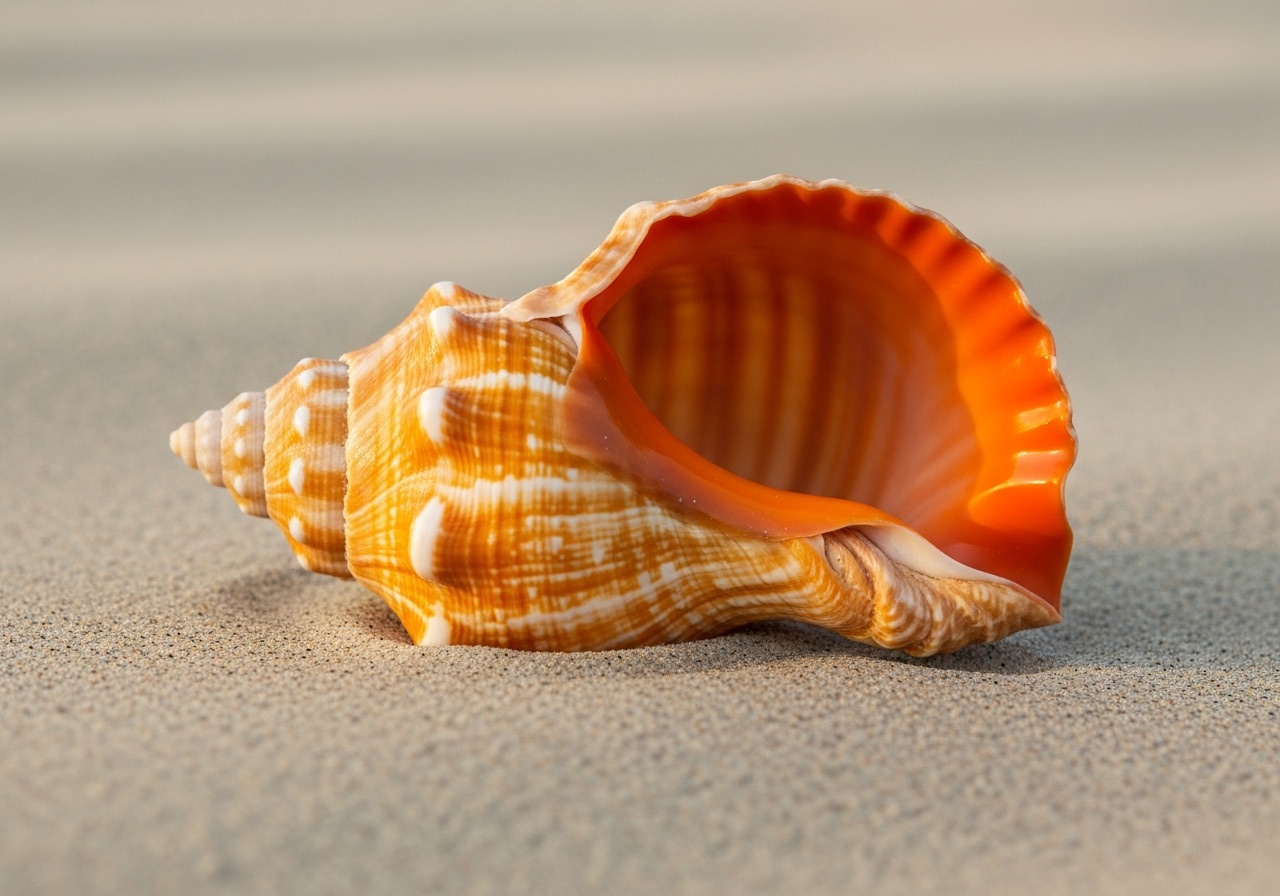
The whole reward of the horse conch is the shell itself — Florida's official state shell, and a real showstopper. After a good winter front, big empty horse conch shells can wash up along the boat-only islands like Keewaydin and Kice, and an empty one is yours to keep. If you ever wonder whether the one you found is fair game, our live-shell-vs-empty guide walks you through the quick checks. And if you want to actually find one, that's our favorite kind of day — our shelling tours run to the islands where these giants turn up, and we'll help you tell a keeper from a live one every time.
From the Helm: The horse conch egg case guests find on the Dismal Key wrack line
Somewhere along the wrack line of a back-bay island like Dismal Key, a guest usually finds a horse conch egg case before they ever find the shell itself — a stack of yellowish, paper-thin discs that looks more like a strange plant than anything laid by a sea snail. It’s one of the more common questions at the rail, and it always surprises people that this odd little tower is exactly the same animal we just spent twenty minutes discussing eating, or not eating.
We usually let guests handle it before explaining what it is, because the guessing game is half the fun — sponge, coral, and even a shark egg are common first guesses. Once we get to horse conch, the follow-up question is almost always the same: does that mean there’s a nursery of baby conchs nearby? Sometimes yes, though we’re careful never to promise it, since plenty of egg cases wash in loose on current from somewhere else entirely.
The mistake we correct most often is guests assuming that because horse conch sits in the same family as the conch served at a raw bar, it must be fair game to bring one home for the pot. We stop that conversation quickly — a live horse conch found in Collier or Lee County stays exactly where it is, egg case, snail and all, since collecting here is limited to empty shells only. It’s an easy rule to remember once you’ve seen how slowly one of these animals actually grows.
Look closely at a live one before we set it back and you’ll spot a hard, claw-shaped trapdoor sealing the opening when it pulls in — guests often mistake that piece for a broken chip of shell until we point out it’s part of the animal itself, its own built-in armor. It’s a small detail, but it’s usually the moment a guest stops seeing a shell and starts seeing a living animal.
Handling one at the rail before we set it back tells you more than any description does — the foot is a deep orange-red, almost the color of the shell itself, and it moves with surprising speed once it’s back in the water. That contrast between the fierce color and the slow, patient way it hunts is usually what sticks with people longer than any fact we could give them.
If the sheer scale of these animals is what’s got your attention, we go deeper on exactly how big they get in our notes on the state shell’s true size. Either way, empty shells make the best souvenirs, and our shell guide can help sort out what else is worth bringing home.