
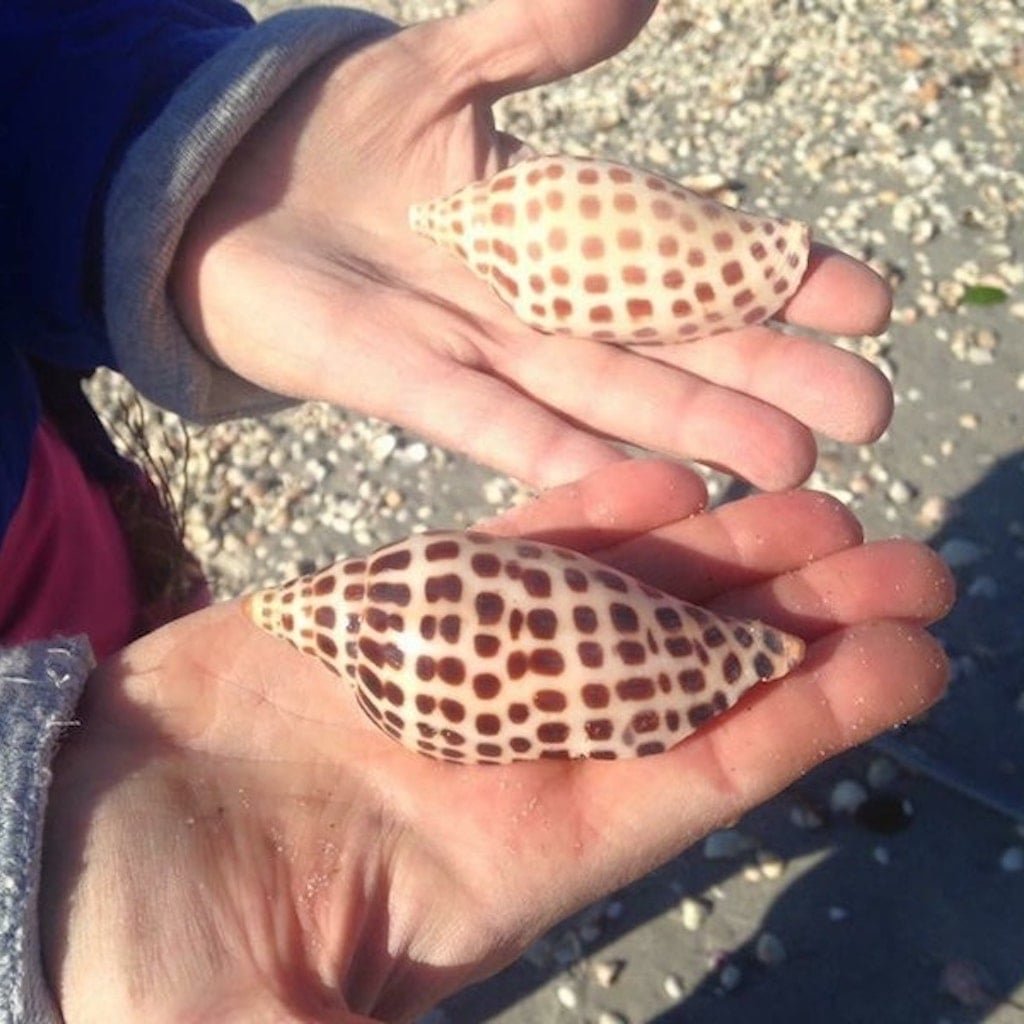
📖 At a glance
- Snail tell
- An operculum (trapdoor) sealing the opening = alive
- Bivalve tell
- Clamped shut, heavy, or slightly gaping then closing = alive
- Sure sign
- Visible soft animal or any movement
- If alive
- Set it gently back where you found it
- Rule
- Live collection banned in Collier & Lee — empties only
Check the opening first
For any spiral snail shell — a whelk, conch, olive or moon snail — the fastest test is to look right into the aperture. If a hard or leathery disc is sealing the opening like a little trapdoor, that's the operculum, and the animal is alive and tucked inside. Many live snails also feel surprisingly heavy and may have the foot or tissue peeking out. Hold it still for a moment; a live fighting conch or crown conch will often shift or extend its foot, settling the question for you. An empty shell, by contrast, is light, dry inside, and open all the way down.
How to tell with clams and scallops
Two-shelled animals — bivalves — play it differently. A live scallop, coquina, cockle or clam keeps its two halves clamped tight, and the whole thing feels dense and waterlogged because the animal is in there. Coquina are the classic giveaway: scoop a handful of wet sand at the surf line and you'll watch the little colorful clams flip and burrow right back down — very much alive. A truly empty bivalve is usually a single loose half, hinge often broken, light and dry. When in doubt, if it's snapped shut and won't open, leave it.
Leave live, take empties
This isn't just etiquette, it's the law where we shell. In Collier and Lee Counties it's illegal to collect live shells, and the same goes for live sand dollars and starfish. So the rule our captains repeat on every shelling tour is simple: if anything's living in it, gently return it to the water, ideally right where you found it. A live sand dollar is brown or purplish and fuzzy with tiny moving spines; a dead, collectible one is bleached bone-white and smooth. Knowing the difference keeps you legal and keeps the islands thriving.
| Find | Alive looks like | Empty looks like |
|---|---|---|
| Snail (whelk, conch) | Operculum sealing opening; heavy; foot may show | Light, dry inside, fully open |
| Bivalve (scallop, clam) | Both halves clamped; dense and wet | Single loose half, light and dry |
| Sand dollar | Brown/purple, fuzzy, spines move | Bleached white and smooth |
| Starfish | Soft, flexible, tube feet move | Hard, dried, brittle (still must be left in Collier/Lee) |
Why it matters out here
The reason the boat-only islands like Keewaydin and Kice stay so loaded with shells is that the living animals keep making more. Every live snail you set back is a future shell in someone's bucket. Take only the empties and you get the prize without the smell, you stay on the right side of the law, and the wrack line stays full for the next family that climbs off our boat.
From the Helm: The sorting tray we run at the shoal edge off Cape Romano
At the shoal edge off Cape Romano, where the sandbar exposes fast on a dead-low tide, we keep a shallow tray divided down the middle at the stern rail — empties on one side, "not sure yet" on the other. Nothing goes straight from the sand into a bag. That middle step catches the shells that look fine cupped in a fist but tell a different story once they're sitting still in good light for one more second, out of the glare bouncing off the wet sand.
The mistake we correct most out here isn't whelks or clams, it's the keyhole urchin. A bleached-white one, flat and dry, is an old test long since washed clean, and that's a keeper. A live one is fuzzy, brownish-purple, and noticeably heavier for its size, with tiny spines you can feel shift under a light touch. Guests hand us plenty of the second kind convinced they've found "a weird flat one," and we walk it straight back to the shallows together.
A second mistake shows up just as often: a shell that's genuinely empty of its original owner but has a hermit crab living in it now. New tenant, same rule. If anything backs deeper into the shell when you tip it toward the light, or a claw so much as twitches near the opening, that one goes back on the sand exactly where it was picked up, not into the tray at all — a hermit crab without a spare shell nearby won't last long against a hungry gull.
We also carry a soft rinse bottle at the rail rather than dunking everything straight into the live well, because a shell that's genuinely borderline doesn't need a bath, it needs thirty more seconds of attention. Tip it, check the weight against an empty one of the same size sitting in your other hand, and let that comparison — empty against maybe — do the teaching a description never could.
When a stiff onshore chop starts pushing over that shoal edge and the tray work gets hard to do standing up, we'll move the whole routine to the sheltered back-creek water off Panther Key instead, a short run away. Same tray, same middle step, just flatter water underfoot so nobody's trying to balance a borderline shell in one hand while a wave rocks the deck under the other, and the light stays easier to judge a shell by, too.
Our legal-collecting guide covers the county rules behind this habit in full, but the tray system itself is really just muscle memory built over enough shelling tours to trust our own hands over a quick glance every single time.