
☀️ At a glance
- Morning
- Low-tide shelling run to the Cape Romano shoals
- Midday
- Lunch in Goodland, the island's old fishing village
- Evening
- Sunset cruise departing San Marco Marina
- Best months
- Nov–Apr for cooler air; year-round for sunsets
- Rule
- Empty shells only — live collection is banned in Collier
Morning: a low-tide shelling run to Cape Romano
Start before the heat does. The best shelling happens on a falling or low tide, so we time the morning run to whenever the Gulf pulls back and uncovers the bars. From Marco it's a short, pretty ride south to the Cape Romano shoals — a maze of sandy flats that the tide restocks faster than anyone can pick clean. You'll step out onto sand nobody has touched since the last high water, and that's where the keepers hide: lightning whelks, fighting conchs, sometimes a fat horse conch half-buried at the wrack line. Our shelling tours put you right on those beds. You'll also drift past the famous Cape Romano dome houses — the half-submerged ruins of a futuristic home that Hurricane Ian toppled in 2022, now standing in the surf like something out of a movie. Just remember: in Collier County it's empty shells only, so flip everything over and make sure nothing's living inside.
Midday: lunch and shade in Goodland
By late morning the sun is high and your cooler is full of shells, so point the boat toward Goodland — the tiny, wonderfully unpolished fishing village tucked on the back side of the island. This is where you slow down. Grab grouper or stone crab at a waterfront dock, let the kids watch the pelicans work the pilings, and take the hottest part of the day off the open water entirely. If you'd rather make a whole afternoon of it, our guide to things to do in Goodland covers the spots locals actually go. From here you can also peek into the Ten Thousand Islands, which begin just past the village docks.
Evening: a sunset cruise from San Marco Marina
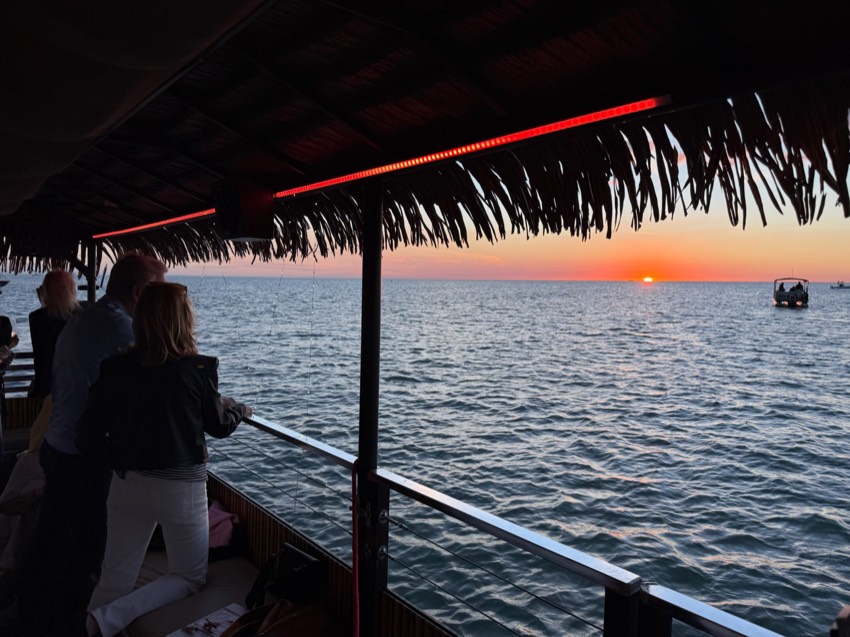
Save the best for last. As the afternoon cools, head back to San Marco Marina and trade the shelling boat for a sunset run. There's a reason this is the one thing nearly every guest books twice: the Gulf opens up flat and gold, dolphins tend to feed in the cooler evening light, and the sky over the western islands goes through every color it owns. Our Marco Island sunset cruises aim to have you in open water at the magic hour, and a dolphin sighting on the way out is more the rule than the exception. Want it for two, with no strangers aboard? A private charter lets you write the whole day yourself.
| Time | What you're doing | Where |
|---|---|---|
| Morning | Low-tide shelling run | Cape Romano shoals |
| Midday | Lunch & shade | Goodland village |
| Late afternoon | Reset, swap boats | San Marco Marina |
| Evening | Sunset cruise + dolphins | Gulf off Marco |
From the Helm: swapping Cape Romano for Kice when the wind turns onshore
Most mornings we point the bow straight for the Cape Romano shoals while the tide’s still low and the light is barely up, because that’s the water our captains trust first for a Marco Island day. But a shoal that fishes beautifully in a light easterly turns rough and stirred-up the moment the wind clocks onshore out of the southwest, and that’s a call we make before anyone’s even finished their coffee — shoals, or Kice instead, and we’d rather make that call at the dock than out on the water with a family already aboard.
Kice sits far enough south and tucked enough that it holds a clean lee even when Cape Romano is churned up, though it costs a slightly longer run to get there. We’d rather add fifteen minutes to the ride than land a family on a beach with an ugly shorebreak and call it a morning. The trade-off is real, but the shell hunting rarely suffers for the swap — you’re just working a different stretch of sand than you planned on, with the same fresh wrack line to work through at the tide’s edge.
Getting to either spot means threading past Coon Key Pass, where the current runs harder than the open water around it would suggest, especially on an outgoing tide. We slow down there on principle, not because the channel is poorly marked, but because a boat wake through that pinch point at speed puts an unnecessary rock into an otherwise calm morning for everyone aboard, including whoever’s trying to pour coffee at the console.
We front-load the shelling for a reason: it’s the part of the day that rewards fresh legs and patient eyes, and both fade fast once the sun climbs and the heat sets in. Save it for after lunch and you’re rushing people off a beach they just started to enjoy. Put it first instead, and Goodland’s shade and a slower afternoon feel earned rather than like a consolation prize tacked onto a day that already peaked. Even the lunch stop gets picked with that fatigue in mind — shaded tables, no rush, nothing that asks much of anyone.
If it were our own family’s day, we’d build that flexibility in from the start rather than treat the shoals as the only option, and we’d tell the kids the beach might be a surprise before they ever step off the dock. Check the wind before you lock a date, and know our shelling tours run that same wind-based call every single morning we’re on the water, whichever island it ends up landing on.
🧭 Captain’s call
- Primary spot
- Cape Romano shoals on a light easterly, low tide
- Backup spot
- Kice Island when wind swings onshore from the southwest
- Slow zone
- Coon Key Pass — hard current, wake down on approach