
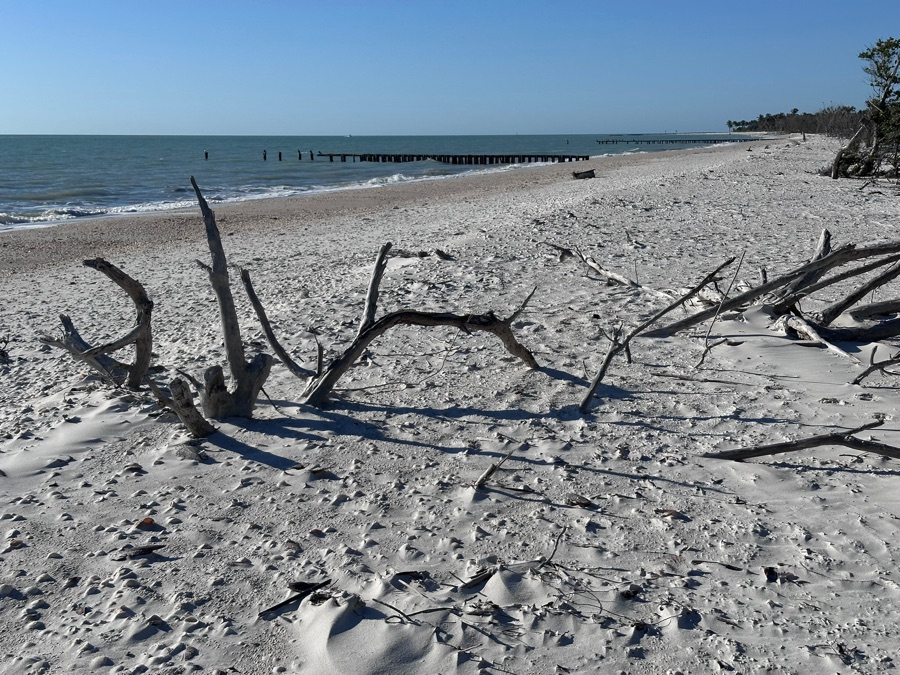
🏝️ At a glance
- Quietest of all
- Kice Island & Cape Romano (boat-only, no roads)
- Why they win
- No foot traffic + tide restocks the sand every cycle
- Best timing
- Low tide, early morning, day or two after a winter cold front
- Busy & picked-over
- Tigertail main beach, Vanderbilt, Naples Pier by mid-morning
- Rule
- Empty shells only in Collier & Lee Counties
Why quiet beaches out-shell the busy ones
Shelling is a footrace you can't win on a popular beach. A drive-up beach with a big parking lot gets walked end-to-end before your coffee's cold, so the good shells are in someone else's bag before you arrive. A boat-only spit is the opposite: the same tide that drops fresh shells overnight has nobody competing to grab them. That's the whole game. The math is simple — fewer feet on the sand means more shells per square yard for you.
It's also about the shape of the coast. The wild Gulf-facing flats of the Ten Thousand Islands and the points of Cape Romano act like catcher's mitts for shells riding the current, and because there are no roads to them, the only way in is by boat. That barrier — literally no parking lot — is what keeps them stocked. For the full breakdown of which spots you can drive to and which you can't, see our drive-up vs. boat-only guide.
The quiet beaches, ranked honestly
We rank these by how few people you'll share the sand with, not by hype. The top three you cannot reach by car — which is exactly why they stay good.
| Beach | Access | How quiet | What washes up |
|---|---|---|---|
| Kice Island | Boat only | Often nobody | Whelks, conchs, olives, sand dollars |
| Cape Romano | Boat only | Very quiet | Big whelks, fighting conchs, augers |
| North-end Keewaydin | Boat only | Quiet (busier mid-island) | Olives, whelks, scallops, coquina |
| Sand Dollar Island spit | Wade at low tide | Moderate | Keyhole sand dollars, jingles, scallops |
| Tigertail main beach | Drive-up | Busy by 9 a.m. | Picked-over but restocks at low tide |
The flagship is Kice Island — an uninhabited barrier island just south of Marco where you can walk a half-mile of Gulf beach and not see another soul. Cape Romano is a close second, famous now for its half-submerged dome-house ruins toppled by Hurricane Ian, with shoals that pile shells along the point. Both ride at the top of our best boat-access shelling list for a reason.
The honestly-busy ones (and how to beat them)
We're not going to pretend the easy beaches are empty. Tigertail, Vanderbilt and the Naples Pier stretch are lovely, but they're picked clean by mid-morning. If those are your only option, the trick is timing: arrive for the low tide, beat the parking-lot crowd by an hour, and walk past where everyone clusters. Even then, you're working a beach that a hundred people walked yesterday. The honest upgrade is to put a boat between you and the crowd — that's what our shelling tours are built around, running to the islands the tide just refilled. And wherever you go, keep it empty-only: Collier County is strict about live shells.
From the Helm: the wind call that decides which quiet bar we run from Capri Pass
Somewhere around the second stop of a morning, a guest usually leans over the rail and asks how we picked this exact bar out of a hundred that look almost the same from the water. The honest answer is wind, decided before we ever cleared Capri Pass. A light easterly keeps most of the outside water calm enough to work comfortably; anything with real push out of the west sends us hunting for a bar tucked in the lee of an island instead. That single read decides almost everything else about the morning.
Capri Pass is where we make that call, because the current running through it tells us how the whole system is behaving that day. A hard outgoing flow usually means the outside bars are firing and worth the longer run; a sluggish, wind-stalled tide has us leaning toward sheltered back-bay water instead. Anything blowing much past ten to twelve knots out of the west or northwest is our line for skipping the exposed bars entirely — not because the shelling turns bad, but because nobody wants to stand bent over wet sand in a stiff chop.
The choice usually comes down to two very different kinds of quiet. An outside bar sits exposed to open Gulf swell, gets scoured hard by every tide, and tends to hand up bigger, heavier drift — the kind of shell that’s been tumbled clean of grit. A tucked bay-side flat behind an island stays calmer and finer-grained underfoot, but the finds run smaller since less water moves across it each cycle. On a rough-water day we’ll trade size for comfort every time and run the sheltered flat instead.
If the wind builds faster than the forecast promised, which happens more than people expect on a Gulf afternoon, we’ll swap plans mid-trip rather than fight it — easing off an exposed bar and idling the last stretch into a bay flat on the trolling motor so we don’t spook the shallows or ground the hull. That’s usually when we hand out mesh bags instead of hard buckets, since wet sand sifts straight back through and nobody’s hauling extra weight off the boat. Most guests stay at the rail for that approach, watching the water color change before we cut the engine.
An untouched bar looks different from the water before anyone even steps off it — the wrack line sits raised and unbroken, packed tight instead of churned soft by footprints, and it glints with fresh shell instead of the dull, sun-bleached kind. That’s the tell we look for from the helm while we’re still idling in, and it’s usually the last piece confirming we picked the right spot for the day. Only the empty shells go in the bag once you’re down there, same rule as everywhere else in Collier and Lee.
If having a stretch of sand to yourselves matters more than checking a famous name off a list, this is the trip built around exactly that trade-off. We can build a whole morning around it on a private charter, picking the day’s quiet bar to match your group and the wind, or fold that same read into a standard Ten Thousand Islands run where we’re already making the call for everyone aboard.