
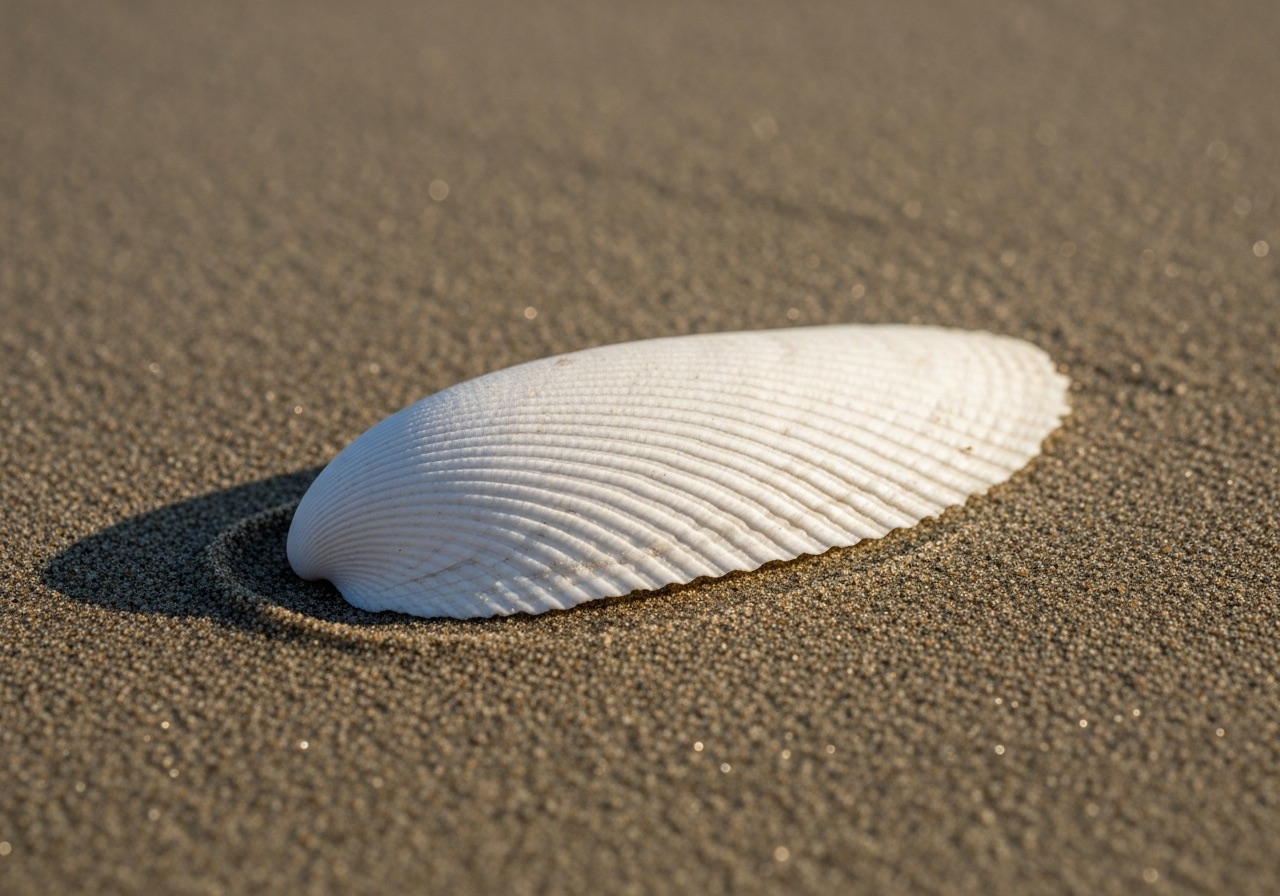
🐚 At a glance
- Scientific name
- Cyrtopleura costata
- Color
- Pure chalky white
- Shape
- Long, wing-like, ribbed and sculptured
- Tell-tale
- Very thin & fragile; weak hinge, deep-mud burrower
- Where & when
- Muddy bays & flats; whole ones after calm weather
How to identify an angel wing
The color and sculpture give it away: a clean, chalky white shell, elongated and gently curved, covered in rows of radiating ribs crossed by fine ridges that give it a delicate, feathered texture. Held alone, a single valve really does look like one folded wing. The shell is thin and light, almost brittle, and a fresh one may carry a thin grayish skin that wears off to leave the bright white beneath.
People sometimes confuse it with the smaller, sturdier false angel wing. The real angel wing is larger, more delicate and more elegantly sculpted — once you've handled both, the difference is obvious.
Why whole pairs are rare
Angel wings live an oddly hidden life. The clam burrows deep into soft mud and sand, sometimes a foot or more down, and the two valves are joined by a weak, easily-broken hinge. When the animal dies and the surf goes to work, that fragile hinge usually snaps, so the shells wash ashore as singles, and even those chip easily. That's exactly why a complete, unbroken angel wing — and a still-joined pair especially — is one of the more cherished finds on the Gulf coast.
| Feature | Angel wing | False angel wing |
|---|---|---|
| Size | Larger, often 4–7 in | Smaller, ~2 in |
| Build | Thin, fragile | Sturdier, more compact |
| Sculpture | Delicate, finely ribbed | Coarser, tougher ribs |
Where we find them
Angel wings favor the soft, muddy bottoms of bays and protected flats, so they wash onto the quieter, sheltered beaches more than the high-energy Gulf surf. On our shelling tours we know the calm pockets around the Ten Thousand Islands and the back beaches off Keewaydin and Kice where fragile shells survive the trip. Your best odds for a whole one come after a calm stretch, not a pounding storm. Collier County is empty-shells-only, so handle any whole find gently and keep only the empties.
From the Helm: The soft mud flat behind Panther Key, low tide, for whole angel wings
We ease off the throttle well before the flat behind Panther Key comes into view, because the last thing this hunt needs is a wake rolling across still water and stirring the mud we’re about to walk. At low tide the flat firms up just enough to hold a footprint without swallowing a boot, and the water sitting in the shallow depressions stays glassy calm back here, tucked out of any wind chop. That stillness is the whole game — it’s what lets a sliver of white show against gray mud from ten feet away.
Angel wings burrow rather than wash up loose, so we’re not scanning a wrack line here the way we would on a Gulf beach — we’re watching the mud surface itself for a pair of small dimples where a siphon once reached up, or the exposed edge of a wing lip poking through the crust. It’s a slower, more deliberate walk than any other shell hunt we run, more like reading a floor for a seam than scanning a beach for a shape.
The last hour of a falling tide, right before the flat goes fully dry, is our favorite window, because the thin film of standing water still left in the low spots catches enough light to separate white shell from dull mud. Once the flat dries flat and gray all over, everything reads the same tone and the hunt gets noticeably harder, so we’d rather arrive a little early and wait than show up after the flat’s already baked.
These shells are so thin they can crack under their own weight in a careless hand, so a whole matched pair found still nested in the mud gets bedded in a soft cloth the moment it comes up, never dropped into a bag with heavier shells. A valve that arrived here loose after rough water almost always shows up chipped or broken, since that hinge rarely survives being tumbled — which is exactly why an intact pair found in place, undisturbed, is worth the slow walk to begin with. We ask guests to lift with two fingers under the widest curve rather than pinching the ribbed edge, since that edge is exactly where the shell wants to snap first.
We also stay downwind of the flat itself as we work it, walking in from the side the breeze is blowing toward rather than straight across it, since foot traffic straight into the wind stirs a fine cloud of mud that drifts ahead of the group and clouds the very spots we haven’t searched yet. It sounds like a small thing until you’ve worked a flat the wrong way once and spent the rest of the stop looking through your own silt.
When the flat’s still too covered to work, or the tide hasn’t dropped enough yet, we shift the group to the drop-off’s swash edge instead and reset expectations toward broken valves rather than whole pairs, which still keeps the afternoon moving. It’s the kind of patient, close-in hunting we build time for on our shelling tours, and it rewards a slow walk far more than a long one.