
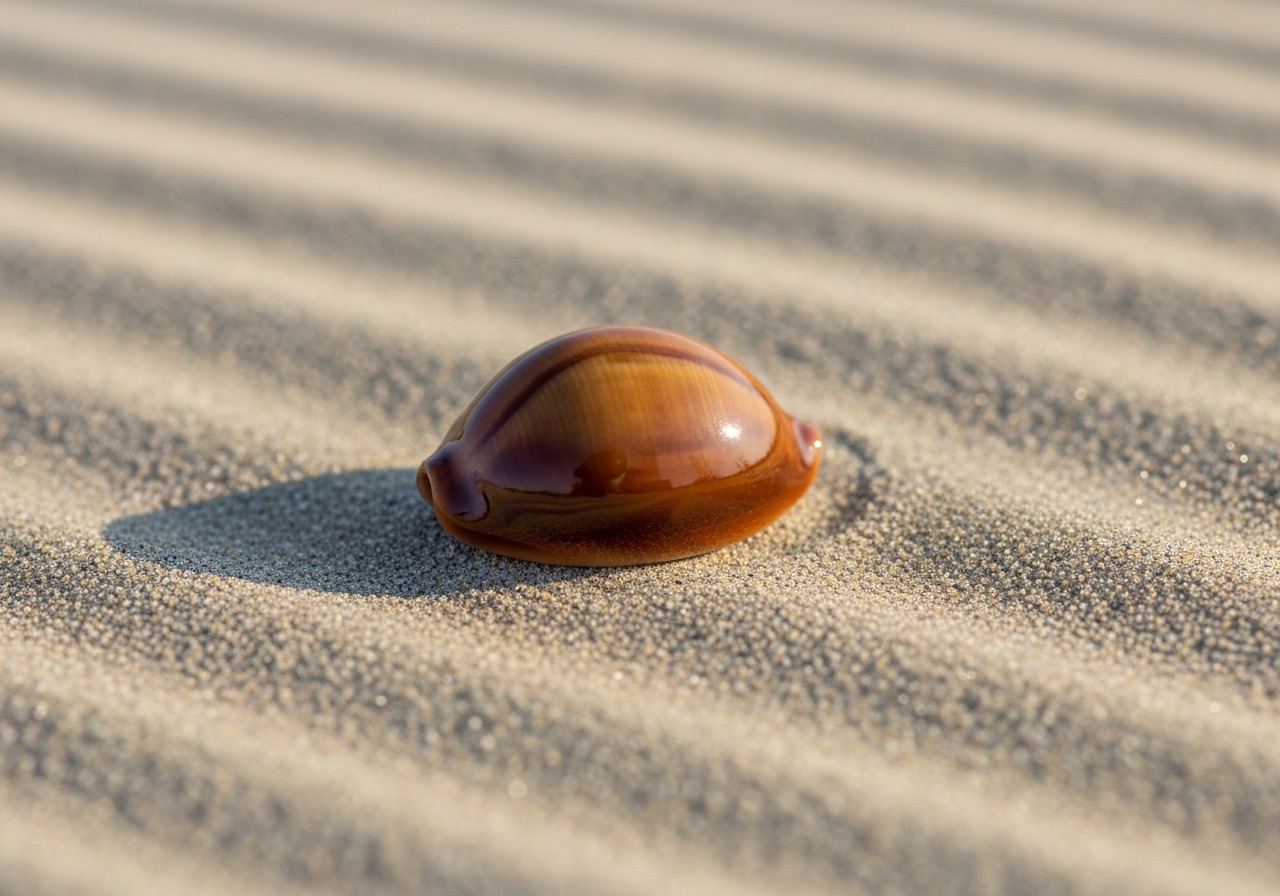
🐚 At a glance
- Scientific name
- Melampus coffea
- Family
- Ellobiidae — air-breathing marsh snails (not a cowrie)
- Size
- Tiny — often under 0.5 in
- Tell-tale
- Glossy dark-brown bean shape with a narrow slit opening
- Where & when
- Mangrove & marsh wrack line of the Ten Thousand Islands
How to identify a coffee bean snail
This one rewards slowing down. The coffee bean snail is small — usually under half an inch — and shaped just like its namesake: an oval, slightly pointed brown bean. The shell is smooth and glossy, dark chocolate to reddish-brown, often with a paler band or two. Turn it over and you'll find a long, narrow, slit-like aperture with a few little tooth-like ridges inside, which is a key tell. Because they're so small and so brown, they vanish into the mangrove leaf litter, which is exactly why beginners miss them.
They live in a completely different world from the big Gulf-surf shells like the fighting conch — you find these back in the quiet mangroves, not out on the open surf line.
Why it isn't a cowrie
People meet a glossy brown bean and immediately think “cowrie,” but the coffee bean snail is something else entirely. It belongs to the family Ellobiidae — the air-breathing marsh snails — and it actually crawls up mangrove roots and stems above the waterline to breathe air, riding the tides rather than living fully submerged. A true Atlantic cowrie is a marine snail with a humped, porcelain-glossy shell and a toothed slit running its full length. Here's the quick sort:
| Shell | What it is | Quick tell |
|---|---|---|
| Coffee bean snail | Air-breathing marsh snail | Tiny brown bean; mangrove wrack line |
| Atlantic cowrie | Marine sea snail | Humped, porcelain-glossy, toothed slit |
| Cerith | Marine sea snail | Tall, pointed, beaded spiral |
Where we find them
Coffee bean snails are creatures of the mangroves, so you won't find them on the open Gulf beach — you find them in the wrack line and leaf litter back among the islands. On our shelling tours through the Ten Thousand Islands we slip into the quieter, sheltered shorelines where the mangroves meet the marsh, the kind of spots near Goodland you can only reach by boat. Look low and look small, right where the tide piles up leaves and twigs. Whole empties are easy keepers — just check nothing's living inside, because Collier County is empty-shells-only.
From the Helm: Working the Marsh Hem at Gullivan Bay for Coffee Bean Snails
Coffee bean snails don’t show up on an open beach walk, so we make a point of easing the boat along the marsh hem at Gullivan Bay instead, right where the red mangrove roots meet the mud. We cut the engine and creep in on the trolling motor as the tide drops off the prop roots, because that’s the moment the drape of dead leaves and twig litter gets left high and wet against the bank — and that litter is exactly where these little snails collect in numbers worth stopping for.
We keep a small mesh kitchen strainer aboard just for this stop, because picking through wet leaf litter by hand is slow going and guests end up muddy to the elbow for very little reward. A scoop of litter dumped onto a rinse tray does the sorting for you — the twigs and mud wash through the mesh, and what’s left behind is easy to scan for that glossy dark-brown bean shape. It turns five frustrating minutes of one-by-one digging into thirty seconds of actual finding.
In the hand, a coffee bean snail feels almost like a polished seed rather than a shell — smooth, cool, and small enough to lose in a damp palm if you’re not paying close attention. That’s the appeal of this stop for us: it rewards slowing down and looking tight instead of scanning wide the way you would for a big showy conch out on the Gulf beaches. We tell guests to work small circles rather than walking a long stretch, because the marsh hem gives up more finds per square foot than distance ever will.
A dropping tide is the whole game at this stop. Too high and the litter’s still floating loose against the roots; too low and it’s baked dry and blown clear off the bank by the wind. We watch for that narrow window right as the water lets go of the mangrove fringe, and if Gullivan Bay is running cloudy after a recent blow, we’ll shift the same search to a quieter backwater creek nearby where the litter settles faster.
The mix-up we correct most in the strainer isn’t confusing this shell for a cowrie — it’s confusing it with the small marsh periwinkles that share the same leaf litter. Periwinkles run lighter gray-brown and more conical, with a rounder whorl, while a coffee bean snail is glossier, darker, and more elongated with that narrow slit mouth. We’ll set a periwinkle and a coffee bean snail side by side in a guest’s palm so the size and shape difference clicks before anyone starts sorting a strainer full on their own.
This stop rarely runs on its own — it usually rides inside one of our shelling tours as the quiet middle chapter of the day, a deliberate slow-down between the open-Gulf islands. If tiny finds are your thing, the crown conch works these same backwaters, just a size class up and a lot easier to spot without a strainer in hand.