
📖 At a glance
- The test
- Apex up, opening toward you — left = sinistral
- Dextral
- Right-handed; nearly all snails
- Sinistral
- Left-handed; uncommon
- Local star
- Lightning whelk, Busycon sinistrum
- Rule
- Empty shells only in Collier & Lee
The one-second handedness test
This is the move every local makes without thinking. Hold the shell with the pointed apex up and the aperture — the opening — facing you. Now look at which side the opening is on. Sits on the right? It’s dextral, right-handed, normal. Sits on the left? Congratulations, that’s a sinistral shell, and you don’t find those every day. If the anatomy words trip you up, our seashell glossary lays out apex and aperture in one quick read.
Why left-handed shells are rare
Coiling direction is set in a snail’s genes, and evolution overwhelmingly settled on right-handed. The vast majority of the world’s sea snails are dextral, which is exactly why a left-handed shell stops you in your tracks — it just looks wrong in a way that’s instantly fun. A few species buck the trend and coil left as their normal form, and rarer still, an individual of a normally right-handed species is occasionally born reversed, a one-in-thousands fluke prized by collectors. Either way, when a shell opens to the left, you’ve got something worth a second look.
| Dextral | Sinistral | |
|---|---|---|
| Opening (apex up) | On the right | On the left |
| How common | Nearly all snails | Uncommon |
| Local example | Knobbed whelk, tulips | Lightning whelk |
| Sheller’s reaction | “Nice find” | “Get the camera” |
The lightning whelk: our local lefty
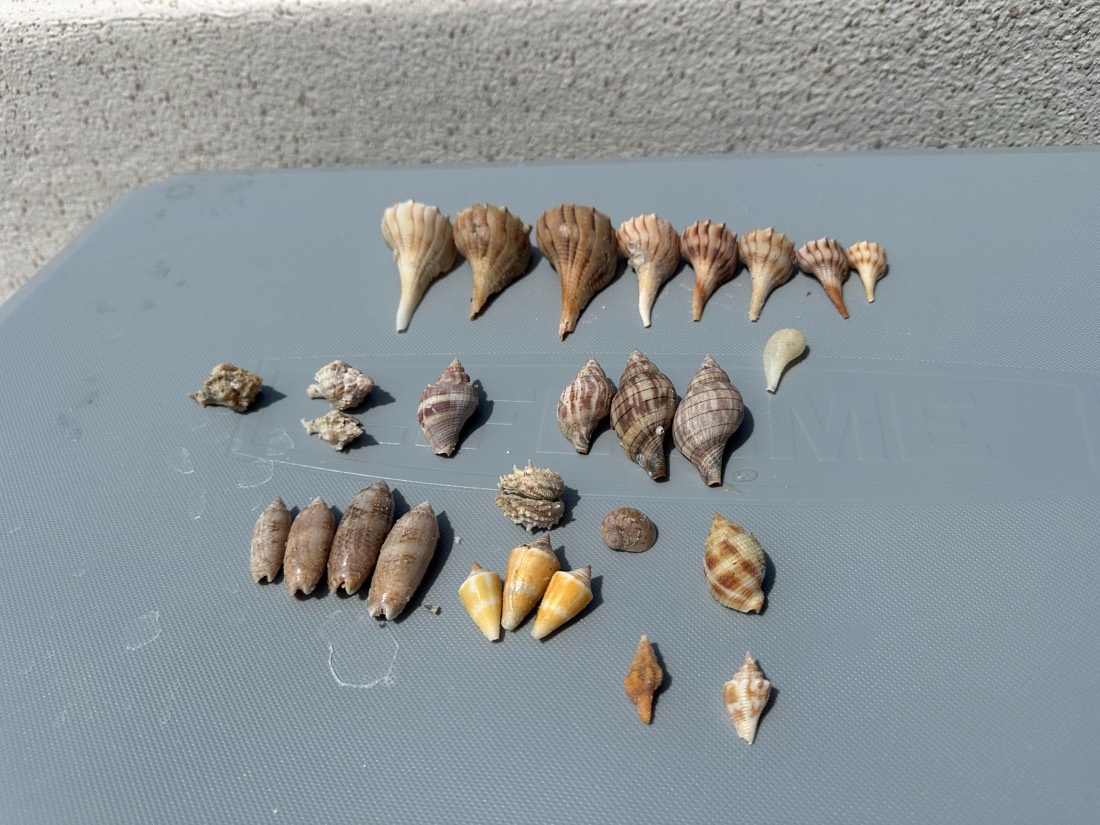
Here’s the beautiful part — our most famous big shell is a left-hander. The lightning whelk (Busycon sinistrum; the name literally means “left”) is sinistral as a species, so every healthy one you find opens to the left. That makes it the perfect shell to practice the test on, and the easy way to tell it from its right-handed look-alike, the knobbed whelk — same stout, knobby shape, opposite handedness. We put them side by side in our lightning vs. knobbed whelk comparison. Find a big, clean lightning whelk on the flats and you’ve got the souvenir that gets the “wait, it opens the wrong way” reaction every time.
The boat-only islands — Keewaydin, Kice, Cape Romano — turn up lightning whelks more often than the picked-over public beaches, especially after a winter front. On a shelling tour our captains know exactly which flats they wash up on.
From the Helm: The show-shell we keep clipped to the rail for Keewaydin's outside bar
We keep one lightning whelk tied in a rope net at the gunwale specifically to demonstrate handedness before anyone starts digging — not because it's rare, but because most guests test it wrong the first time. They cup the shell sideways instead of holding the spire straight up, so the direction reads backward and they walk off half-convinced they've found something extraordinary in a shell that's actually common. Thirty seconds with the show-shell in hand, its ridges worn smooth from years of passing between palms, fixes that for the whole afternoon.
On a westerly wind, the outside bar at Keewaydin takes the brunt of the Gulf swell, and that's when a fresh batch of whelks tends to wash up loose on the sand rather than staying buried where nobody can spot them. Our mates walk that stretch first, low and slow, before letting guests spread out along it, mostly to flag anything worth a closer look before it gets stepped past by someone hunting six feet further down the beach.
The mistake we correct most out there isn't the coiling test itself, it's confusing a true sinistral shell with one that's simply been tumbled and worn until the spire looks flattened and hard to read either way. We turn it aperture-toward-us, spire straight up, and let the guest's own thumb trace the opening from the top down. When it lands on the left, we let them say it out loud — that's usually the moment it actually clicks, and it's the moment most guests reach for their phone to get a photo before the shell goes back in the net.
Guests also ask why we don't just point to exactly where the lefties sit that day and skip the walking. Wind moves the good ground overnight out here, so the honest answer is that we're sizing up the same bar fresh every trip, same as anyone else standing on it, just with a few more seasons of practice narrowing down where to start first.
When the wind swings out of the east instead and Keewaydin's outside bar goes quiet on us, we don't force the search there. The show-shell briefing still happens at the rail, but we point the boat toward whichever lee-side stretch is actually holding shells that morning and let guests test the handedness rule on whatever whelks turn up, rather than standing everyone on a bar the wind clearly isn't feeding that day.
For the full walking method that turns up whelks like this one in the first place, our Sanibel Stoop guide covers the technique start to finish, and time aboard one of our shelling tours gets you out to whichever bar the wind's actually favoring that day.