
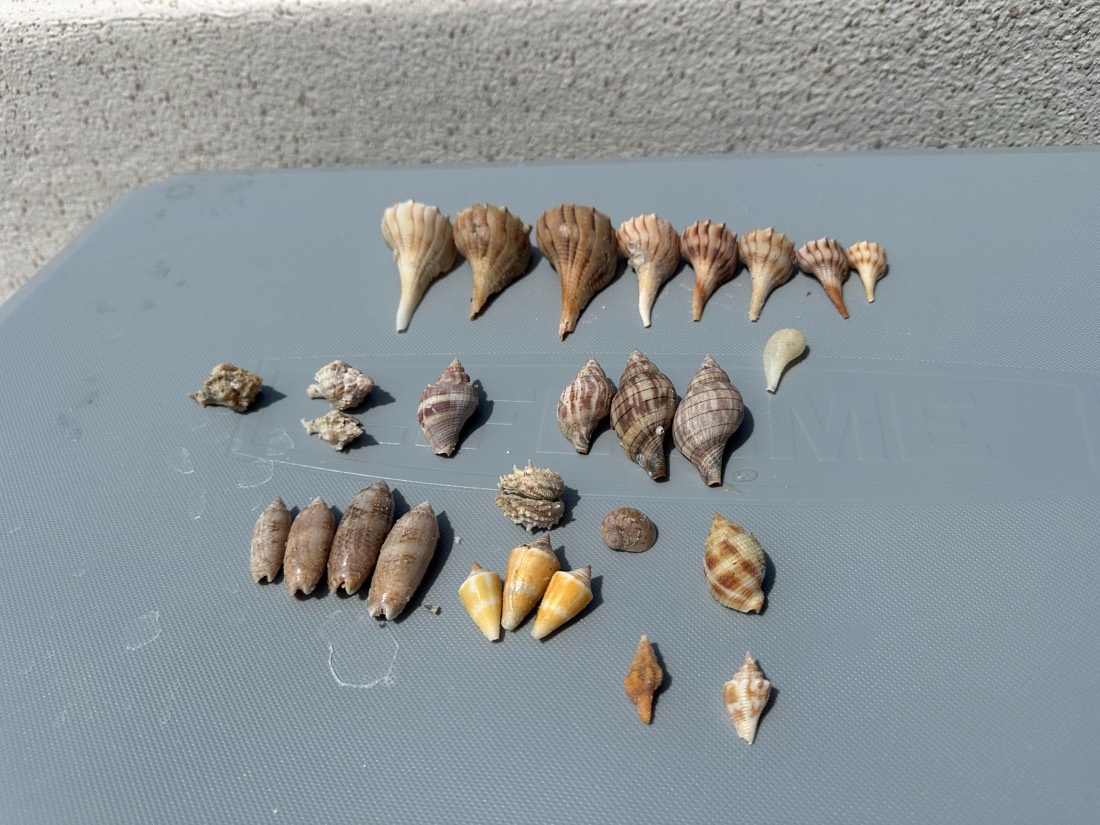
Before we ever hand a guest a mesh bag, we’re reading two things: the tide chart taped inside the console, and whichever way the wind is blowing that morning. Those two facts decide which of these guides actually applies to your day, not the calendar. A falling tide before nine, with a light north wind behind it, sends us toward Dismal Key, where the old Calusa shell mounds sit above a wide, shallow flat that a good outgoing tide drains fast. A brisk southwest breeze that same morning, and we’ll swing for Panther Key instead, tucked enough to stay calm when the Gulf side is chopping.
Once we’re anchored, the kit we hand off the rail barely changes: a mesh bag that drains as you walk, and the same short briefing every time — empty shells only, and a quick check that nothing’s still living before it goes in the bag. What changes is pace. Families new to it get fifteen unhurried minutes working the wrack line together while we point out whelks and olives by name. Hunters who’ve done this before get sent straight to whichever stretch our tide-reading guide says is draining fastest, then we leave them to it. Both groups come home with full bags; they just got there by different routes.
Some mornings neither read holds up. If an onshore breeze pushes in harder than forecast and lays chop across Dismal Key’s flat by mid-morning, we cut that stop short and idle instead into the lee of Coon Key, where the current still moves enough to keep shells rolling up onto the point even after everything outside has gone flat and murky. It’s rarely our first choice — the flat there runs smaller and the pickings thinner — but a solid instead-of beats a great somewhere-else you never actually reach.
For guests chasing something rarer than a whelk, the calculation changes again. A junonia doesn’t wash up on an ordinary tide; it takes a storm or a strong cold front to dredge one up from the deep water it actually lives in, and even then the odds stay long. We say so plainly: our guide to finding a junonia will sharpen your odds, but it won’t promise you an hour with a shell that rare. What we can promise is real ground under a real tide, and captains who’ll tell you honestly which approach fits the day you actually got.
We also treat the rulebook as part of the read, not an afterthought. Most guests don’t realize Collier County’s empty-shells-only rule applies the moment a hermit crab has moved in, so we check at the rail before anything goes in a bag, whether it’s a whole whelk or a sand dollar someone’s eyeing. Pair that habit with the tide-and-wind call we made before you ever stepped aboard, and the whole morning gets built around the water in front of us, not a script we run regardless of what it’s doing.