
📖 At a glance
- What it is
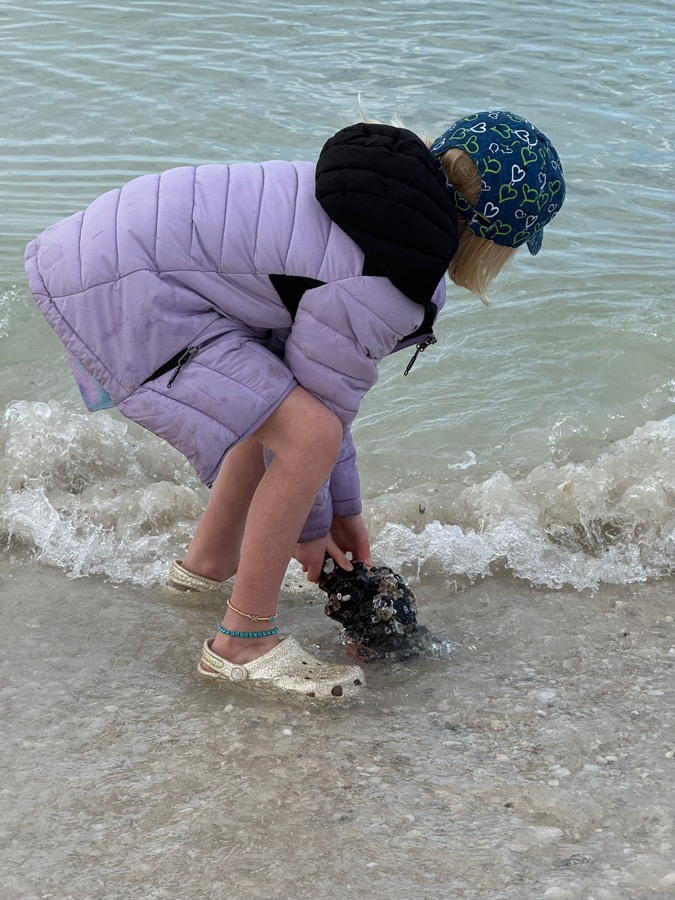
- The bent-over scanning posture shellers use along the tide line
- Named for
- Sanibel Island, whose east-west beach catches Gulf shells
- The trick
- Walk slow, bend at the hips, scan the wrack & swash lines
- Where it works
- Any Gulf beach — Marco, Keewaydin, Kice, Cape Romano
- Rule
- Empty shells only in Collier & Lee
What is the Sanibel Stoop?
The Sanibel Stoop is the half-joking, wholly affectionate name for the posture you fall into the second you get serious about shelling: feet shuffling, back curved, eyes drilling into the wet sand a few feet ahead. Locals also call it the “Captiva Crouch” on the next island over. It looks a little silly from the boardwalk, and every veteran sheller wears it like a badge. If your lower back is sore the next morning, you did it right.
Here’s the thing people miss: it’s a technique, not a location. The stoop didn’t come from magic sand. It came from people who learned that shells reward slow, low, patient eyes — and that exact same patience pays off on our home beaches around Marco Island.
Why Sanibel scoops so many shells
Sanibel earned the name for a reason: its geography is a shell trap. Most Florida barrier islands run north-south, parallel to the coast. Sanibel sits sideways, on an east-west axis, so its south-facing beach acts like a giant catcher’s mitt, scooping shells the Gulf currents push up from the broad, shallow shelf offshore. Add a gentle slope and you get one of the great shelling beaches on earth.
You don’t need Sanibel’s angle to cash in, though. Our boat-only islands win a different way: they get the same Gulf-fed shell supply but a fraction of the foot traffic, so the good stuff is still lying there. Compare the two on our Sanibel vs. Marco breakdown, then read up on Keewaydin Island, where the stoop really earns its keep.
How to do the stoop on Marco and Keewaydin
The posture is half of it; the pace and the spot are the rest. Walk at half your normal speed — shellers who hustle walk right over the good shells. Bend from the hips, not the neck, and let your eyes sweep a slow arc across the wet sand. Work the swash line (where the water just retreated) and the wrack line (the dried band of seaweed and debris higher up); both are where shells pile. Go at a falling tide toward low, when fresh material is exposed, and after a winter front when the Gulf has stirred things up — see our tide guide and post-front shelling guide.
Stoop technique at a glance
| Element | Do this | Why |
|---|---|---|
| Speed | Half your normal walking pace | Your eye needs time to catch shape and color |
| Posture | Bend at the hips, not the neck | Saves your back over a long hunt |
| Where to look | Swash line and wrack line | That’s where currents and tide drop shells |
| Timing | Falling-to-low tide, after a front | More sand exposed, more fresh shells |
| Tool | Mesh bag, no rake | Drains sand; bottom-raking is restricted |
Do all five and you’ll fill a bag fast. The last edge is getting to a beach nobody’s combed yet — which is exactly what our shelling tours are built to do.
From the Helm: The stoop drill we teach dockside before the Coon Key oyster bar
Before anyone steps off onto sand near the Coon Key oyster bar, one of our mates runs the stoop the same way every time: knees soft, hands loose on the thighs, eyes down and about six feet ahead rather than straight at your own boots. That last part is the one guests miss on their own. Stare straight down and you'll walk right past the good shell sitting just past where your eyes are pointed, already gone before your next step lands.
The mistake we correct most isn't the bend itself, it's guests folding at the waist instead of the knees and hips, which turns a slow scanning walk into a sore back after twenty minutes. We show the hip-hinge version standing on the deck before anyone's boots hit sand, weight low and easy, the kind of stance you could hold for an hour rather than one you're fighting the whole time out there.
Polarized sunglasses do more work here than people expect, cutting the glare off wet sand so a shell's curve actually separates from the shine around it instead of blending into one white blur. We hand a spare pair to anyone who forgot theirs, because the difference between squinting at glare and actually seeing shape is most of what makes the stoop work at all on a bright morning. A shell that's nearly invisible bare-eyed will suddenly stand out the moment the glare cuts away.
Guests also ask if the technique changes island to island, and mostly it doesn't — wind and tide move where the shells pile up, not how you look for them once you're standing on the sand. What changes is patience: newer shellers want to cover ground fast, and we slow that pace down deliberately, because a careful six feet beats a rushed sixty every single time out here, and a slower walker almost always fills a bag faster than a fast one does.
When a stiff onshore breeze kicks sand into the air along the open oyster bar and eyes start watering, we'll shift the lesson to the calmer back side instead, walking with the wind at your shoulder rather than your face. Same stoop, same six feet of scanning ground, just without a squint fighting the technique the whole way through, and without sand stinging the back of your neck on every gust that rolls off the open water.
Our left-handed shells guide gives you something specific to hunt for once the stoop starts turning up whelks, and a spot on one of our shelling tours puts you on ground worth stooping over in the first place.