
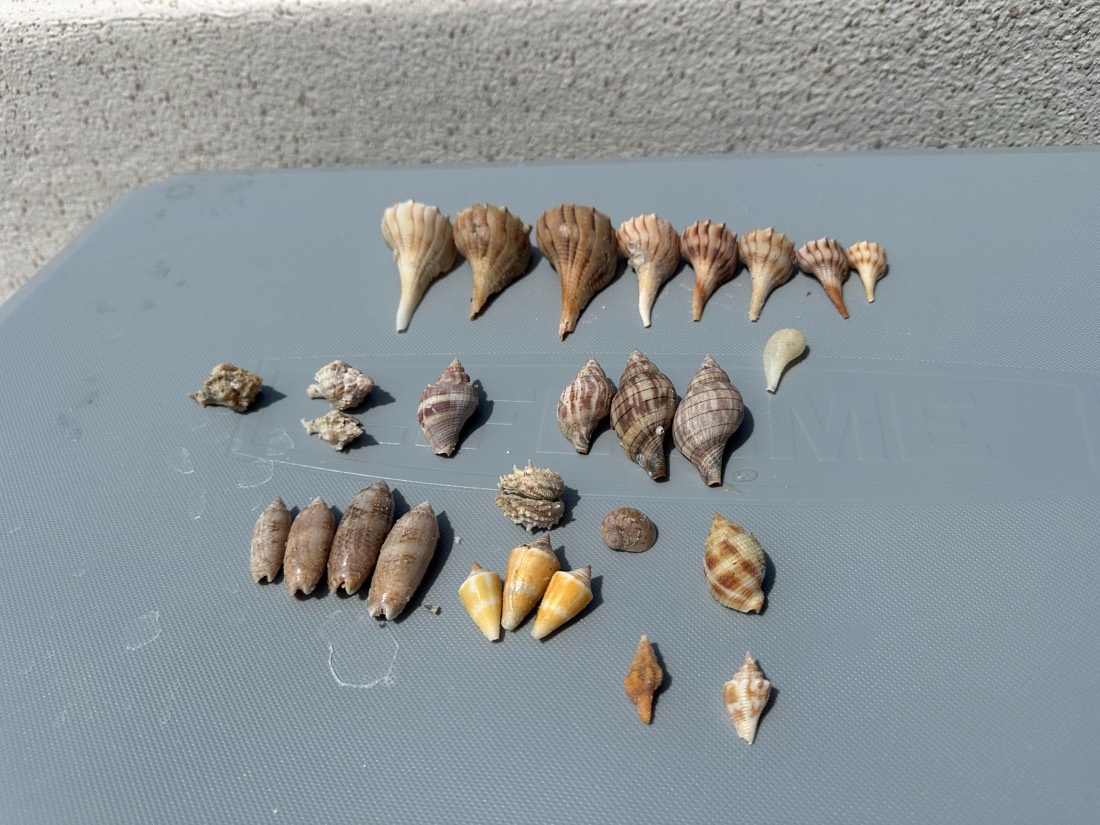
🐚 At a glance
- Lightning whelk
- Busycon sinistrum — opens LEFT (sinistral)
- Knobbed whelk
- Busycon carica — opens RIGHT (dextral)
- One-step test
- Spire up, opening facing you — which side?
- Bonus tell
- Knobbed whelk has taller shoulder knobs
- Rule
- Empty shells only in Collier & Lee
The one-step test
Here's the move every local makes without even thinking about it. Hold the whelk so the pointed spire is up at the top and the opening (the aperture) faces you. Now just look at which side the opening is on. Left means lightning whelk — it's sinistral, one of the very few large sea snails that coil counter-clockwise. Right means knobbed whelk, which coils the normal way, like almost every other snail on Earth. There's no overlap and no exceptions: a left-handed knobbed whelk doesn't exist. It's the cleanest ID in all of Gulf shelling, and it's the same trick we cover in our left-handed shells guide.
Other tells, if you want to double-check
The opening settles it, but a couple of backups help when shells are worn. The knobbed whelk usually wears taller, sharper knobs marching around its shoulder like a little crown, while the lightning whelk's knobs are lower and rounder. Young lightning whelks also carry those faint brown “lightning” streaks down the body that give them their name; knobbed whelks don't streak. Both fade to gray-white with age, so when in doubt, always come back to the left-or-right test.
| Feature | Lightning whelk | Knobbed whelk |
|---|---|---|
| Opening (spire up) | LEFT (sinistral) | RIGHT (dextral) |
| Shoulder knobs | Lower, rounded | Taller, sharper |
| Young color | Faint lightning streaks | No streaks |
| Range note | Common in our Gulf | More an Atlantic-side shell |
Where we find them
On our side of Florida the lightning whelk is the one you'll actually pick up — the knobbed whelk is more of an Atlantic-coast shell, so a right-handed whelk is the rarer find here and worth a second look. Both like the wide sandy Gulf flats, and the best whole ones turn up on boat-only beaches the tide keeps restocking. We run our shelling tours out to Keewaydin, Kice and the Ten Thousand Islands, where the hauls jump after a winter front. Still arguing whelk versus the conchs? Our whelk vs. conch guide sorts that out too. And remember: empty shells only in Collier County.
From the Helm: Comparing both whelks on the lagoon flats at Capri Pass
When we want a group to find both whelks on the same stop, we don’t run to open beach — we idle into the lagoon-mouth flats at Capri Pass, where the mud gives way to clean sand and both species come in to work the same bivalve beds. It’s a deliberate choice: a spot where lightning and knobbed whelks turn up close enough together that you can hold one in each hand and settle the left-or-right question yourself, instead of comparing a memory of one shell to a photo of the other back on the boat.
Both are predatory snails that plow through soft bottom hunting clams and other bivalves, and that shared habit is exactly why they overlap here — wherever the flat holds a healthy bed of prey, you’ll often find drag trails from both kinds at once. We watch for a shallow furrow in the sand with a shell sitting at the end of it more than we scan for shells lying still, since a fresh trail usually means whatever made it isn’t far off.
When we do turn up a pair, we hand them over together, spire-up, and let a guest do the flip themselves rather than announcing the answer first. Watching someone go quiet, turn a shell slowly in their hand, and realize the opening’s on the wrong side is one of the better small moments of a shelling stop — it sticks with people longer than just being told the fact outright ever does.
If the flat has gone quiet — slack high water, nothing pushing bait through — we’ll shift a short run north toward the mouth of the pass itself, where deeper water keeps moving even at the top of the tide. It’s a narrower stretch of sand and a slower hunt, but moving current beats still water for either species, and we’d rather reposition than idle over dead ground hoping something walks by.
A lightning whelk found on its own is a fine trophy, but finding both side by side is what actually settles the argument for good — and it’s the kind of stop we build into a longer shelling tour rather than a quick beach walk. Whatever you find stays exactly that: found, then left behind as an empty shell, per Collier County’s rules.
On a day when that flat only turns up lightning whelks, we’ll sometimes finish the loop through the shallower cut behind the mangroves just north, where knobbed whelks tend to sit tighter against the shoreline instead of out on open sand. It’s a different kind of looking — on foot along the roots rather than out across open flat — but it’s often the fastest way to complete the pair without doubling back to the same stretch of sand twice.