
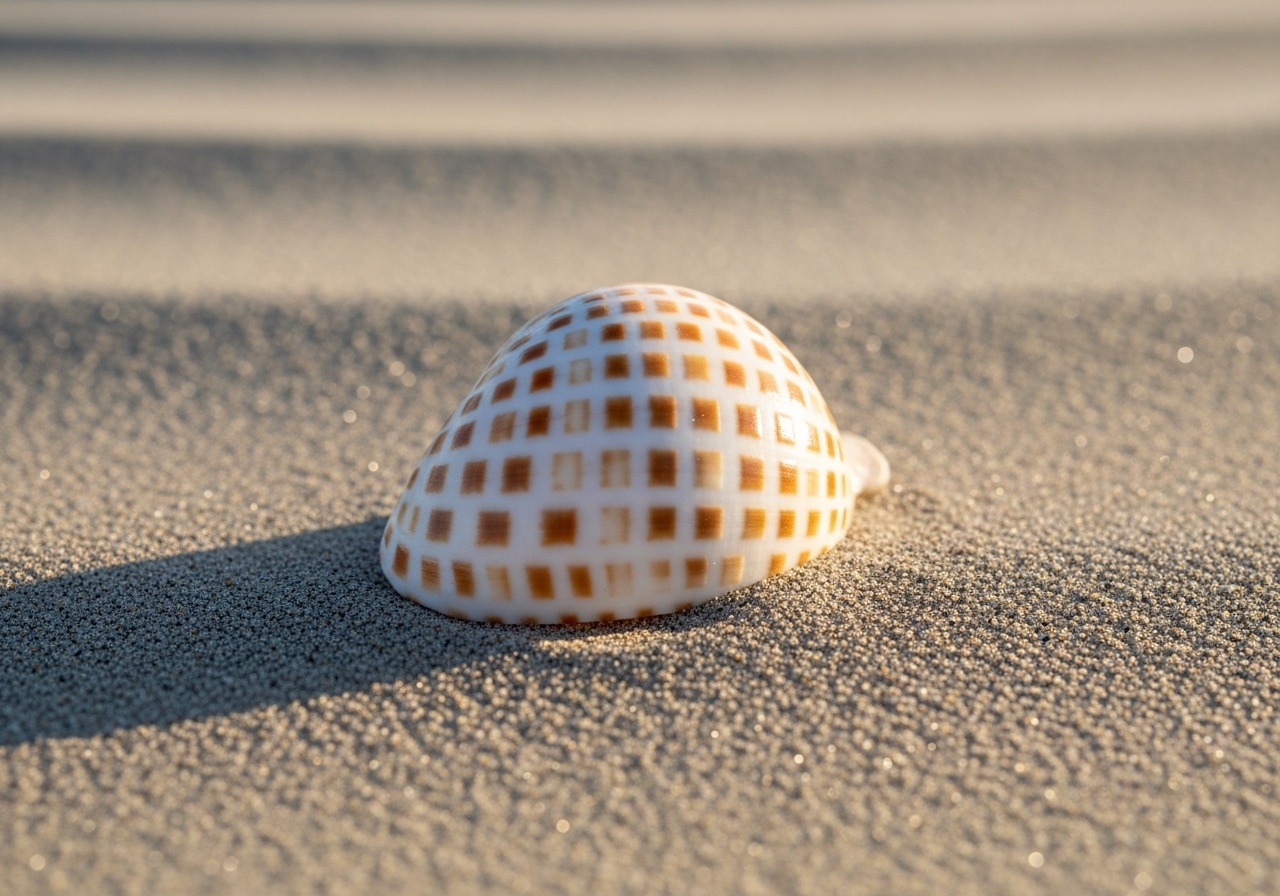
🐚 At a glance
- Scientific name
- Semicassis granulata
- Size
- Commonly 2–4 in
- Tell-tale
- Pale shell with a squared brown-spot grid; rounded helmet shape
- Honest odds
- Uncommon on the beach — more common offshore/deeper
- Rule
- Empty shells only — live collection is banned in Collier & Lee
How to identify a scotch bonnet
Start with the shape: a scotch bonnet is a rounded, somewhat squat helmet shell with a short spire and a broad body whorl — it really does look like a little bonnet or cap. The base color is a pale cream to tan, and across it runs a regular grid of squared brown spots, the leftover pattern from the shell's fine crosshatched (cancellate) sculpture. That orderly plaid-on-pale look is the whole ID. Run a finger over it and you'll feel faint spiral grooves crossing faint ridges, the texture that lays down the grid.
It's one of the very few true helmet snails you'll meet in North American waters, which is a big part of why shellers prize it — and why it earns a place alongside the trophies on our rarest-shells list.
How common is it really?
Here's the straight talk: on the southwest Florida Gulf beaches, the scotch bonnet is an uncommon find, not a daily one. The living animal favors deeper, sandier bottoms well offshore, so empty shells mostly reach the beach when weather stirs the bottom and carries them in. Anyone telling you they're easy to grab on a calm-day stroll isn't being straight. That doesn't mean don't try — it means time it right.
| Shell | Beach odds here | Why |
|---|---|---|
| Scotch bonnet | Uncommon | Lives more offshore; storm-driven to shore |
| Junonia | Rare (holy grail) | Deep water; only after big storms |
| Fighting conch | Common | Lives right inshore on the flats |
Where we find them
If a scotch bonnet is on your wish list, the move is the same one we make for any storm-driven shell: get to the wildest, least-walked beach right after rough weather. On our shelling tours we run to the outer beaches of Cape Romano and the Ten Thousand Islands, where fresh material lands and few footprints beat you to it. We can't promise one — nobody honest can — but we can put you on the right sand at the right tide. And remember it's empty shells only, so we admire any live one and take home just the empties; see our Florida shelling rules.
From the Helm: chasing a scotch bonnet on the outer bar at Gordon Pass after a west blow
We only make the extra run out to the outer bar at Gordon Pass for this one after a specific setup — several days of steady wind out of the west or southwest, the kind that pushes deeper Gulf water and whatever it’s carrying straight onto the bar at the pass mouth. On an ordinary calm week we won’t burn the fuel or the time chasing a shell that mostly lives well offshore in water our guests never touch. It’s a conditions-first decision more than a schedule-first one, which means this particular stop isn’t on every trip — it’s on the trips where the wind actually sets it up.
Even with the wind cooperating, we’re honest that most passes over a season turn up nothing here. We’ve learned to treat a scotch bonnet the way we’d treat any offshore species washing in close — a real possibility on the right day, never a promise on any day. What we can tell you is that the odds go up noticeably right after that kind of blow compared to a stretch of flat calm, and that’s worth timing a trip around if this particular shell is the one you’re after.
A fresh find still carries a faint sheen and the crosshatched grid of spots reads crisp against the pale shell; a shell that’s been tumbling out there for months bleaches paler and the grid softens until it’s easy to mistake for plain rubble. We tell guests to scan for the pattern, not the shape, since a half-buried scotch bonnet at a glance looks a lot like the coquina and moon snail debris scattered around it — the same stretch that turns up plenty of shark eye moon snails on a normal day.
If the outer bar’s been picked clean by other boats before we arrive, or a fresh load of sand has buried the bar entirely, we’ll swing to the opposite side of the pass mouth where the current tends to drop a lighter, thinner fringe of material instead. It’s a smaller shift than changing islands, and it’s often enough on a day when the first spot looks played out and the tide’s not going to turn back in our favor for hours.
Most guests who ask for this one specifically end up booking more than one trip before the wind actually lines up, and we’d rather say that plainly than let a single outing carry expectations it can’t meet. Collier County still means empty shells only here, same as everywhere else we run, scotch bonnet or common cockle. If this particular shell is the one on your list, tell your captain before booking so we can watch the wind forecast together and time the trip around the next real shot rather than guessing, on any of our shelling tours.