
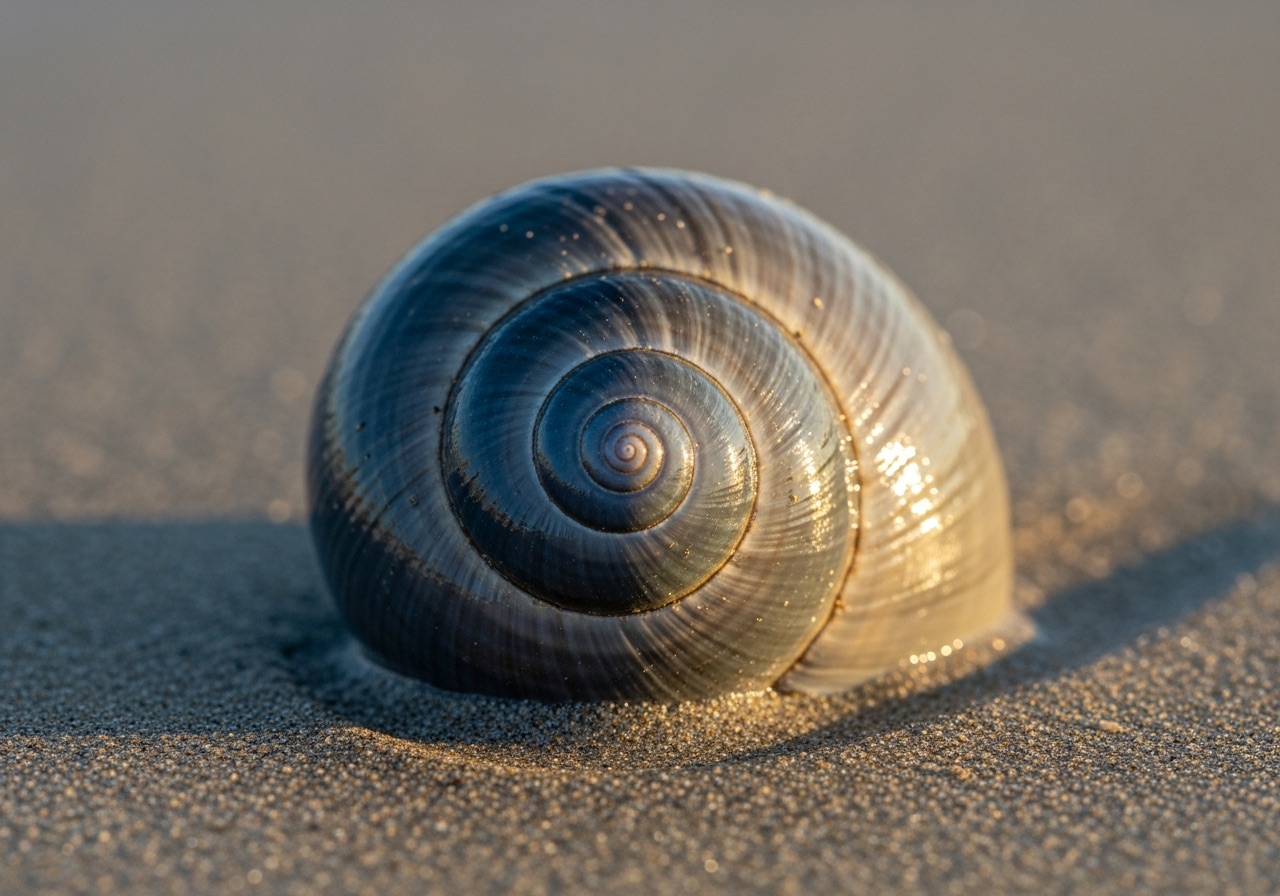
🐚 At a glance
- Scientific name
- Neverita duplicata
- Size
- Commonly 1–2.5 in — rounded and glossy
- Tell-tale
- Steel-blue spiral “eye” at the top; smooth domed shape
- Where & when
- Right on the Gulf surf line; low tide on the barrier islands
- Rule
- Empty shells only — live collection is banned in Collier & Lee
How to identify a shark eye
A shark eye is built like a small, smooth dome — rounded, low-spired and almost ball-like, with a glassy, polished surface that catches the light. The color is usually a soft gray-blue fading to tan toward the base, and the standout feature sits right on top: a dark, swirling steel-blue spiral that genuinely looks like an eye staring back. That eye is the callus and coiling at the shell's apex. Flip it over and you'll see a wide, deep umbilicus — the round dimple at the base — another moon-snail tell.
It's by far the moon snail you'll meet most on the open surf line, and it lives near classic surf-zone neighbors like coquina clams and lettered olives.
The little clam driller
Here's the part kids on our trips love. Ever found a tiny clam or coquina with a perfect, beveled round hole bored straight through it? That's the shark eye's work. The moon snail wraps its big muscular foot around a clam, rasps a neat hole with a file-like tongue, and feeds through it. So the next time you spot a holed shell, you're holding evidence of a slow-motion underwater hunt — and the hunter is this glossy little dome.
| Shell | Look | Quick tell |
|---|---|---|
| Shark eye | Glossy gray-blue dome | Steel-blue spiral “eye” on top |
| Fighting conch | Heavier, flared lip | Orange-brown, pointed, not domed |
| Jingle shell | Thin, translucent disc | Flat and papery, not round and solid |
Where we find them
Shark eyes love the open sandy surf zone, so they turn up right where the waves meet the beach — you'll often spot them rolling in the swash. On our shelling tours we walk the Gulf-facing surf lines of Keewaydin Island, Kice and the Ten Thousand Islands at low tide, when the most surf-line sand is exposed. They're common and beautifully glossy when fresh, which makes them an easy keeper — just confirm nothing's living inside, because Collier County is empty-shells-only.
From the Helm: picking a shark eye out of the swash at Kice on a falling tide
A guest usually spots the first one by accident, mistaking the smooth gray dome tumbling in the last inch of wash for a wet pebble. At Kice, on the back half of a falling tide, we tell guests to watch that thin retreating edge of water rather than the dry sand above it — a shark eye travels light in the swash and rarely sits still long enough to bury itself the way a heavier shell would. Once someone catches the trick of watching the water instead of the beach, they usually start turning up a few more within a few minutes of the first.
Polarized sunglasses cut the glare enough that the gray-blue dome stops blending into wet sand, which is the main reason this hunt goes faster for guests who bring a pair. We tell people to follow one retreating wave back out a few feet rather than walking the tide line broadly, since that’s where the lightest shells concentrate before the next wave resets everything. On a blustery afternoon the wind-driven chop scatters them wider across the swash instead of into one tight band, so we spread guests out further along the beach on those days.
A fresh shark eye has an almost slick, soapy feel to it and the spiral eye at the top still reads a deep blue-gray. Give it months of tumbling in the surf and both the sheen and the eye fade — the spiral goes chalky gray and the whole shell gets easy to walk past without a second look. Guests are often surprised how much smoother a fresh one feels compared to almost anything else they’ve picked up that morning, closer to a polished stone than a typical shell.
If the swash at Kice is running too churned from a stretch of onshore wind, we’ll move the stop to a quieter beach nearby and let guests work a calmer tide line instead. We’ll often shift toward a more protected bay-side flat on those mornings, since a shark eye’s smooth dome still shows up well against calm sand once the open surf itself is too rough to read closely. This same technique — watching the water’s edge rather than the dry sand — works just as well hunting scallop shells and other swash-dwelling finds, so it’s worth remembering past this one species specifically.
Whatever you pick up, Collier County’s empty-shells-only rule still applies, same as it does everywhere else we stop. It’s also one of the few finds where a first-timer can out-spot an experienced sheller simply by standing still and watching one small patch of wash instead of wandering the whole beach at once. If you’re bringing kids who want an easy, fast win early in the trip, this is often the stop we lead with, since the technique is simple enough to teach in under a minute on any of our shelling tours.