
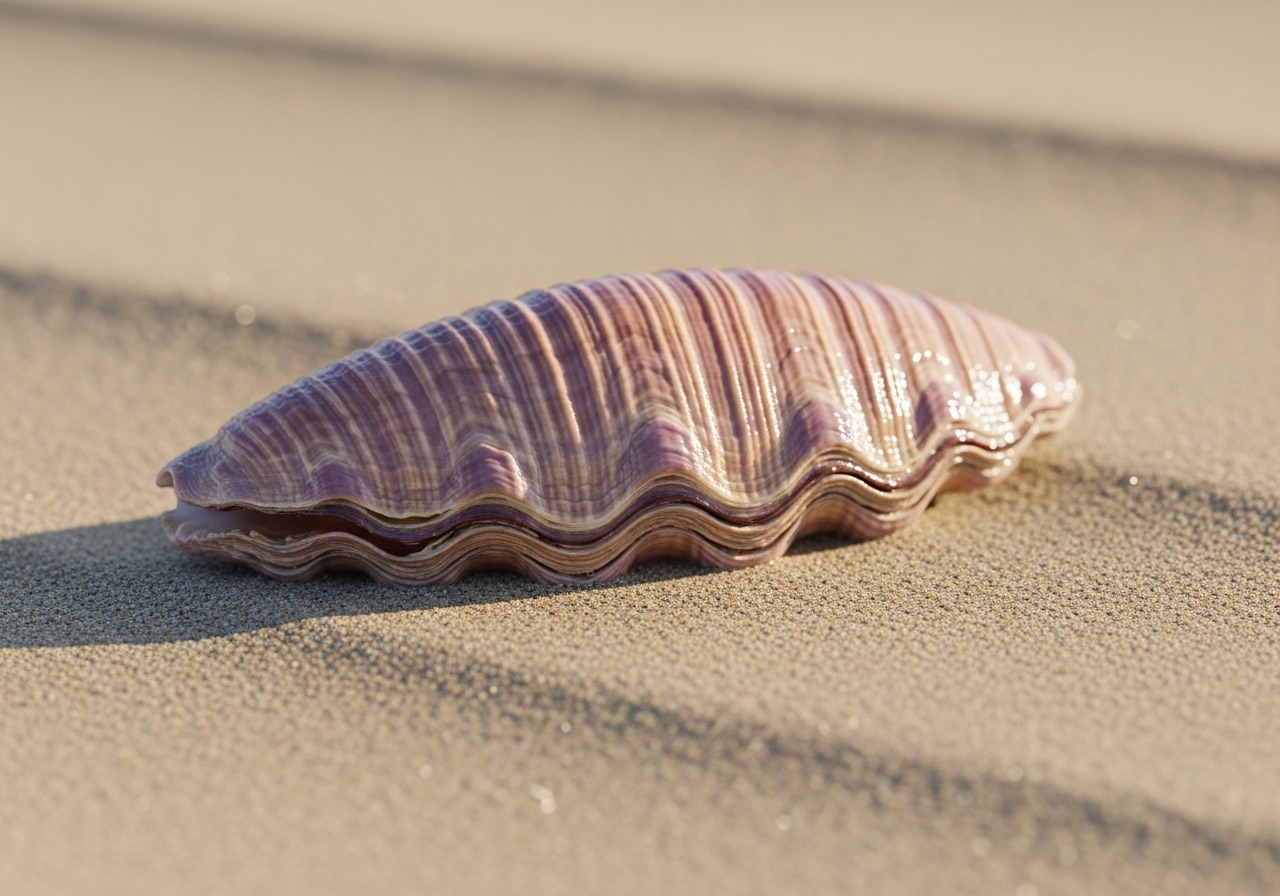
🐚 At a glance
- Scientific name
- Macrocallista nimbosa
- Size
- Up to about 5 in — longer than most local clams
- Tell-tale
- Glossy, elongated valve with radiating violet-tan rays
- Where & when
- Paired valves turn up in Lee County back bays & outer beaches
- Rule
- A prized clam — empty shells only in Collier & Lee
How to identify a sunray venus
Two things set the sunray venus apart from the clam crowd: shape and shine. It's noticeably elongated, more of a long oval than the rounded triangle of most clams, and the surface is smooth and high-gloss, almost like it's been polished. Across that glossy face run broad, soft rays of color — lavender to violet, warm tan, blush pink and gray — that fan out from the hinge like rays of light, which is exactly where the name comes from.
It's an easy step up from the textured cross-barred venus: where that one is all lattice and grip, the sunray is all smooth color. Side by side, the contrast trains your eye fast.
Why shellers prize it
The sunray venus is one of those clams that makes everyone on the boat ask “what's that one?” The combination of size, glossy finish and painted rays makes it stand out in any collection, and a complete, undamaged pair — both valves still joined at the hinge — is the real trophy because the surf usually splits them. Whole, glossy, well-rayed singles are common enough to hope for; a perfect matched pair is the find that earns a photo. It's not deep-water rare like the junonia, just genuinely beautiful and a little harder to get pristine.
Where to find them
Sunray venus clams live buried in sandy bottoms and the quieter back bays, and the empties wash to the outer Gulf beaches and into the calmer water of Lee County. Our captains turn them up on the barrier-island stretches reached by boat — the Ten Thousand Islands and the wild beaches near Cape Romano — where the sand gets restocked faster than crowds can pick it. Our shelling tours time the trip to low tide after a front for the best, freshest finds. Empty shells only, and check our Florida shelling rules before you bag one.
From the Helm: Sunray venus hunting on the Capri Pass shoal after a front
Someone at the rail almost always spots the first sunray venus before we do — the shine catches light even underwater, and half the fun of working the shoal edge off Capri Pass is watching a guest do a double take at a flash of violet in six inches of water. We’ll ease the boat right up to that sandbar rather than anchor off it entirely, because these clams sit shallow enough that the hull’s own shadow passing over can spook the moment before anyone gets a proper look at it.
The best runs happen a day or two after a cold front pushes through and stirs the sand loose on a falling tide — shells that were buried a foot down get rolled up onto the shoal’s edge instead of staying put underneath. We watch for the wind to swing north before committing to this exact stop, because a front arriving from the wrong direction just piles sargassum over the same ground and buries everything we’re after instead of uncovering it for us.
A sunray venus straight off that shoal still has its full gloss, like it’s been freshly waxed, and if you’re lucky the two matching valves are still hinged together in a natural butterfly shape. Give that same shell a few months tumbling in the surf and the shine dulls to a soft satin, the violet rays fade toward gray, and the hinge almost always lets go entirely — a paired find right off the bottom is a different thing altogether from a single valve up on the beach.
We hand guests a shallow mesh scoop for this particular stop rather than have anyone grab with bare fingers, since the shells sit half in, half out of loose sand and a scoop lifts the whole clam clean without cracking the thin, glossy wall underneath. It’s a small tool, but it’s the difference between someone walking away with an intact matched pair and walking away with two broken, jagged halves instead.
If the shoal’s calm and the light’s low and golden, this stop pairs naturally with a slower pass along the edge on one of our regular shelling tours, and we’ll often follow it with a stretch of open water before the next stop so the shine has a minute to be properly appreciated before it goes in the bag. It’s a small, glossy reward for anyone patient enough to watch the sand instead of the horizon that afternoon.
We won’t promise a sunray venus on any given run — some mornings the shoal gives up nothing but bare sand and a few worn coquinas — but the days it produces, it tends to produce several at once, clustered close enough together that one find usually leads a guest straight to the next without us saying a word.