
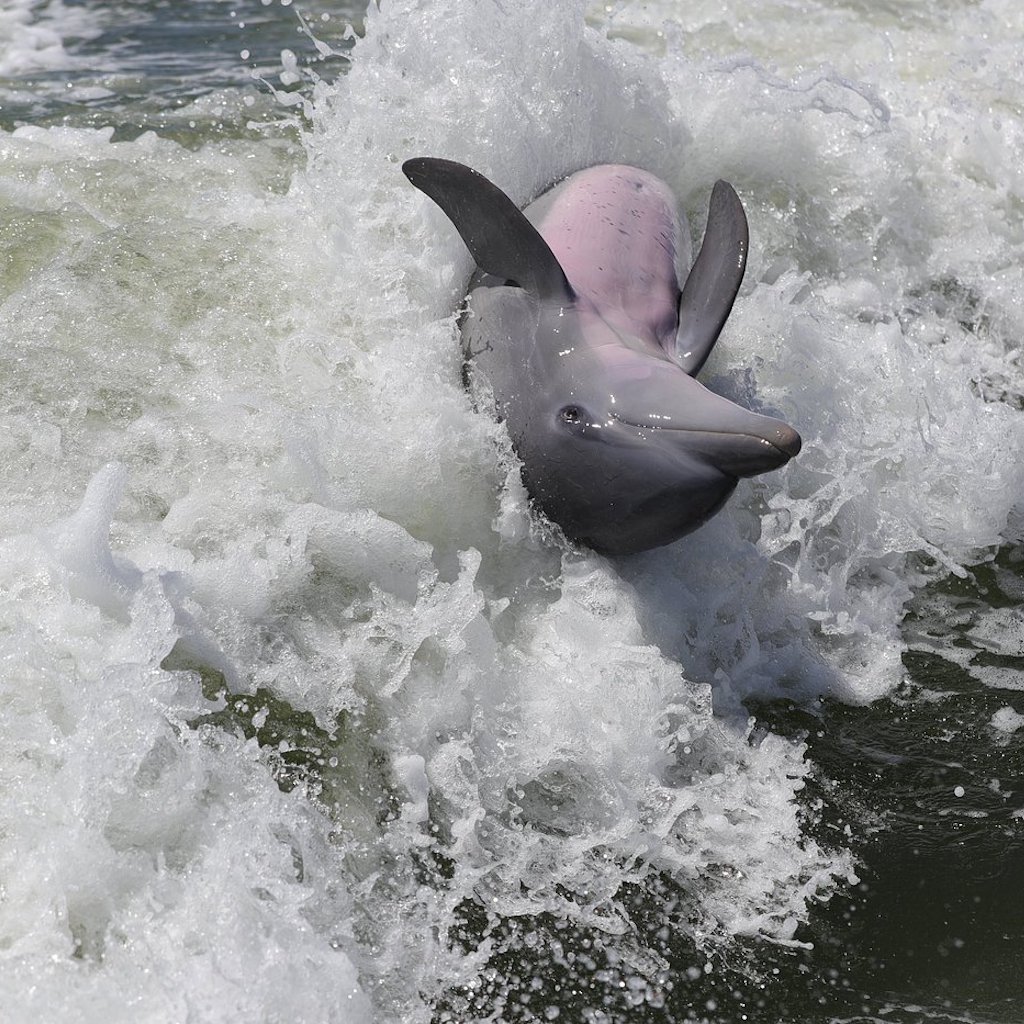
🐬 At a glance
- Clicks
- Echolocation sonar — for hunting in murky water
- Signature whistle
- A unique whistle that works like the dolphin's name
- Other sounds
- Burst-pulse squawks & squeaks during social moments
- Hear them how?
- Sometimes through a quiet hull or near the surface
- Natural?
- Yes — wild behavior, never a performance
Clicks: built-in sonar for hunting
The first system is all business. A dolphin fires a stream of high-frequency clicks from inside its head, and when those clicks bounce off a fish — or an oyster bar, or the bottom — it reads the returning echoes to build a precise picture. Faster clicks mean the dolphin is closing in; you sometimes hear them blur into a buzz at the end of a chase. This is the secret behind how they feed in our murky estuaries, where seeing prey is nearly impossible. Tannin-stained backwater is no obstacle when you can hunt by sound.
Signature whistles: a dolphin's name
The second system is social and, frankly, a little mind-bending. Within its first months, each dolphin develops its own signature whistle — a distinct tune it repeats throughout life. Other dolphins recognize it and can even copy it to get that individual's attention, which is about as close to calling someone by name as anything in the animal world. Mothers and calves use whistles to stay tied together in murky water, and scattered pod members use them to regroup. When a pod is feeling chatty you'll also hear burst-pulse squawks and creaks layered in — the social texture of a tight-knit, intelligent bottlenose group.
| Sound | Purpose | What it sounds like |
|---|---|---|
| Echolocation clicks | Hunting & navigating by sonar | Rapid ticking that buzzes when closing in |
| Signature whistle | Identity — works like a name | A repeated, distinctive tune |
| Burst-pulse sounds | Social & emotional | Squawks, creaks and squeaks |
Why you sometimes hear them on a tour
Most dolphin sound is too high-pitched for our ears or stays underwater, but conditions sometimes line up. On a calm, quiet drift — engine off, no chop — whistles and squeaks can carry through the air or up through the hull, especially when a pod surfaces close while feeding or socializing. It's never on demand and never a trick we cue; it's just a bonus when a wild pod gets vocal nearby on our dolphin & wildlife tours. The chances are best in the sheltered, glassy water of the passes and bays.
Sounds, not a show
We'll say it plainly: everything you hear is wild, self-directed behavior. These dolphins aren't trained, fed, or prompted to vocalize. When you catch a click-train or a whistle, you're eavesdropping on a hunt or a conversation that would happen with or without you there — which is exactly what makes it special. We keep our distance and stay quiet, the same way we approach every animal in our viewing etiquette.
From the Helm: Cutting the engine in Coon Key Pass to hear dolphins surface
Some mornings, when the water inside Coon Key Pass lies flat and the wind hasn’t filled in yet, our captains will make a call most guests don’t expect: cut the engine completely and just drift. Sound travels differently through calm, shallow water than through wind and engine noise, and a pod resting or socializing nearby will sometimes surface close enough that you hear the exhale before you see the blow. It’s a small decision — a few minutes of dead silence instead of an idle — but it’s the difference between watching dolphins and actually hearing them.
If you lean over the gunwale and rest a palm flat against the hull while the boat is stopped, you can sometimes feel a faint vibration pass through the fiberglass when a pod is working nearby — a low thrum under your hand more than a sound in your ears. We’ll point this out to guests who ask why we’ve gone quiet. It’s not something you can pick up over an idling engine or wind chop, which is exactly why the decision to shut down matters more here than it does along a moving, working shoreline.
On a calm morning we’ll sometimes pick up a quick back-and-forth of whistles between a calf and what we take to be its mother, the pair staying close as they surface a few boat-lengths apart. We never claim to know exactly what’s being said, only that the pattern of one whistle answered by another is unmistakable once you’ve heard it a few times. Guests who’ve grown used to engine hum are often surprised how much quieter, and how much more textured, the water actually sounds once we’ve gone still.
This only works with the right conditions. A stiff onshore breeze or a tide ripping through the pass will drown out anything short of a breach, so we save the engine-off approach for slack water or the top of the tide, when Coon Key Pass goes glassy for a stretch. If the wind’s wrong, we’ll keep moving and let guests enjoy the sighting visually instead of chasing a quiet stretch that isn’t there that day. Forcing it just wastes time better spent finding the next pod.
None of it is a performance we can promise on demand — it depends on a calm morning and a pod willing to linger nearby. But when the water cooperates, it’s one of our favorite moments aboard, and it’s part of what makes a dolphin tour with us feel different from a quick drive-by. For the fuller story of how these animals hunt once the quiet moment ends, see our notes on dolphin feeding behavior.