
🐬 At a glance
- The three
- Spotted eagle ray, southern stingray, cownose ray
- Fastest tell
- Behavior: leaps / buries / schools
- Where & when
- Passes & flats off Marco & Naples; year-round, schools peak in migration
- Safety
- Do the “stingray shuffle” when wading flats
Meet the three local rays
Each of our rays has a signature move, and once you learn the move, the ID is automatic. The spotted eagle ray is the showpiece — a big charcoal disc shaken with white spots, a long whip tail, and the rare habit of launching fully clear of the water. The southern stingray is the homebody — a plain gray-brown diamond that settles onto sand and grass flats and buries itself with just its eyes showing. And the cownose ray is the traveler — a brown kite with a notched, cow-like nose that cruises near the surface in flapping schools. Spots and a leap, buried and alone, or a flying squadron: that's your whole field guide.
Quick ID: which ray is that?
Pull this up the next time a shadow slides under the boat. The single best clue is almost never the color — it's what the ray is doing.
| Ray | Look | Signature behavior | Where |
|---|---|---|---|
| Spotted eagle ray | Dark disc, white spots, long tail | Flies in open water; leaps clear | Clear passes |
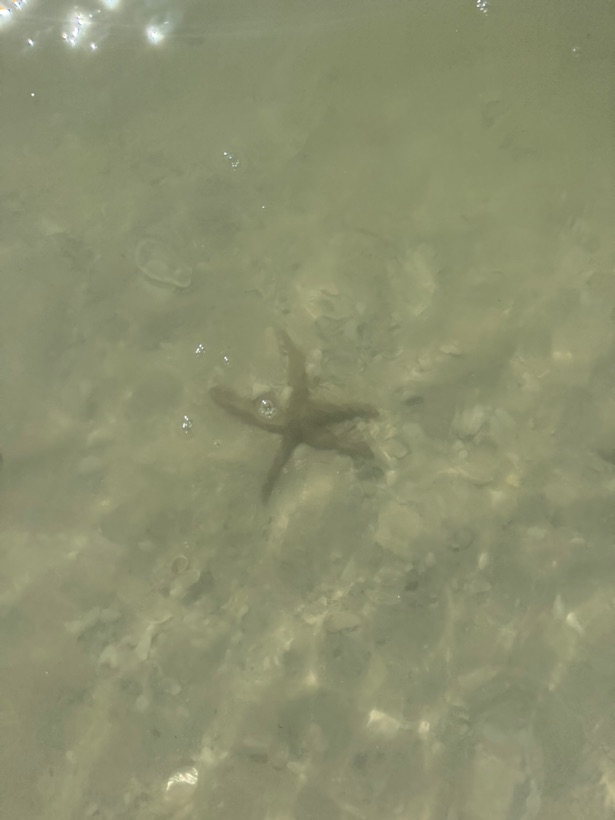
| Southern stingray | Plain gray-brown diamond | Buries in the bottom | Sand & grass flats |
| Cownose ray | Brown kite, notched nose | Schools at the surface | Passes & open bays |
The stingray shuffle: one rule for the flats
The only ray you might ever bump into is the southern stingray, and it never wants trouble. Its barb is purely defensive, used only if you step squarely on a buried ray and pin it down. So you don't step — you shuffle. Slide your feet forward through the sand instead of lifting them, and any ray in your path feels you coming and glides away in a puff of sand long before you reach it. We coach every guest through the shuffle before sandbar stops, and with it the warm flats at Keewaydin and the Cape Romano shoals are about as risky as a wading pool.
Where and when we find them
You'll find all three around Marco and Naples year-round, just in different spots. Eagle rays favor the clean, moving water of the passes; southern stingrays love the warm sandy flats; cownose rays travel the open passes and bays, with the biggest schools in the spring and fall migrations. Calm, clear, low-tide days are best for all of them — flat water lets you spot a shadow on the sand or wingtips breaking the surface. They're a regular highlight on our dolphin & wildlife tours, and they fit right into the broader cast of characters in our wildlife-by-season guide.
From the Helm: Calling Ray Shadows Off the Bow on a Kice Island Sand Flat
A guest at the bow on a Kice Island sand flat once called out "cloud" at a shape gliding under the surface, and that mistake is common enough that we build the correction right into the drift. A cloud shadow moves with the wind and holds roughly the same shape; a ray’s shadow moves with its own purpose, flexing at the edges and occasionally banking hard in a way no cloud ever does. Once a guest catches that difference one time, they rarely need us to point the next one out.
We work these flats once the sand starts showing through on a dropping tide, drifting with the engine dead instead of idling across, because a lower unit crossing skinny water over a stingray buried in the sand is exactly how someone gets hurt stepping off the boat later. The drift produces more sightings too — a ray holding still against the bottom reads as a slightly darker oval with two points at one end, and that outline all but disappears the moment a wake stirs the sand around it. We’ll point the bow to let the wind do the work rather than paddling, since even an oar dipped in skinny water sends a small pressure wave ahead of us.
Cownose rays give themselves away completely differently, usually as a moving raft of dorsal tips breaking the surface in loose formation rather than one shape under the water at all. When we spot that pattern we’ll hold our drift instead of closing in, since a school like that tends to hold a heading, and we’d rather let it pass alongside the boat than push through the middle and scatter thirty rays instead of watching one.
The spotted eagle ray is the one that gets the loudest reaction, and it’s also the one we spend the least time positioning for, since it typically announces itself — a sudden clear of the water, wingtips first, sometimes twice in the same spot before it settles back down. We’ll often idle toward the ripple rings left behind rather than the leap itself, on the chance it repeats, though a single jump on a given pass is common and a second one isn’t something we plan around. Guests who keep a camera up through the quiet stretch usually catch it; the ones who put it down after a minute rarely do.
Sand flats like this one sit right next to the oyster bars and seagrass that hold the crustaceans rays are actually working the sand for, so the two habitats are worth watching together rather than separately. If a slow drift over structure like this sounds like your speed, our private charters can build a whole afternoon around exactly this kind of flat instead of squeezing it into a bigger route.