
🐬 At a glance
- What it is
- A common bottom-dwelling ray of sandy and grassy flats
- Tell-tale
- Plain gray-brown diamond disc; buries with just its eyes showing
- Where & when
- Sandbar flats at Keewaydin & Cape Romano; year-round
- Safety
- Do the “stingray shuffle” — slide your feet, don't stomp
How to identify a southern stingray
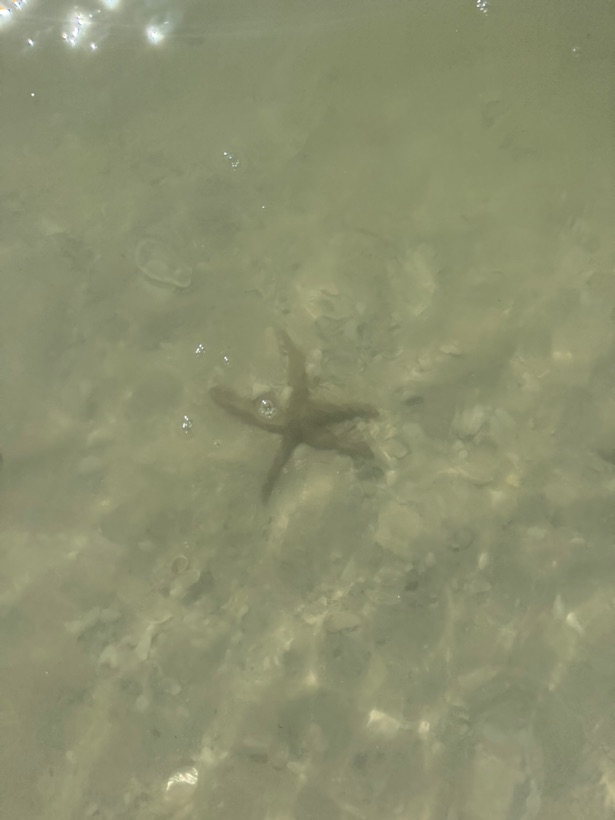
This is the plain one, and that's how you know it. The southern stingray is a smooth, gray-brown diamond — no spots, no fancy markings — with squared-off wingtips and a stout tail carrying a serrated barb near the base. Most you'll meet on the flats are dinner-plate to manhole-cover size. Unlike the spotted eagle ray, which flies through open water, this one is a bottom animal: it settles onto the sand, flicks its wings to throw a blanket of grit over itself, and lies still with only its eyes and breathing holes poking up. Spot a ray-shaped lump in the sand with two little eyes? That's it.
The stingray shuffle, explained
Here's the only safety rule you need on the flats, and it's an easy one. Stingrays never come after people — that barb is strictly for defense, and a ray will only use it if you step squarely on top of it and pin it down. So you simply don't step. You shuffle: slide your feet forward through the sand without lifting them, so you bump a buried ray harmlessly with the side of your foot instead of landing on its back. It feels the vibration, decides it wants no part of you, and glides off in a cloud of sand. We coach every guest through it before sandbar stops on our wildlife tours and sandbar trips. Do the shuffle and the flats are about as dangerous as a swimming pool.
Where we find them
Southern stingrays love exactly the kind of warm, shallow, sandy-bottom flats that make our sandbar stops so good. We see them year-round on the Keewaydin Island flats, around the Cape Romano shoals, and across the grassy lagoons where they hunt buried clams, shrimp and crabs by feel. They'll often have a small fish or two tagging along, picking up scraps the ray digs up. Calm, clear water at low tide is prime sighting time — you can wade slowly and watch one work the bottom, throwing little sand-puffs as it goes.
| Ray | Look | Where you meet it |
|---|---|---|
| Southern stingray | Plain gray-brown diamond | Buried in sand & grass flats |
| Spotted eagle ray | Dark disc, white spots | Cruising clear passes |
| Cownose ray | Brown kite, notched nose | Schooling at the surface |
Watching them the easy way
The best stingray encounters are the quiet ones. Wade slowly, keep your shuffle going, and you'll often get within a few feet of a buried ray before it decides to leave. They're a great kids' lesson too — calm, harmless if respected, and a perfect example of how everything out here gets along when you give it room. It's the same low-key approach we bring to all the flats wildlife, and it's why our sandbar stops stay relaxed.
From the Helm: Picking the lee-side sandbar off Keewaydin before anyone wades
We start reading a sandbar off Keewaydin before the engine’s even off, looking less for a shadow than for a subtle rise in the sand — a low, dinner-plate-sized dome where a ray’s tucked itself in just under the surface. Guests scanning for something dark and shaped like a hole in the sand usually miss it, because a resting ray barely disturbs the color at all; it’s the texture, the faint mound, that gives it away first. We’ll idle in slow and let that texture settle before anyone steps off, rather than announcing a ray and having the whole boat crowd one rail to look.
Which side of the bar we pick depends entirely on the wind that morning. The lee face stays glassy enough to pick out that faint dome, while the windward face chops up and turns the whole sand flat into texture-less glare, so we’ll circle around to whichever side is calm rather than defaulting to the same spot every trip. We like to swing by once the ebb’s most of the way out and the bar’s started to show — enough water off it to concentrate rays in skinnier depth, but still enough covering the sand that nobody’s high-stepping through dry flat to reach one.
Polarized sunglasses matter more here than people expect, cutting the surface glare enough to tell a resting ray’s low profile from a plain patch of packed sand nearby. Without them, we’ve second-guessed plenty of shapes that turned out to be nothing more than a compressed clump of shell hash. With them, that faint dome and the two small points where the eyes sit above the sand line usually stand out enough that we can call it before we’ve even throttled all the way down.
Finding one usually means there are more nearby — southern stingrays tend to work a sandbar in loose, scattered company rather than alone, so guests who spot the first one are often standing within a few yards of a second or third without realizing it. Some mornings the bar’s just quiet, though, whether from a shift in water temperature or a storm having reshaped the sand since our last pass, and when that happens we’ll idle to a different bar rather than talk guests into wading an empty one.
It’s one of the calmer wildlife stops we run, more sand-flat patience than open-water chase, which pairs well with faster company like the spotted eagle ray working the nearby passes on the same afternoon. Between the two, most guests come away with a clear sense of how differently two closely related animals choose to live — one tucked flat and still in the sand, one airborne and loud out in open water.