
📖 At a glance
- Local species
- Keyhole urchin (Mellita quinquiesperforata)
- Live tell
- Brown/gray, fuzzy, tiny moving spines
- Dead tell
- White, bleached, smooth, no movement
- Quick check
- Hold it still — live spines wave; it may leave a yellow stain
- Rule
- Empty white ones only; live ones go back in Collier & Lee
Live or dead: the two-second test
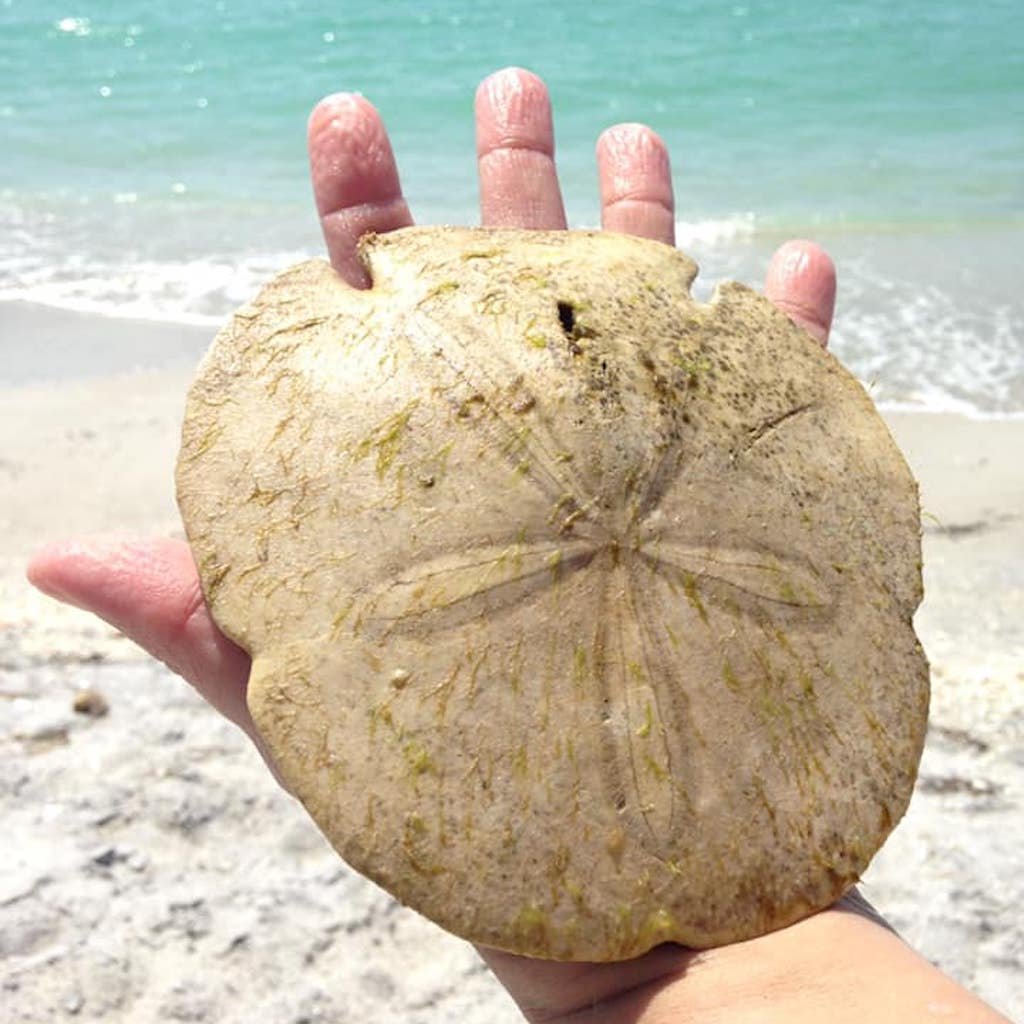
The fastest check is color and texture. A living sand dollar is some shade of brown, gray or even purplish, and the surface is covered in thousands of short, hair-like spines that give it a velvety, almost fuzzy feel. Set it flat in your palm and hold still — those spines wave and ripple, and the whole animal may very slowly inch across your hand. A dead sand dollar has lost all of that. It’s white or sun-bleached gray, smooth and hard like a cracker, and it doesn’t move at all. One more giveaway: a live one rubbed on your hand often leaves a faint yellowish stain (a harmless substance called echinochrome). White and motionless means a true empty skeleton. Brown and fuzzy means a living animal that needs to go back. Our sand dollar ID guide walks through every variation if you want the deep version.
What you're actually finding here
The “sand dollar” you find around Marco Island and Naples is usually the keyhole urchin, Mellita quinquiesperforata — the flat one with the distinctive slots punched through it. They live just under the surface of sandy flats, filter-feeding on tiny bits of food, so on a good low tide you’ll feel them before you see them. They’re cousins to sea urchins and sea biscuits, all part of the same spiny-skinned family. If you want the full backstory on the species and its slots, our keyhole sand dollar page covers it, and the sea biscuit page shows the puffier relative that washes up nearby.
| Trait | Live (leave it) | Dead (keeper) |
|---|---|---|
| Color | Brown, gray or purple | White or bleached |
| Surface | Velvety, fuzzy with spines | Smooth, hard, bare |
| Movement | Spines wave; may inch along | None |
| Stain test | Leaves a faint yellow tint | Leaves nothing |
Keep it or put it back?
Here’s the rule we live by on the boat: white empty skeletons are yours, living animals go back. In Collier and Lee County it’s illegal to collect live sand dollars, shells or starfish, and beyond the law it’s just the right thing — a beach picked of its living sand dollars stops producing the white ones everyone wants. So when in doubt, set it gently back on the wet sand and let the tide take it. The good news is the boat-only flats we run to on our shelling tours turn up plenty of clean white keepers, especially out around Sand Dollar Island and the bars near Keewaydin. For the full rundown on what’s legal to pocket, see our Florida shell rules.
From the Helm: Live or Empty: How We Check the Sandbar Flats Inside Capri Pass
The clearest place to teach live-versus-empty is a shallow sandbar flat just inside Capri Pass on a falling tide, when a thin skim of water still sheets over the sand and you can watch for movement instead of guessing from a dry shell in your palm. We like to crouch guests down right there, because a live sand dollar half-buried in that skim will often show a faint ripple of spines before you even touch it — a small, fuzzy shiver across its velvet-brown back that a photo never quite captures.
The wrinkle beginners never expect: a sand dollar can look perfectly still and dry on top yet still be alive underneath, which is exactly why we teach the flip-and-feel instead of the glance. Turn it over, and a living one has a soft, almost suede-like underside with tiny tube feet still working; a bleached, empty test is hard and papery clear through, with none of that give left in it, more like a dry cracker than a living animal.
We keep a small mesh scoop aboard rather than letting guests dig with bare hands, because a light scoop lifts the animal with the thin layer of sand it’s sitting in and makes the return gentler than fingers alone ever manage. Guests are always surprised at how light an empty shell feels compared with a live one — the empty ones practically float in your palm, whisper-thin and hollow, while a live one has real, surprising heft.
Every one of these, live or dead, gets treated the same way in Collier and Lee County: whatever’s alive goes back exactly where it sat, and only the bleached, empty skeletons ride home in a guest’s bag. Winter’s morning low tides tend to expose more of this flat than summer’s evening lows do, so the lesson plays out a little differently depending on the season we’re running the boat.
We also warn guests that a live sand dollar buried an inch deep will sometimes leave nothing but a faint five-petaled outline pressed into the sand above it — that pattern alone is worth pointing out and stepping around, rather than digging to confirm what’s already a pretty clear signature underneath. It’s a habit we ask kids to practice first, since they usually spot the faint outline before an adult walking the same stretch even slows down.
If this two-second test is a skill you’d rather practice hands-on than read about, it’s exactly the kind of thing our shelling tours build a whole morning around, mesh scoop and all, right alongside the rest of what’s covered in our shell guide.