
📖 At a glance
- State shell
- Horse conch (Triplofusus giganteus)
- Adopted
- 1969 as Florida's official state shell
- Claim to fame
- Largest gastropod in U.S. waters — up to ~24 in
- Color
- Fiery orange alive; gray-white when empty
- Rule
- Empty shells only in Collier & Lee
So what is the horse conch?
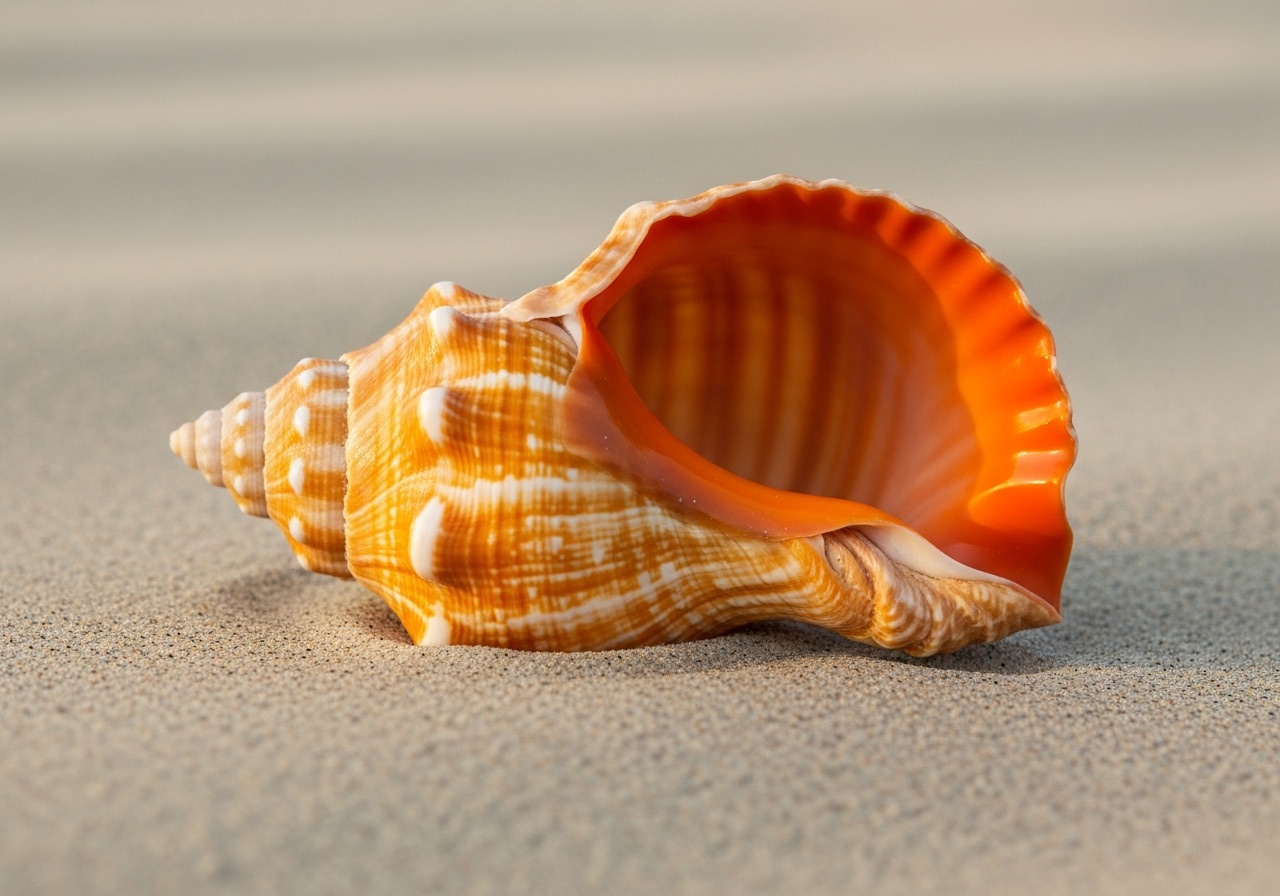
The horse conch is a true giant — the largest sea snail in U.S. waters and one of the biggest in the world, with the record reaching roughly two feet long. Despite the name, it's technically a whelk, a fierce predator that hunts other snails along the Gulf bottom. A living one shows off soft tissue in a startling burnt-orange that almost glows; the empty shell weathers to a chalky gray-white with a spindle shape and a tall spire. Pick up a big one and the weight alone tells you this isn't an ordinary beach shell.
Why Florida chose it
Florida named the horse conch its official state shell in 1969, and the logic is easy to love. It's native up and down both Florida coasts, it's unmistakably big and dramatic, and it's a genuine local heavyweight rather than a shell you'd find anywhere. There's a nice bit of trivia here too: the horse conch is the state shell, but it is not the same as the lightning whelk, whose own claim to fame is opening left-handed. People mix the two up constantly. If you want to keep your Gulf snails straight, our whelk vs. conch breakdown sorts the whole confusing family out.
| Feature | Detail |
|---|---|
| Status | Florida state shell since 1969 |
| Size | Up to ~24 in — largest U.S. gastropod |
| Alive | Vivid burnt-orange soft tissue |
| Empty | Gray-white spindle with tall spire |
| Family | Actually a whelk, a predatory snail |
The empty-only rule you must know
This is the part too many visitors miss. Because the horse conch is big and beautiful, the temptation to grab a live one is real — but in Collier and Lee County, taking live shells is prohibited. If you flip a horse conch and find that bright orange animal still inside, gently set it back exactly where you found it. An empty shell — faded, vacant, no occupant — is yours to keep. The same rule covers sand dollars and starfish. Our guide to live shell vs. empty shows you exactly how to tell, so you collect with a clear conscience.
Where you might see one
Honestly, big intact horse conchs are an uncommon beach prize — they live in deeper grass flats and don't wash up every day. Your best odds are the boat-only barrier islands, where Gulf-facing beaches get less foot traffic and the good shells aren't picked over by mid-morning. Our captains run shelling tours to the low tides on islands like Keewaydin and Kice, where you've got a real shot at a state-shell-worthy find. Even if you don't snag the giant, you'll come home with bags of beautiful Gulf shells and a story or two.
From the Helm: Picking a fresh horse conch out of the wrack line off Panther Key after a front
The best horse conch shells we find rarely turn up sitting pretty in open sand — they’re buried at the edge of the wrack line, that ragged strip of grass and shell debris the tide leaves along the swash off spots like Panther Key after a winter cold front pushes through. Our captains walk that line slower than guests expect, eyes down, because the shell’s weight usually gives it away before its color does, a dense, solid heft sitting under a thin layer of sand and turtle grass that a lighter shell wouldn’t have.
Pick up a fresh-dead horse conch and you’ll notice it immediately — it sits heavier in your palm than its size suggests, the spire still sharp-edged rather than worn smooth, and if you’re lucky enough to catch one recently vacated, a trace of that burnt-orange color still clings inside the aperture before the sun bleaches the whole thing gray-white. A shell that’s tumbled through the surf for a season feels different: lighter, the lip chipped and rounded, any color long gone. Both are legal finds, but only one still tells you it was recently alive out there.
Falling tide after a cold front is genuinely the best combination for this, and not because shells wash in fresh overnight — it’s that the retreating water strips away the loose sand covering what’s already down there, exposing shells that have been sitting buried for who knows how long. A calm summer evening low can turn up plenty too, just usually smaller specimens than the true giants a winter front tends to expose along that same stretch of beach.
Before anyone pockets one, we always ask them to check for a tenant — a horse conch’s own shell can be reoccupied by a hermit crab long after the original snail’s gone, and it’s an easy thing to miss when you’re excited about the size of a find. A quick peek at the opening and a gentle tip toward the light usually settles it fast, and if something’s living in there, back it goes onto the sand exactly where it was picked up, no exceptions in Collier County waters.
That combination — a fresh find, the right weight in your hand, and the confidence to check it’s truly empty — is most of what separates a lucky beach walk from an actual horse conch story worth telling. Pair a front-driven low with one of our shelling tours out toward islands like Panther Key, and add a stop through the broader shell guide if you want to know what else might be sitting in that same wrack line.