
📖 At a glance
- Scientific name
- Busycon sinistrum
- The quirk
- Sinistral — coils counter-clockwise, opens LEFT
- How rare
- One of very few large left-handed sea snails
- Where & when
- Keewaydin, Kice & the Ten Thousand Islands; best after a winter front
- Rule
- Empty shells only in Collier & Lee County
Why it coils to the left
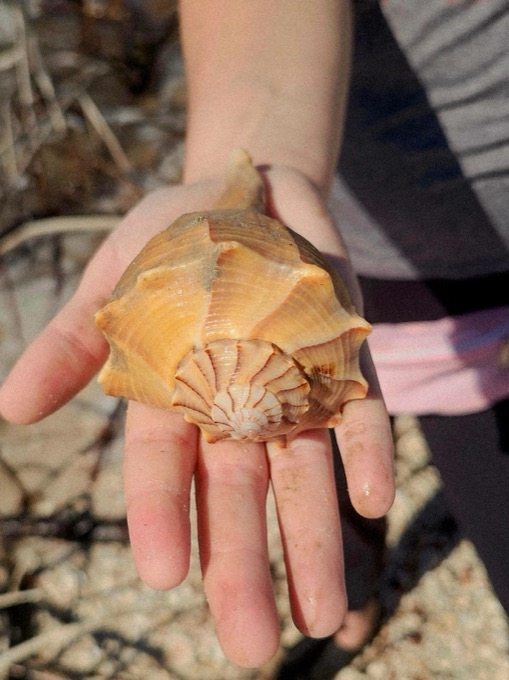
Almost every sea snail on the planet grows its shell by spiraling clockwise, which puts the opening on the right when you hold the pointed spire up. The lightning whelk does the opposite — it spirals counter-clockwise from the moment it’s a tiny larva, so the whole shell winds up “backward.” Scientists call that sinistral coiling, and its scientific name, Busycon sinistrum, literally points at the left-handedness. It’s baked into the animal’s genetics, not the result of a wave or a bad break. So every lightning whelk you find, from a thumb-sized juvenile to a sixteen-inch giant, opens on the left. That’s why the second you flip one over and feel it open the “wrong” way, you know exactly what you’re holding.
How to tell it from a true whelk
This is where the left-handed trick earns its keep. Set a lightning whelk next to a knobbed whelk or a pear whelk and they look like cousins — pear-shaped body, low spire, a long canal at the bottom. The difference is which way they open. Lightning whelks open left; the “true” whelks (knobbed, channeled, pear) all open right. Once you’ve got that, the rest is just texture. Young lightning whelks wear thin brown streaks fanning down the body like little lightning bolts, which fade to a clean grayish-white with age. For a deeper side-by-side, our lightning vs. knobbed whelk breakdown lays it all out, and the left-handed shells guide covers the handful of other sinistral species you might run into.
| Shell | Opens on the… | Quick tell |
|---|---|---|
| Lightning whelk | Left (sinistral) | Knobbed shoulder, lightning streaks when young |
| Knobbed whelk | Right (dextral) | Taller knobs, no streaks |
| Pear whelk | Right | Smoother, no big shoulder knobs |
Why it's a prized local find
A big, intact lightning whelk is one of the trophies of Southwest Florida shelling. They’re not rare exactly, but a whole one without a chipped lip or worn-down spire takes some luck and good timing. They like the wide, sandy Gulf-facing flats of the boat-only barrier islands, and the freshest ones turn up where nobody can drive to pick the beach clean. On our shelling tours we run out to Keewaydin Island, Kice and the Ten Thousand Islands, timing trips to low tide after a winter cold front when the Gulf shoves fresh shells ashore. Find a whole, empty one and that’s the photo that ends up on the fridge. Just be sure nothing’s living inside — Collier and Lee County are empty-shells-only.
From the Helm: The thumb test our captains use on Panther Key lightning whelks to prove the twist is real
Half the guests who find a lightning whelk on a Panther Key beach walk back to the boat convinced it’s broken, not left-handed. Our captains have the same response every time: turn it spire-up, opening toward you, and run a thumb down into the aperture. If your thumb naturally slides in on the left instead of the right, nothing is wrong with that shell — it grew that way from the very first whorl. Guests usually flip it over two or three times before it clicks, and that moment of the shell finally making sense is half the fun of finding one.
A fresh lightning whelk off Panther Key feels different in the hand than one that’s tumbled around the Gulf for a season — heavier for its size, the outer lip still sharp rather than worn smooth, sometimes with faint brown streaking still visible near the aperture instead of bleached fully white. Our captains will point out that streaking specifically, since it fades fast in the sun and is one of the easier tells that a shell came off the flat recently rather than washing around for weeks first. Give it a gentle tap against a fingernail, too — a solid, unbroken shell rings a little sharper than one with a hairline crack you might otherwise miss.
The mistake we correct most isn’t the direction of the coil, it’s guests assuming every whelk they find must be a lightning whelk simply because it’s big. We’ll do the same thumb test on a knobbed whelk right next to it so the difference registers side by side — right-handed, blunter shoulder, no mistaking the two once you’ve held both. That comparison, more than any description, is usually what makes the identification stick for the rest of the trip, and it’s a habit we pass on to newer crew before they ever run their first shelling trip solo.
Whatever we find gets photographed and set back down — empty-shell rules apply on every Collier County island we visit, and a lightning whelk is no exception even when it’s the best find of the day. Our captains carry that expectation into the briefing before anyone steps off the boat, so nobody’s disappointed at the rail later on. The shell stays on the sand for the next tide to work on; the photo, and the story of the shell that opens the wrong way, is what comes home with you instead.
If shells like this are the whole draw for you, our shelling tours run to exactly the kind of boat-only islands where lightning whelks turn up, and the broader seashell guide is worth a look before you go so you know what else might be sitting in that same wrack line.