
🐚 At a glance
- Scientific name
- Busycotypus spiratus
- Size
- Commonly 3–5 in
- Tell-tale
- Smooth, pear-shaped, low spire — no knobs
- Note
- The true channeled whelk does not occur on the SW FL coast
- Rule
- Empty shells only — live collection is banned in Collier & Lee
How to identify a pear whelk
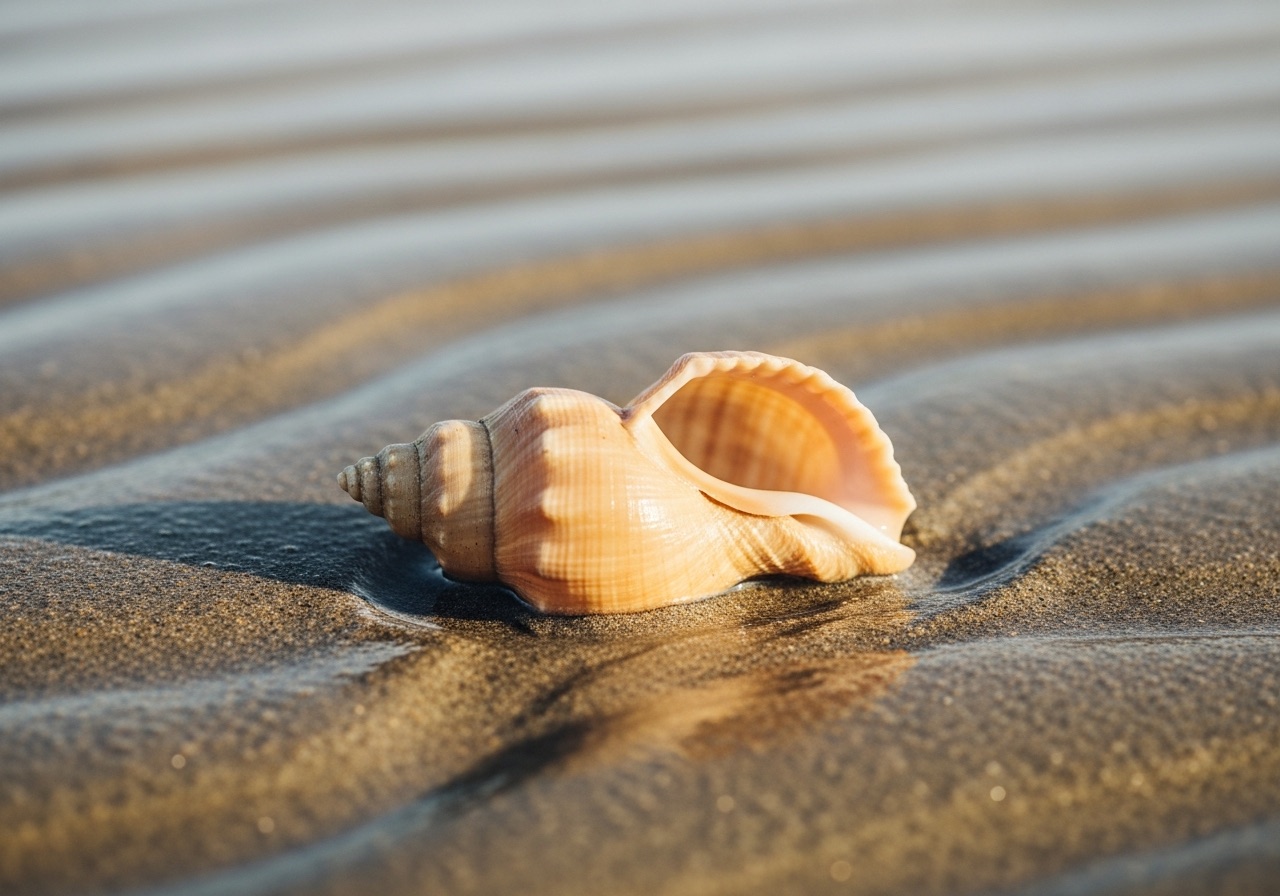
The pear whelk earns its name honestly: it’s a clean, pear-shaped shell, widest at the shoulder and tapering to a fairly short canal. The surface is smooth and the spire is low, giving it a softer, rounder profile than its bumpy cousins. The color runs creamy tan with faint brownish streaks, and the shoulder has a gentle channel or shelf rather than knobs. Set it next to a knobbed whelk or lightning whelk and the difference is obvious — no spines, no big knobs, just a smooth, graceful shell.
Why it's not the channeled whelk
This is the one worth getting right. The true channeled whelk (Busycotypus canaliculatus) has a deep, distinct groove spiraling between its whorls — and it simply doesn’t live on the Southwest Florida Gulf coast. So when a guidebook or a fellow beachcomber points at your smooth whelk and says “channeled,” the honest answer is almost always pear whelk. They look similar at a glance, but the pear whelk’s shoulder channel is shallow and its overall shape is plumper and more pear-like.
| Shell | Surface | Quick tell |
|---|---|---|
| Pear whelk | Smooth, low spire | No knobs; shallow shoulder channel |
| Knobbed whelk | Knobbed shoulder | Tall, pointed knobs |
| Lightning whelk | Knobbed, streaked when young | Opens LEFT (sinistral) |
Where we find them
Pear whelks are a common, reliable find on the Gulf-facing beaches around Naples and Marco Island, and the freshest ones land on the boat-only barrier islands where crowds can’t pick them over. On our shelling tours we run to Keewaydin Island, Kice Island and the Ten Thousand Islands, working the wrack at low tide after a winter front. They’re a great shell for a beginner to learn on because they’re both common and distinctive. As always, keep only empties — Collier County is empty-shells-only.
From the Helm: Finding pear whelks on the low-tide flats at Dollar Bay
Someone hands us a smooth, pear-shaped whelk almost every week and calls it a channeled whelk, and we don’t rush to correct them — we just ask them to run a thumb over the shoulder first. There’s no knob, no spine, nothing to catch on, and that alone is usually enough for a guest to talk themselves into the right answer before we ever say a word. It’s one of the more common shells we hand across the rail, and one of the most consistently misnamed.
This is a shell we find often, not occasionally, and mostly on the quieter bay-side sand flats rather than the open Gulf beach — the flats at Dollar Bay hold them reliably on a low, dropping tide, tucked into the same soft bottom the whelks use to hunt. We don’t need a storm or a cold front to turn one up here the way some shells demand it; an ordinary low tide on an ordinary morning is usually enough.
In hand, a pear whelk feels lighter and smoother than its knobbed cousins, the shoulder rounding away instead of stepping out in ridges, and the whole shell carries a plain, almost soapy finish under a thumb. We tell guests that smoothness is the whole test — no counting spines, no measuring anything, just whether the shoulder catches a thumbnail or lets it slide straight past.
We work these flats on foot as the tide drops, walking the drainage cuts where water is still running off rather than the driest high ground, since that’s where a whelk that’s been feeding tends to still be sitting. It’s an easier, lower-effort hunt than some of the boat-only islands we run for rarer shells, which makes it a good stop early in a trip before anyone’s tired of looking down.
On a shelling tour with us, this is usually the smooth whelk you end up holding by the end of the day, and the whelk comparisons elsewhere in the guide sort out the knobbed and lightning look-alikes if a knobbier one turns up beside it. Keep it as the empty shell it already was when you found it.
We don’t dress this one up with a big buildup at the rail, since it shows up often enough that oversell would feel a little silly. What we do instead is let a guest find their own second and third one once they’ve got the smoothness test down, since it’s one of the few shells out here where a first-timer can go from confused to confident on their own within the same short stop.