
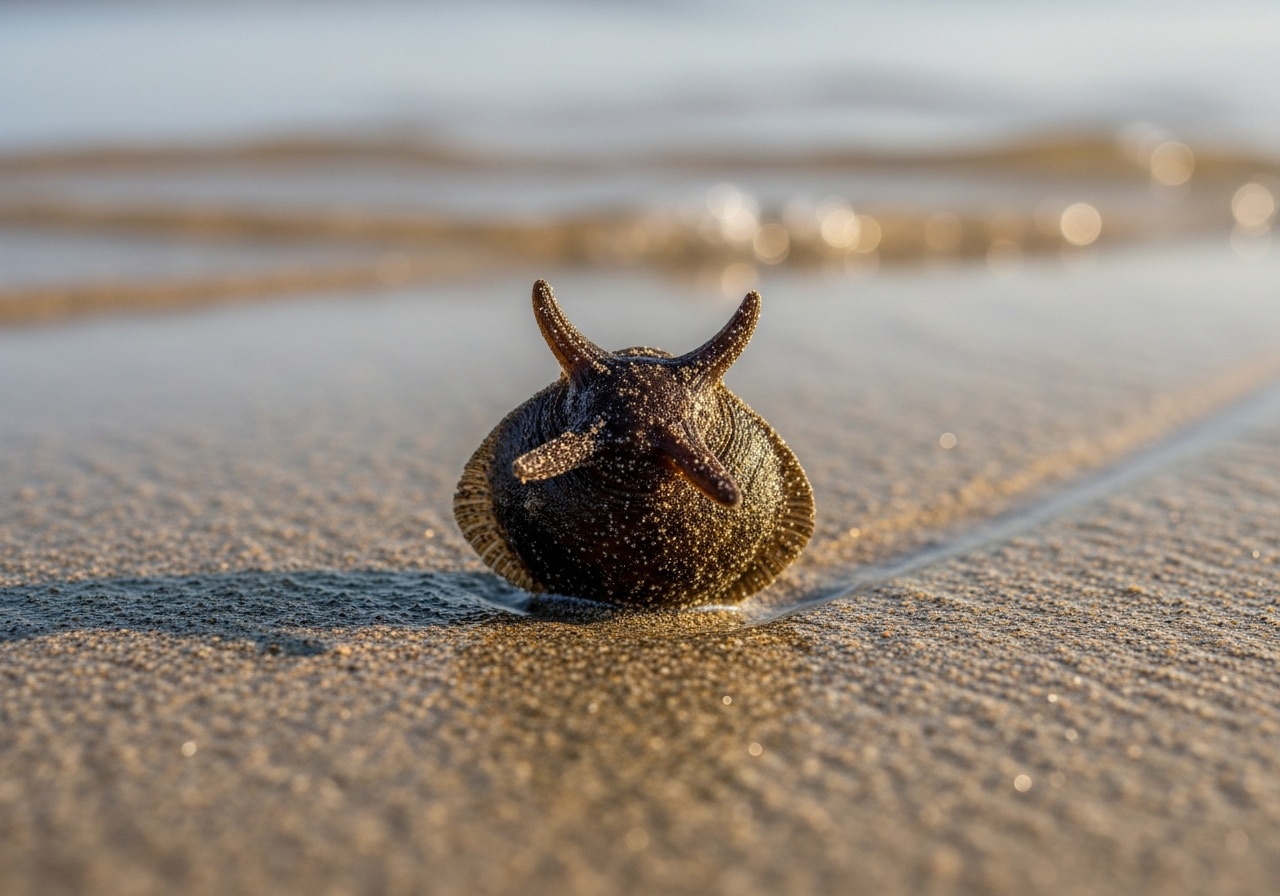
🐚 At a glance
- What it is
- The egg case of a skate (family Rajidae)
- Look
- Flat black-brown keratin pouch with four pointed horns
- Size
- Roughly 2–4 in across, leathery and dry
- Where & when
- In the wrack line on outer-island beaches, often after storms
- Rule
- Empty cases are fine to keep — empty finds only in Collier & Lee
How to identify a mermaid's purse
Pick it up and you'll see why it earned a fairy-tale name. A mermaid's purse is a small, flattened rectangle, usually blackish-brown, made of the same tough keratin as your fingernails. The four corners each taper into a curved, pointed horn, and the long edges often have a thin seam running down them. When fresh they feel slightly rubbery; after baking on the beach a while they go stiff and crackly. Nothing else in the wrack quite matches that four-horned outline — it's a dead giveaway. You'll usually find them tangled in dried seagrass and algae alongside whelk egg cases and bits of sponge and sea whip.
Why it's a skate, not a ray
Here's the part most beach signs get wrong. People call these “ray egg cases,” but in our Gulf waters they almost always come from skates. The difference is in how the two groups reproduce: most of our local rays — southern stingrays, cownose rays, eagle rays — give birth to live young, so they don't lay egg cases at all. Skates, on the other hand, are egg-layers. Four skate species roam the Gulf shelf off Southwest Florida (spreadfin, rosette, clearnose and roundel skate), and the leathery purses you find washed up are theirs. So when you hold one, you're holding the nursery of a skate, not a stingray.
| Animal | How young arrive | Leaves an egg case? |
|---|---|---|
| Skate (Rajidae) | Lays eggs in a leathery case | Yes — the mermaid's purse |
| Stingray / cownose / eagle ray | Live birth | No |
Hatched or still cooking?
Almost every purse you find on the beach is already empty — the baby skate hatched at sea and the case drifted ashore later. To check, look at the ends. A hatched case has an open slit at one end where the pup wriggled out, and it'll feel light and hollow. A rare unhatched one feels heavier and stays sealed; if you find one of those near the waterline, the kind move is to gently set it back in the shallows so the embryo inside has a chance. Either way, a dry empty purse is a great keepsake and a fun thing to show the kids on our shelling tours — just remember Collier County is empty-finds-only. These show up best on the wild outer beaches we reach by boat, especially after a blow churns the wrack line.
From the Helm: Mermaid’s Purses: working the mangrove wrack behind Dollar Bay after a wind shift
The calmer wrack line tucked behind Dollar Bay, in the lee of the mangroves, is where these little black egg cases turn up most reliably for us, especially in the day or two after a wind shift pushes loose weed and debris off open water into that quieter corner. Out on the exposed Gulf beaches the same cases get buried or torn apart by surf; back here in the mangrove-sheltered shallows, they settle gently into the weed line mostly intact, horns and all. We run there specifically for that reason rather than a longer open beach.
A fresh case still has some give to it, dark and almost rubbery, and if you hold it up to the sun you can sometimes see whether it’s already hatched or still has something inside. An older, sun-worn one goes brittle and pale gray, the horns snapping off if you’re not gentle picking it out of the weed. Our captains hand guests both stages when the wrack offers them, since feeling the difference between a fresh, pliable case and a bleached, cracked one teaches the identification faster than any description does.
Most of what we find has already hatched and is simply drifting empty, which is worth saying plainly, since a few guests always assume every one holds a live skate waiting inside. Empty is the honest default, and it’s still a genuine find either way — a real look at how a bottom-dwelling fish reproduces, no aquarium required. If the mangrove wrack is thin on a given stop, we’ll work the open flats past Coon Key Pass instead, where a different mix of debris tends to collect after the same wind.
We treat every case the same way we treat the rest of a beach-finds stop — empty and dead only goes in the bag, no exceptions, and that habit gets repeated at the rail before anyone starts sorting through weed. Guests curious about the skates and rays themselves will find more in the wildlife hub, and this stop typically tags along inside a longer shelling tour rather than running as its own trip.
The whole stop rarely takes more than a few unhurried minutes, since the mangrove wrack concentrates finds into a narrow band rather than spreading them across open sand. We’d rather guests spend that time turning a few cases over carefully than racing down a long beach hoping for volume. It’s a quieter, shadier stop than the open Gulf beaches too, one that guests traveling with young kids or during the hottest part of the day tend to appreciate more than they expect going in.