
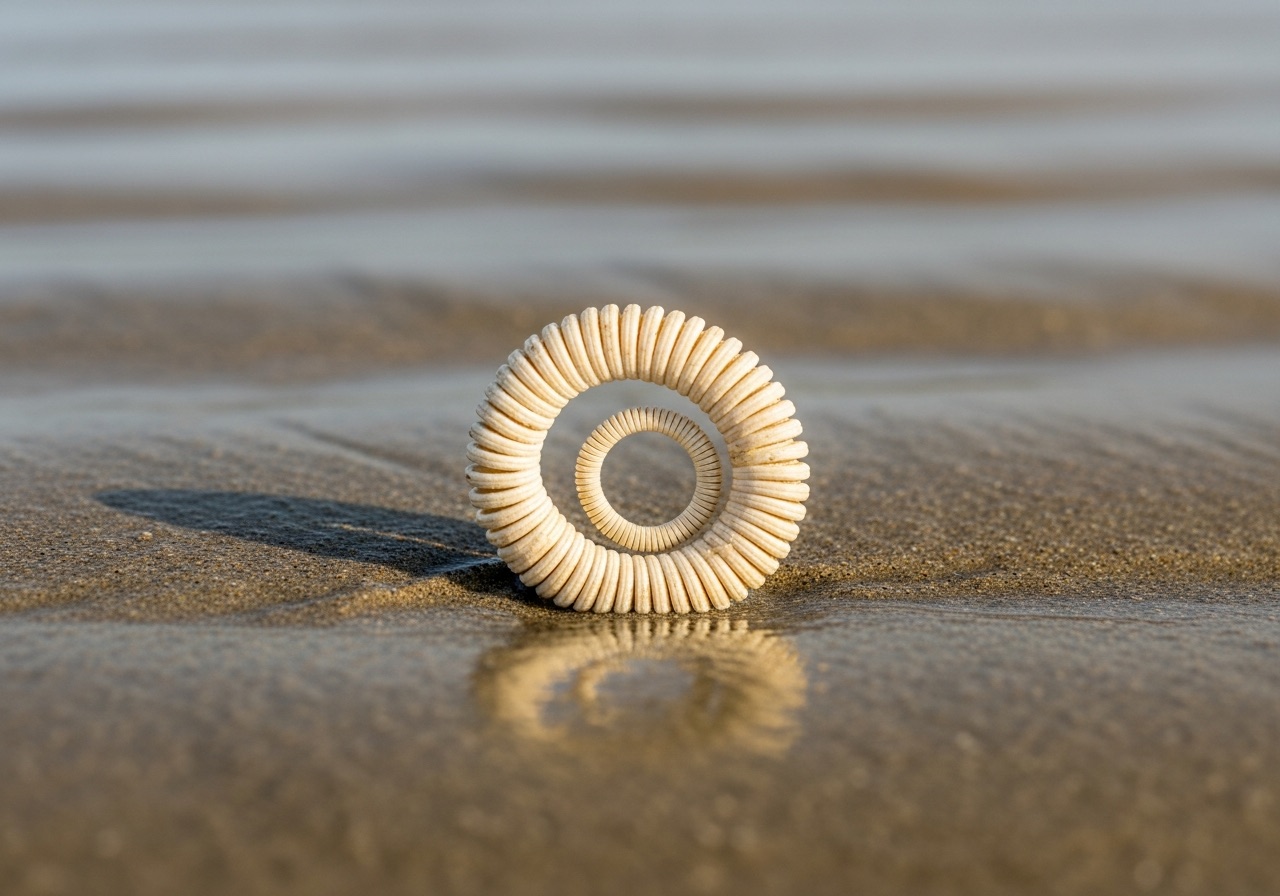
🐚 At a glance
- What it is
- The egg-capsule strand of a whelk (most often lightning whelk)
- Look
- A coiled string of flat, papery, coin-like discs
- Inside
- Each disc holds dozens of miniature developing whelks
- Where & when
- In the wrack on Gulf-facing island beaches, year-round
- Rule
- Empty strands fine; return any with live eggs inside
How to identify a whelk egg case
People pick these up thinking they're some kind of seaweed, plastic, or a dried-up rattlesnake tail. They're none of those. A whelk egg case is a single coiled strand, often a foot or more long, made of dozens of flat, parchment-thin discs strung together down a central spine. Hold one up to the sun and you can sometimes see the outlines of the embryos still tucked inside. Give a spent one a gentle shake and you may hear the rattle of tiny finished baby shells rolling around in their capsules — that sound is the giveaway that the whelks already hatched and crawled away.
Telling whelk strands from conch strands
Not every egg case on the beach is a whelk's. The lightning whelk lays that classic coil of stacked discs, and so do its cousins the knobbed and channeled whelks, with slightly different disc edges. Conchs do it completely differently. The Florida fighting conch and its relatives lay long, tangled, spaghetti-like egg strings rather than neat coiled discs — another quick way to tell the two groups apart, just like you can with the grown shells in our whelk vs. conch guide.
| Egg case | Shape | Most likely from |
|---|---|---|
| Coiled disc-strand | Stacked papery coins on a coil | Lightning, knobbed or channeled whelk |
| Tangled string mass | Spaghetti-like loose strands | Florida fighting conch & relatives |
When to return it to the water
Here's the rule of thumb our captains use. If the discs are dry, crisp and empty — the babies long gone — the strand is just a beautiful spent keepsake, and an empty one is fine to keep in Collier County. But if the capsules feel soft and plump and you can see eggs still developing inside, that strand is a living nursery. The kind thing is to walk it back to the wet sand and let the tide take it — those are dozens of future whelks. Either way it's a wonderful thing to find, and a teaching moment we love sharing with kids on our shelling tours. As with all our shelling rules, we only bring home what's truly empty, and you'll see far more of these on the wild outer beaches we reach by boat than on the picked-over mainland.
From the Helm: Finding Whelk Egg Strands in Coon Key Pass's Oyster Bars
We choose the oyster bar flats inside Coon Key Pass for this one, not the open Gulf beaches, because the calmer water tucked behind the bar snags drifting whelk strands against the shell rock instead of letting them wash straight through. As the tide pushes in and covers the flats, strands that broke loose somewhere out in the pass drift in and hang up on the exposed oyster clusters, looking at a glance like a tangle of dead seaweed until you get close enough to see the coin-like discs. A brisk wind riding on top of that push speeds the whole process along, sometimes stacking two or three strands against the same cluster instead of the single find we usually turn up.
We wear old dive booties onto that bar rather than bare feet, since oyster shell edges are sharp enough to cut and the footing is uneven between clusters. Once we spot a strand caught on the rock, we lift it by the top end and let the rest hang free rather than gathering it into a coil, because that's the only way to check every disc along its length without missing a live section tucked in the middle of an otherwise spent strand.
A spent strand feels dry and papery even wet, and the discs crack a little at the edge when you press one between two fingers — that's the one worth keeping. A strand still doing its job feels slightly swollen at each disc, almost rubbery, and holding it up to the light shows small dark shapes inside instead of empty space. We hand back anything with that rubbery feel immediately, laying it gently across the same oyster cluster instead of setting it loose in open water where the current might strand it somewhere worse. We've learned to check the middle discs as carefully as the two ends, since a strand can look spent at both tips while a handful near the center are still very much alive.
When the bar itself hasn't caught much yet, we work the mangrove root edge just inside the pass instead, where the same drifting strands tend to snag on prop roots at that same stage of water. It's a slower pick through more clutter, but it keeps the stop from coming up empty on a morning when the oyster bar hasn't caught anything on its own.
The lightning whelk that laid most of these strands is worth knowing on its own — you can read up on it over in the seashell guide before you go looking. We usually work this stop into a broader shelling tour through the pass, since the bar sits right on the way out to the barrier islands anyway.