
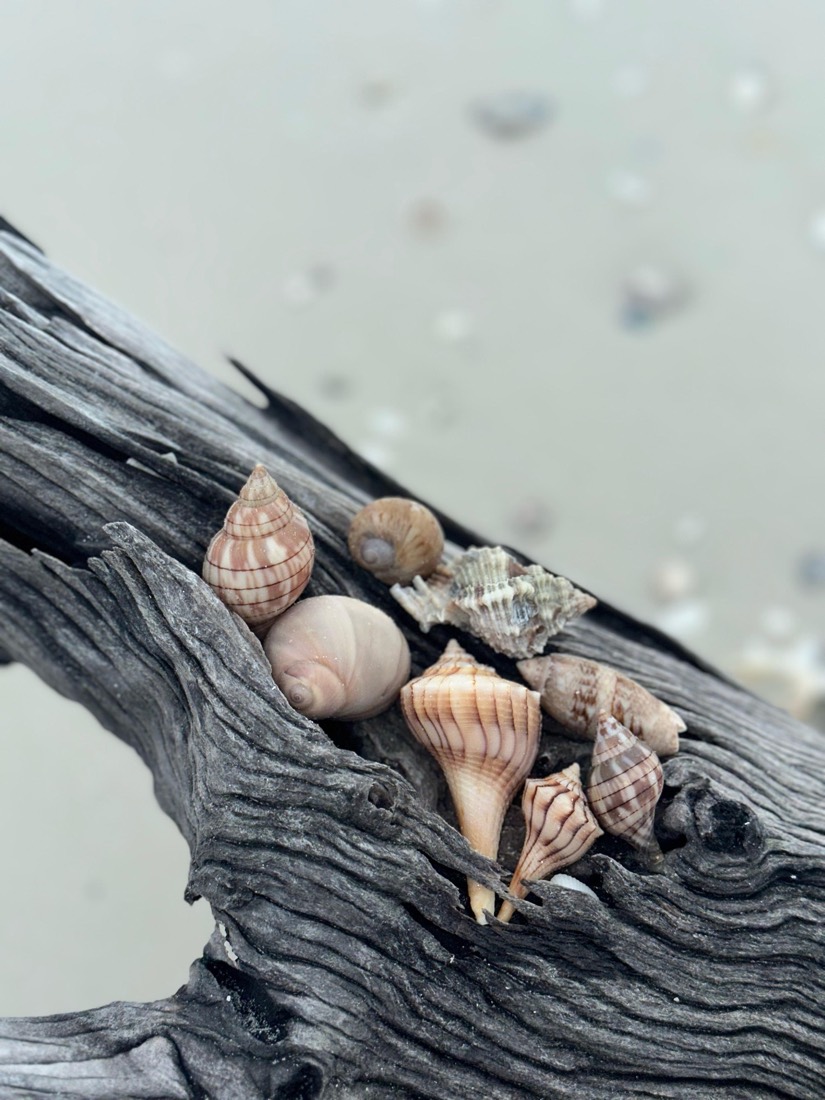
🐚 At a glance
- True scallops
- Calico (Argopecten gibbus) & lion's paw (Nodipecten nodosus)
- Look-alike
- Kitten's paw (Plicatula gibbosa) — not a true scallop
- Scallop tell
- Small wings (“ears”) on each side of the hinge
- Rarity note
- Calico & kitten's paw common; lion's paw a prized find
- Rule
- Empty shells only in Collier & Lee
The true scallops
True scallops belong to the family Pectinidae, and you'll meet two of them here. The calico scallop is the little crowd-pleaser — a couple of inches across, fan-shaped, and splashed with bright mottled patterns in red, purple, orange, white and brown, no two alike. Kids fill cups with them. The lion's paw is the heavyweight: a thick, deeply ribbed shell, usually a rich orange or red, with raised bumpy knobs marching along the ribs. We'll be honest — a whole lion's paw is a genuinely prized find around here and not something you should expect every trip, which is exactly why it earns a spot among our rarer Gulf shells.
The impostor: kitten's paw
Now the fun part. The kitten's paw is small, ribbed, fan-ish and easy to mistake for a baby scallop — but it's in a different family entirely (Plicatulidae). It's usually a chunky little white shell with bold dark-edged ribs that really do look like a tiny paw print, and unlike a true scallop it cements itself down to rocks and shells as it grows. The dead giveaway is the hinge: true scallops have small triangular wings, or “ears,” on either side of the hinge line, and the kitten's paw has none.
| Shell | True scallop? | Quick tell |
|---|---|---|
| Calico scallop | Yes | Small, mottled bright colors, has ears |
| Lion's paw | Yes | Big, heavy, knobbed ribs, orange-red |
| Kitten's paw | No (look-alike) | Small white, dark-edged ribs, no ears |
Telling them apart on the beach
Run this quick sort. Tiny and rainbow-mottled with ears? Calico scallop. Big, thick and knobby? Lion's paw — pocket that one, it's special. Small, white, with bold dark ribs and no ears at the hinge? That's your kitten's paw impostor. All three turn up on the boat-only island beaches we reach on our shelling tours, with the freshest, most colorful hauls after a storm or cold front stirs them in around Cape Romano and the outer islands. Whatever you scoop up, it's empty shells only in Collier County.
From the Helm: hunting scallop shells in the swash at Caxambas Pass after a wind-chop day
After a day or two of brisk wind kicks up a little chop, we like to idle the shoal edge at Caxambas Pass and let guests work the swash line right where the small waves are breaking. Scallops and their look-alikes don’t bury themselves the way a pen shell does — wind and wave energy tumble them, so you’re watching the water’s edge for a flash of color rolling in the last few inches of wash rather than digging anywhere. It’s a different kind of hunting than most of our stops, more watching than digging, and it moves fast once you get the rhythm of it.
Polarized sunglasses matter here more than almost anywhere else we stop, since a calico scallop’s color can look almost identical to wet sand until the glare cuts away and the ridges pop into focus. We tell guests to watch one small patch of swash rather than scanning the whole shoreline — let the water bring the shells to you instead of chasing up and down the beach. A kitten’s paw will catch your eye the same way at first glance, which is exactly why so many guests pick one up expecting a scallop and learn otherwise on the spot.
A calico scallop fresh out of the swash still has real color and a slight sheen to it, thin ridges you can feel individually under a thumbnail. Give it a few weeks of tumbling and both the color and the ridge definition start to fade. A lion’s paw is the one that surprises people most in hand — it’s genuinely weighty for its size, almost like you’re holding a small paperweight instead of a shell, and finding one at all is a bonus, not something we count on for any given trip.
If the wind’s been dead calm for several days before your trip, the swash at Caxambas goes quiet and we’ll shift the stop to wherever the chop’s actually working that morning instead of forcing a spot that isn’t producing. Wind direction matters more for this hunt than tide stage does, which is the opposite of most shelling we do, and it’s worth asking your captain about conditions before you book if fan shells are your main goal for the day.
Pair this stop with a run at the Sanibel Six families on the same trip and you’ll leave with a genuinely varied cup of shells rather than just fan shapes. We usually work this swash early in a trip, right after checking the wind that morning, since a shift in direction can shut a good swash down again within an hour or two of finding it. Either way, everything comes home empty here in Collier County, kitten’s paw included even though it isn’t a true scallop at all. We build this stop into several of our shelling tours whenever the wind cooperates.