
🐬 At a glance
- What it is
- A tern-like seabird, the only bird with a longer lower bill
- Tell-tale
- Skims open-mouthed across calm water at dusk; red-based black bill
- Where & when
- Big Marco Pass & Sand Dollar Island sandbars; best at dawn and dusk
- Status
- State-threatened — keep well back from nesting flocks
How to identify a black skimmer
Start with the silhouette: a slim, long-winged bird, jet black above and clean white below, flying low and straight like it's on rails. Then look at the bill, because that's the dead giveaway. It's a flattened blade, bright red at the base fading to black at the tip, and the lower half sticks out well past the upper half. No other bird in North America has that. On the ground they loaf in tight, all-facing-the-same-way flocks on the open sand, often mixed with terns. In flight they're quieter and steadier than the terns, with deep, easy wingbeats.
If you're working through the shorebirds on our wildlife-by-season list, the skimmer is the one that needs no second guess once you've clocked that bill.
Why it plows the water with its mouth open
That oversized lower bill isn't a deformity — it's a tool. The skimmer flies just above the surface with its mouth hanging open and the long lower mandible knifing through the water. The instant it touches a small fish, the bill snaps shut. It's pure touch, no sight, which is exactly why you see them working at dusk and after dark when the water lies flat and the fish push up shallow. Watch one make a pass and you'll see the thinnest little wake peel off behind the bill. They'll run the same stretch of glassy pass over and over, banking around for another lap. It's one of the best feeding shows on the water, and a favorite stop on our dolphin & wildlife tours.
Where and when we see them
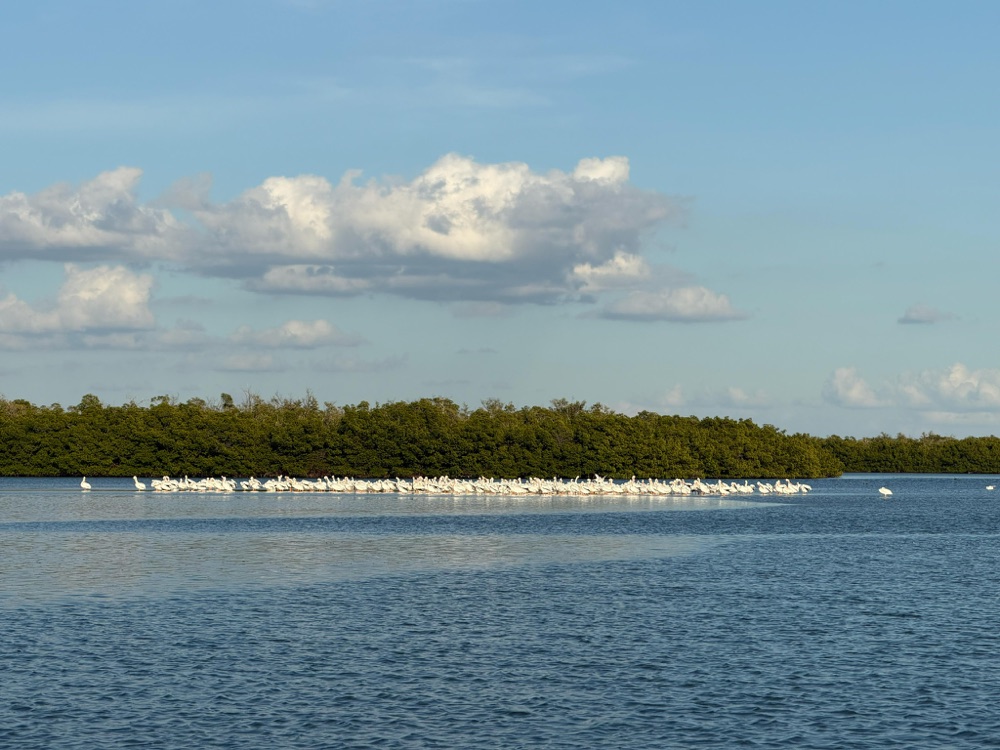
Skimmers love the wide, undisturbed sandbars where the passes open to the Gulf. Around Marco that means Big Marco Pass and the Sand Dollar Island Critical Wildlife Area, where they nest right on the open sand alongside terns and plovers. Because the eggs and chicks are camouflaged into the sand, a posted nesting colony is one place we always give a wide berth — a flushed flock can mean lost eggs. We run our wildlife loops out toward Big Marco Pass at the calm ends of the day, which is both the best light and the best feeding window. Cooler months bring bigger flocks down with the snowbirds; summer thins them out to the breeders.
| Bird | Bill | Feeding style |
|---|---|---|
| Black skimmer | Red-black blade, lower half longer | Skims the surface by touch |
| Royal tern | Orange, even-length | Plunge-dives from the air |
| Least tern | Yellow, even-length | Hover-and-dive on small fish |
Giving the colony room
Black skimmers are listed as state-threatened in Florida, and the biggest thing you can do for them is simple: don't push a resting or nesting flock. We watch from the water with the camera doing the zooming, never the boat. The same goes for the other shorebirds sharing those sandbars. Keep your distance and the flock keeps doing its thing, and you get the far better show — a colony at ease, plowing the dusk pass for dinner.
From the Helm: Watching skimmers work Caxambas Pass at dusk
Skimmers need water they can trust, so before we look for the bird we're checking the pass itself — Caxambas Pass has to lie glass-calm, no chop rolling in off the Gulf, before a skimmer will commit to flying that lower bill through the surface at speed. A choppy pass just means the birds sit it out on a sandbar instead, so a dead-calm dusk is really the whole ballgame here, more than any particular time on the clock.
Once conditions cooperate, we idle well off to the side of the flight line rather than motor down the middle of it — a skimmer working a pass flies a repeated track low over the water, and a boat sitting in that lane just pushes the whole line somewhere else. We cut to a slow drift and let the birds come to us instead of chasing the pass looking for action, holding that drift as long as the light allows.
The bill itself is the payoff up close: that long lower mandible slicing a thin wake of its own through the water, snapping shut the instant it touches a fish, all while the bird never seems to break stride in the air. It's an almost mechanical rhythm to watch repeat down the length of a calm pass, and dusk light does the color of that red-and-black bill more favors than midday sun ever does, turning it almost the same shade as the sky behind it.
When skimmers are nesting on an exposed sandbar rather than feeding, we hold much farther off and never let the boat drift down onto the bar itself — a flushed colony burns energy it can't spare and leaves eggs exposed to sun and to gulls. We'd rather guests get a slightly longer lens view than a colony that scatters because we crowded it for a closer look at a nest.
What surprises most guests at the rail is the sound as much as the sight — a faint hiss where the bill parts the surface, then a soft snap on a hit, repeated over and over down the line of the pass until it almost blends into the slap of small waves against the hull. We'll cut the engine entirely and just drift a minute so that sound carries clean across the water instead of getting lost under an idling motor.
If Caxambas Pass is choppy on a given evening, Coon Key Pass is often our next call, since the two don't always turn calm or rough at the same time, and one usually gives us the window the other won't. Pair a look at the pass with our bird photography guide if you're bringing a camera, or fold it into a sunset cruise timed to catch the pass at its stillest.