
📖 At a glance
- Most reliable
- Bottlenose dolphins — here year-round
- Seasonal star
- Manatees, gathering Nov–Mar in cooler water
- Birds
- Ospreys, pelicans, herons, egrets, spoonbills, ibis
- Lucky finds
- Sea turtles, rays, leaping tarpon
- Guaranteed?
- No — it's wild, and that's the fun of it
Dolphins: your near-sure thing
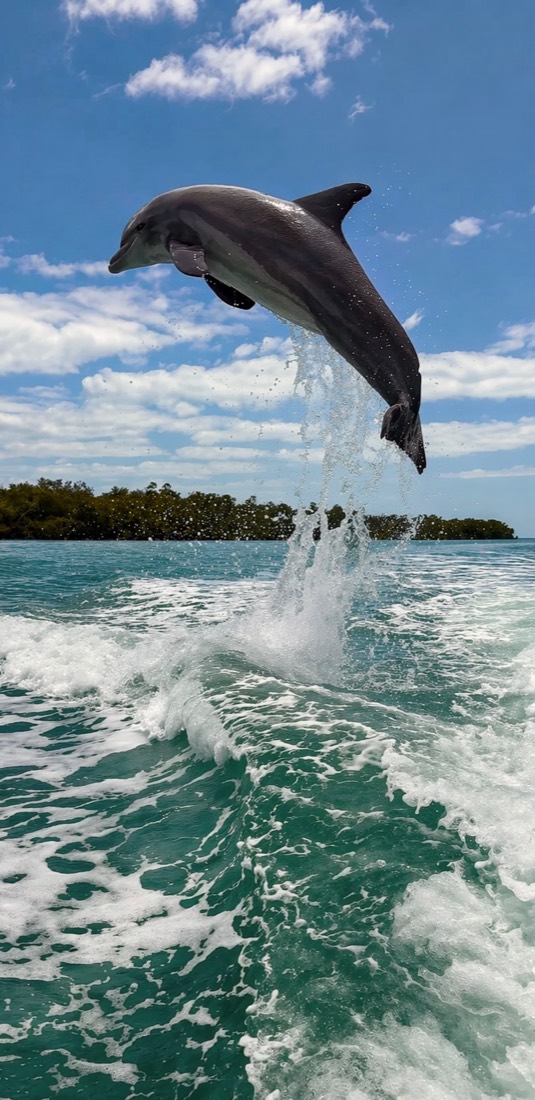
If there's one animal you can almost count on, it's the bottlenose dolphin. They live in these waters year-round — not migrating through, just home — and they're genuinely curious about boats. On a good day a few will peel over to ride the wake, rolling and surfacing just off the rail close enough to hear them breathe. We never bait or chase them; we just know the passes and grass flats where they like to hunt. If dolphins are the whole reason you're coming, our dolphin tours are built around finding them.
Manatees and the seasonal cast
Manatees are the prize most people don't expect. They're here, but they concentrate in the cooler months — roughly November through March, when Gulf temperatures drop below about 68°F and they move into the warmer, sheltered Rookery Bay mangroves. This isn't a Crystal River springs scene with herds packed in one window; our manatees are dispersed through the backwater, so a sighting is a real thrill rather than a sure thing. When you spot that gray back and whiskered nose rise for a breath, it's a moment. Curious how the season works? See our cold-season manatee rundown.
Birds you'll see almost every trip
The bird life out here is constant and underrated. Ospreys nest on channel markers and crash the water talon-first for fish. Brown pelicans dive-bomb in formation. Long-legged waders stalk the shallows — great blue herons, snowy egrets, white ibis — and if you're lucky, a flame-pink roseate spoonbill sweeps its spatula bill through the mud. The mangrove islands of the Ten Thousand Islands double as rookeries, so some days the trees are practically decorated with birds.
| Animal | When | How likely |
|---|---|---|
| Bottlenose dolphin | Year-round | Very likely |
| Ospreys & pelicans | Year-round | Very likely |
| Herons, egrets, ibis | Year-round | Very likely |
| Roseate spoonbill | Year-round, best fall–spring | Possible |
| Manatee | Nov–Mar | Seasonal, a real treat |
| Sea turtle / ray | Warm months | Lucky find |
The honest part: nothing's guaranteed
We'll level with you, because that's the only way to do this right: this is wild Florida, not an aquarium. We can't promise a dolphin will breach or a manatee will surface on cue. What we can promise is captains who've read this water their whole lives and know where the life is on a given tide. Some of the best sightings — a turtle popping up, a cownose ray gliding under the bow — are the ones we never see coming. Bring binoculars, keep your eyes on the water, and let the islands surprise you. For the full rundown, our wildlife checklist covers everything that calls these waters home.
From the Helm: The bird stacks and bait showers that tip off wildlife near Coon Key Pass
Long before a guest points and shouts, our captains are already watching for the signs that something’s working a school of bait. A stack of frigatebirds or terns wheeling low over one patch of water near Coon Key Pass usually means there’s bait balled up underneath, and where there’s bait, there’s often a dolphin pod working it from below. We’ll ease off the throttle and angle toward that stack well before anyone aboard has noticed a thing, because closing in slow and quiet is what keeps the animals comfortable enough to stick around.
A flat, oily-looking slick on otherwise rippled water is another tell our captains watch for constantly, especially over grass flats on a falling tide — it can mean a ray or a school of mullet stirring the bottom, sometimes a manatee working just under the surface. Mud boils, that cloudy blossom in clear shallow water, tell a similar story from a different animal. We’ll idle down and cut across at an angle rather than run straight over a slick, since a flat approach gives us a beat longer to see what’s actually underneath before the wake stirs it up. None of it guarantees a sighting; it’s simply where we point the bow first, because those signs have paid off often enough that ignoring them would be careless.
Once something’s in view, positioning the boat matters more than people realize. Our captains typically cut the engine to idle and let the boat drift into position rather than motoring straight at an animal, giving dolphins or a manatee room to choose whether they come closer. Guests get moved gently toward whichever rail has the better angle, and we’ll hold there rather than chase if the animal moves off — a pod that’s bow-riding on its own terms sticks around far longer than one that feels crowded.
Late winter into spring, we give extra room to any osprey nest platform along the route, because a pair working a nest gets noticeably more vocal and defensive if a boat lingers too close underneath. Our captains will point out the nest, then ease off rather than idle right beneath it — you still get a clear look, the birds stay settled, and it’s one of those small course corrections a first-time visitor would never notice unless someone explained it. It’s a habit built from running past the same nests trip after trip, and it’s the same reason we’ll cut the engine well short of a manatee rather than idle up close and let the animal decide if it wants to close the distance.
If wildlife is the whole reason you’re booking, our dolphin tours run routes built around these same signs, and the wildlife guide is a good rabbit hole if you want to know what you’re looking at before you ever step aboard. Either way, bring binoculars if you’ve got them — the birds are often the first clue something bigger is working just beneath the surface.
🧭 Captain’s call
- Signs we watch
- Bird stacks, bait showers, slicks and mud boils before any fin shows
- Our move
- Ease to idle and let the boat drift into position rather than motor straight in
- Best odds
- Calm morning water inside Coon Key Pass and the grass flats nearby