
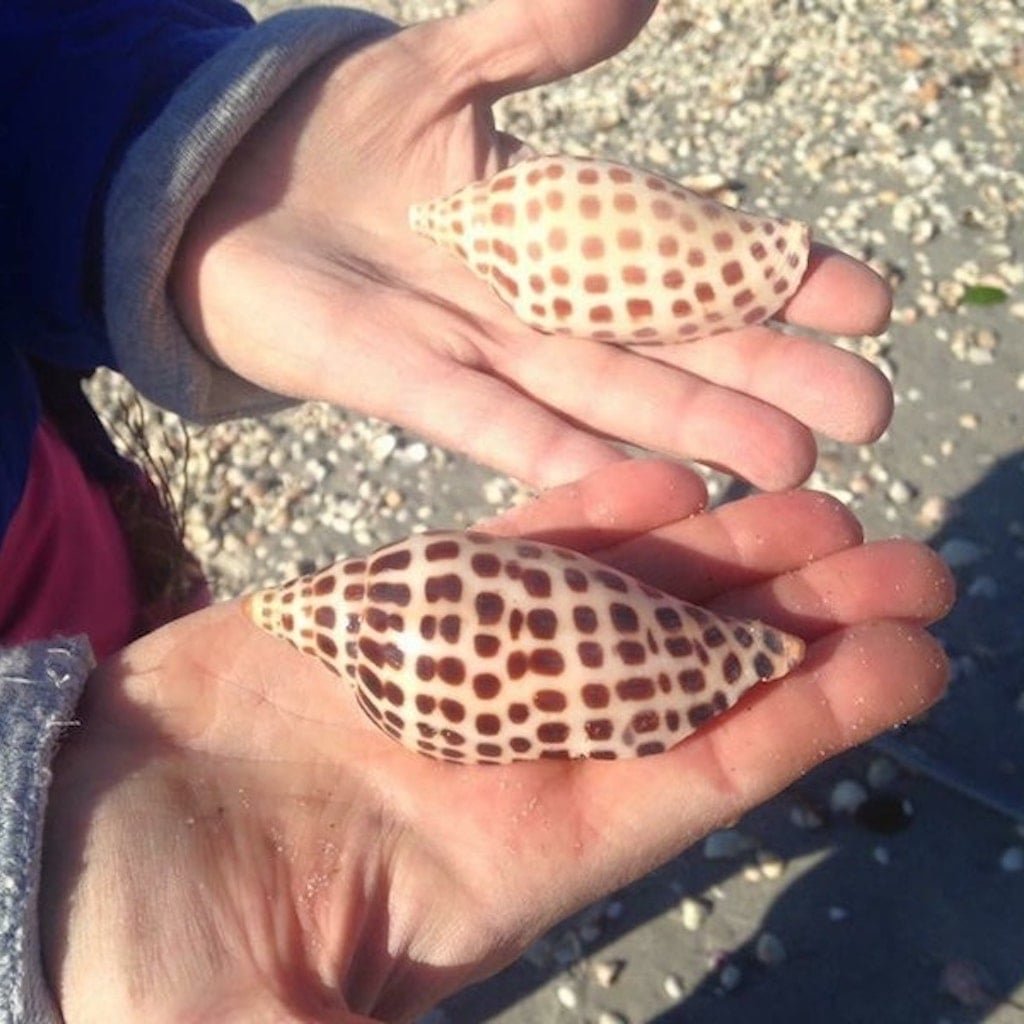
🏝️ At a glance
- Scientific name
- Scaphella junonia
- Where it lives
- Deep water, ~100–425 ft offshore
- When it washes up
- After storms / strong cold fronts — unpredictable
- Best odds
- Sanibel, Captiva, Marco-area & boat-only islands
- Look
- Cream shell with brown leopard-spot rows
Why the junonia is the holy grail
The junonia earns its legend honestly. It's a volute, Scaphella junonia, with a glossy cream shell wrapped in tidy rows of chocolate-brown spots that look exactly like a leopard's coat. The catch is where it lives: not in the shallows like a whelk, but down in 100 to 425 feet of water, far offshore. A junonia only reaches your feet when something violent — a storm, a hurricane swell, a powerful winter front — rolls the deep bottom and pushes one shoreward. That's why finding a whole one is a genuine event around here, the kind that gets your name passed around at the local shell shop. Anyone promising you a guaranteed junonia is selling something; we'd rather tell you the truth and help you beat the odds.
Where to stack the odds
The famous junonia beaches are the ones that catch deep-water shells well: Sanibel and Captiva, whose east-west angle scoops shells like a mitt, sit at the top of most lists. But the Marco-area beaches and the boat-only islands — Keewaydin, Kice and the Ten Thousand Islands — have a quiet advantage: almost nobody is walking them right after a storm. If a junonia washes onto an island flat at dawn and no one's there for hours, it's still sitting in the wrack line when our boat noses up. That window — fresh post-storm wrack, no competition — is the single best edge you can give yourself.
Timing is everything
The junonia rewards patience and a weather eye. Watch for the day or two right after a strong cold front, a tropical swell, or any rough offshore weather that's stirred deep water. Walk at the bottom of a low tide, when the most beach is exposed, and scan the freshest, highest wrack line where the heaviest shells settle. The post-front pattern is the same one that fills the beach with whelks and conchs — the junonia just rides in on the same energy, much more rarely. Our guide on shelling after a storm or cold front breaks the timing down, and our how to find a junonia guide covers the hunt itself.
| Beach | Access | Junonia edge |
|---|---|---|
| Sanibel / Captiva | Drive-up / boat | East-west angle catches deep shells |
| Keewaydin / Kice | Boat only | No crowd to beat you to it post-storm |
| Marco-area beaches | Drive-up / boat | Good wrack lines after a front |
The edge a boat gives you
Here's the local secret: the junonia is a numbers game, and a boat lets you play more numbers. On our shelling tours we run to whichever island the tide and the last front have loaded best, walking fresh sand the public can't reach on foot. We won't promise you a junonia — nobody honest can — but we can put you on the freshest post-storm wrack line on the coast, which is exactly where one would be. Many a grail shell has come off a quiet island flat with the captain standing two steps away. That's the kind of morning worth booking for.
From the Helm: Chasing a junonia off Cape Romano’s outer shoal after a cold front
A junonia run starts two days before we ever leave the dock, watching the forecast for a cold front that actually pushes wind out of the north or northwest hard enough to churn the outer Gulf. Once that front clears and the wind lays back down, our captains start watching the tide tables for the biggest low of the week lining up with a morning departure. That combination — recent rough weather plus a big low — is the only real edge in this hunt, and it’s still just an edge. We’ve learned not to promise a junonia; we promise the best shot at one.
When the timing lines up, we run south out of Caxambas Pass toward the Cape Romano shoals rather than the closer islands, because that stretch of outer shoal takes the brunt of a front and gets rearranged more than protected water ever does. Our captains ease off well before the shallows show on the sounder — those shoals shift after every storm, and running them at speed is how a prop finds sand instead of water. We idle the last few hundred yards, watching for the color change that marks the deeper cut we want to follow in.
A fresh junonia doesn’t look like much in bad light — it’s the leopard spotting against cream that gives it away, and you’ll usually spot it half-buried rather than sitting on top of the sand. What guests notice most is the weight of it in the hand compared to almost anything else in the bucket that morning; a junonia this fresh still has a glossy shine the wrack line hasn’t dulled yet. Most of what we turn up on any given run is still whelks and olives, and every one of them — junonia included — goes in the bucket empty, nothing living comes off that beach.
If the shoal isn’t giving up anything after a reasonable stretch of walking, our captains will pull the group back aboard and work a second wrack line farther down the same stretch of beach rather than call the morning off. Sometimes the productive line sits closer to the dune grass than the open sand, especially if the front pushed harder than the tide pulled. We’d rather reposition twice in an hour than have everyone stand on one disappointing patch of sand for the whole trip.
None of this turns a junonia hunt into a guarantee, and any operator who tells you otherwise is selling something other than the truth. What we can promise is a boat that runs the shoals right after the weather that actually matters, on the tide that matters, with captains who’ve made this exact call before. If the timing’s right, a shelling tour gives you a real shot the shoreline crowds don’t get; if you want the fuller island rotation, that’s covered on our boat-only beaches page.