
🐚 At a glance
- Scientific name
- Arca zebra
- Shape
- Long, boxy, rectangular — not a rounded fan
- Color
- Cream with bold reddish-brown zebra stripes
- Tell-tale
- Stripes + long straight hinge lined with tiny teeth
- Where & when
- Sandy Gulf flats off Keewaydin, Kice & the islands
How to identify a turkey wing
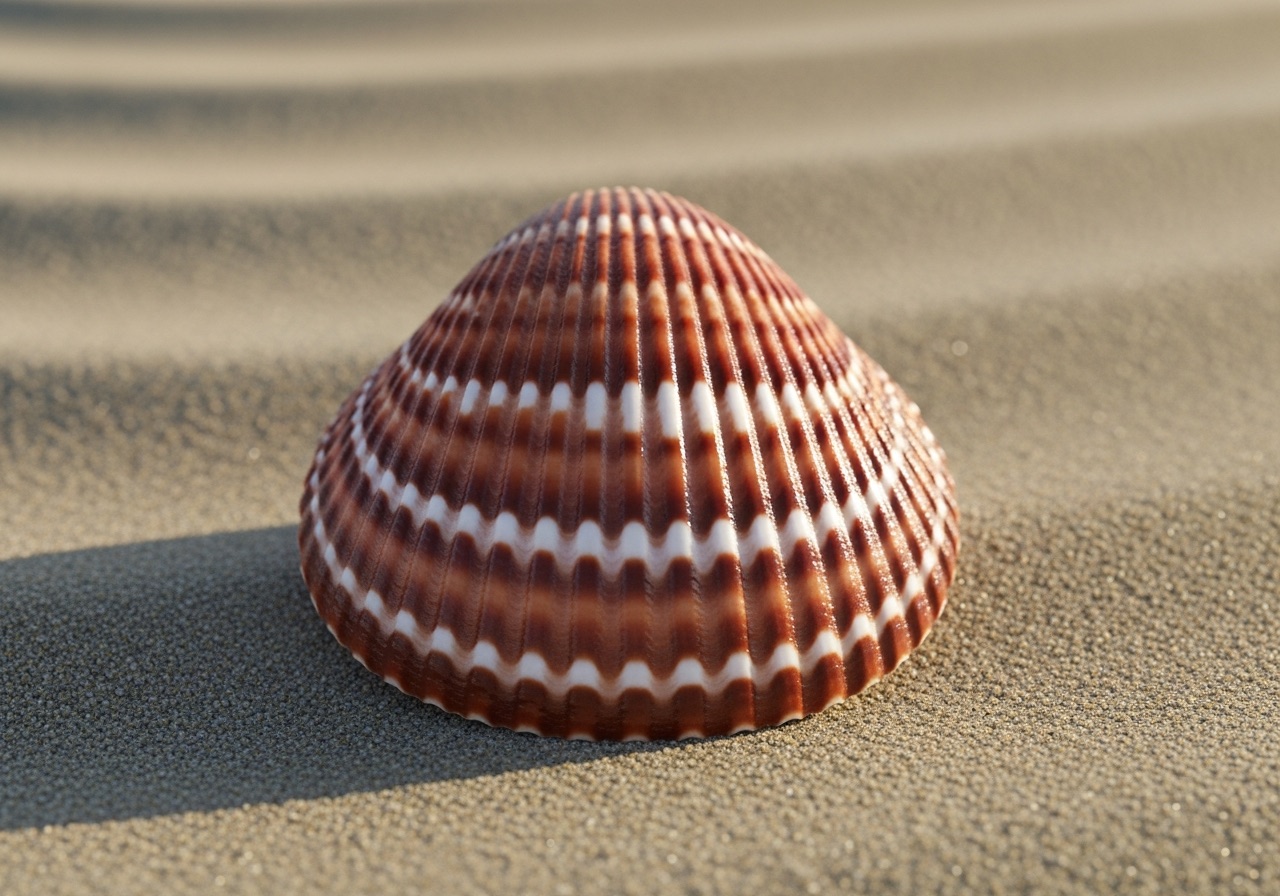
Two features lock it in. First, the color: bold reddish-brown stripes radiating across a cream shell, the pattern that gives the turkey wing its name. Second, the shape: not a rounded fan like a cockle or scallop, but a long, boxy, almost rectangular shell that sits flat and squared-off. Flip it over and you'll see a long, straight hinge line crowded with a row of many small, even teeth — the signature of the whole ark family.
Fresh shells may still wear a fuzzy dark coating called the periostracum; rinse it off and the stripes pop. Even weathered, faded ones keep enough of the pattern to call.
It's an ark shell
The turkey wing is the showiest member of the ark family, and its plainer relatives — the ponderous, blood and mossy arks — share that same long straight hinge with its comb of little teeth. If you find a boxy bivalve with that toothy hinge but no stripes, you've likely got a different ark. The stripes are what make the turkey wing the easy one to name in a lineup.
| Shell | Color & pattern | Shared trait |
|---|---|---|
| Turkey wing | Cream with reddish-brown zebra stripes | Long straight toothed hinge |
| Other arks | Mostly plain white, gray or chalky | Long straight toothed hinge |
| Cockle | Ribbed, often mottled brown | No straight toothed hinge |
Where we find them
Turkey wings attach to rocks, rubble and hard bottom out in the Gulf and wash onto the open barrier-island beaches in good numbers. On our shelling tours we comb Keewaydin, Kice Island and the Ten Thousand Islands, where the tide keeps restocking the wrack line all day. They show up year-round and pile up after a winter front. As always, Collier County is empty-shells-only, so make sure nothing's living inside before you keep one.
From the Helm: Picking turkey wings off Caxambas Pass’s outside rubble after a NW blow
Turkey wings get the outside-bar treatment in our planning, not the calm bay side, because the swash along Caxambas Pass only turns them up loose in real numbers after wave energy has worked the sand for a day or two straight. We check the recent wind history before ever committing to this stop — a couple days of fresh northwest wind behind a front does more for this spot than any flat calm morning ever would, so we save it specifically for those conditions.
Live turkey wings anchor themselves to shell rubble and hard bits of bottom with a thread-like byssus, so the empty shells we’re after tend to wash up still tangled in clumps of broken shell hash rather than sitting alone and clean out in open sand. We teach guests to look for those loose clumps first and pick carefully through them by hand rather than scanning bare sand at random, since that’s where the stripes actually turn up in any real, worthwhile number.
A turkey wing straight out of a fresh clump still has sharp, deep grooves you can feel distinctly with a fingertip, and stripes that look almost painted on, reddish-brown against a pale background underneath. Give that same shell a season of sun and surf and the grooves round off, the stripe color fades toward a uniform tan, and the whole thing feels smoother and noticeably lighter in the hand — still identifiable, just softer at every worn edge.
For this particular stop we hand out a small garden trowel rather than leave anyone digging with bare fingers in shell hash, since broken edges hiding in a rubble clump can be sharp enough to nick a knuckle badly. It’s a two-minute tool briefing before anyone steps off the ladder, and it turns a slow, cautious pick-through into something guests genuinely enjoy instead of wince their way through.
On a good post-front morning this stop alone can fill a bag faster than anywhere else we run all day, which is exactly why it earns a fixed slot on our shelling tours rather than being left purely to chance. If the wind hasn’t cooperated that week, we’ll swap it for a different bar on the same loop and circle back to this one another day.
From the helm, the tell is a darker, coarser patch of bottom breaking up the pale sand well before we’re close enough to make out individual shells at all — that texture change is packed shell rubble, and it’s usually worth easing over for a look even on days we hadn’t planned on stopping there. Guests are often surprised how much of this particular hunt happens before anyone’s feet ever touch the water.